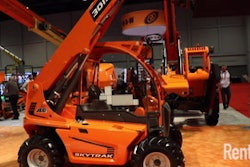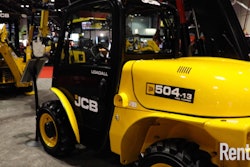
A skid-steer loader can dig more efficiently for longer periods of time, and a full-size telehandler can lift heavier loads to higher heights, but when it comes to doing a combination of both, a compact telehandler is hard to beat.
Compact telehandlers are relatively new to the construction industry, having migrated to North America within the last 10 years. Their heritage can be traced to the agriculture industry in Europe, where farmers used them for everything from cleaning livestock facilities to stacking hay and pulling wagons. For European contractors, they have proven to be essential fleet machines for moving in and around tight spaces and in between close buildings. Since their introduction to this side of the Atlantic, they've been on a roller coaster ride from boom to bust and back again. Today, sales are on the rise, in large part because of the machine's versatility.
"Recently, there has been an upsurge in activity in this market segment," indicates Jay Barth, product manager at JCB. "The whole compact market is really beginning to unfold and heat up. I think we'll see some exciting new features with these machines. A lot of people are now realizing what compact telehandlers can do. They're beginning to see that they aren't toys, but rather fully capable machines."
Dave Baxter, director of marketing & market development at JLG Industries Inc., which introduced two new compacts at this year's Rental Show, states that compact telehandlers make up the fastest-growing segment of the construction equipment market in North America in terms of unit growth. "The reason for this growth is a result of the emerging need for this type of versatility."
Operating in tight spaces
The compact telehandler's capability and versatility stems from its design. As its name suggests, it's a small machine — much smaller dimensionally than a large construction telehandler, says Scott Cooper, senior project engineer at Caterpillar.
For example, Caterpillar's TH210 is only 5 ft. 11 in. wide and 6 ft. 5 in. tall. With these dimensions, it can operate in much tighter spaces than its full-size counterpart, including in parking garages and inside buildings that don't have commercial truck doors.
"We see these compact machines in applications where size is critical in industries such as construction, agriculture, landscaping, nurseries and in rental fleets," says Cooper. "In these applications, large telehandlers may be too large, too heavy or not maneuverable enough to work effectively."
Baxter at JLG notes that another benefit to their diminutive size is ease of transport. Usually weighing in between 9,000 and 14,000 pounds, compact telehandlers can be towed by a pickup truck and trailer, which means your customers can drive away with them, leaving you with one less delivery to make.
Because they are designed as lifting machines, the compact versions can lift and place materials — although admittedly not to the heights of full-size models, which reach to 42 ft. and beyond. But most compacts will be able to move materials to a height of a two-story building. "Since it is smaller, the physics of the compact machine just don't allow it to lift as high or as much," says Marty Miller, VersaHandler product manager at Bobcat. "But for general contractors, two stories is typically high enough."
Mike Schlauch, Schlauch/Bottcher Inc., finds that his Gehl RS5 compact telehandlers are a nice complement to his larger units. The custom home builder from Bozeman, MT, has equipped his fleet with three compacts and nine full-size models.
"My smaller machines may not reach as high or lift as much weight, but I would never want to be without them," he says. "They aren't as heavy as my large machines so they don't tear up the ground as much. And I can also use them in lieu of scaffolding for some jobs."
Intended as a tool carrier
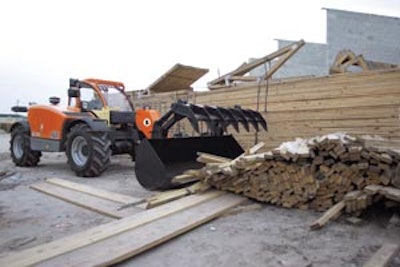
While Schlauch uses his compact telehandlers mostly for material handling, he occasionally mounts attachments such as personnel baskets or buckets for loader-type work. This feature is part of the beauty of the compact sizes. Because of its boom design — which is typically two-stage vs. three- or even four-stage — a compact machine can do much more extensive loader work than its larger brother.
"A full-size telehandler just isn't designed to do loader work," says John Koepf, product manager at Gehl.
Some manufacturers actually refer to compact telehandlers as tool carriers and tout the many attachments you can use. Some models can utilize attachments directly, while others can connect to essentially any skid-steer attachment via a universal skid-steer adapter.
The fact that many compacts offer auxiliary hydraulics pumped to the front of the machine also makes the use of attachments such as grapples and augers possible. "When you get into the larger machines with three-stage booms, it's more difficult to plumb the hydraulics to the end so you lose some versatility in those larger units," says Miller. "But with the boom design of the compacts, you can more easily utilize hydraulically controlled attachments."
Adds Koepf, "That ability to use skid-loader attachments really opens up the door. If you already own a skid loader, you don't have to go out and buy a whole new series of attachments."
A skid-steer replacement?
Some contractors will even use a compact telehandler in place of a skid-steer loader, especially if they need extra reach for tasks such as lifting spoil into trucks or backfilling along retaining walls.
"Contractors who don't have enough height with their skid loaders are moving to a compact telehandler to gain additional reach," says Koepf.
For example, Gehl's 7810 skid loader has a 12-ft. reach. Many compact telehandlers can easily reach to this height and beyond — up to 18 ft. in the case of Gehl's CT6 model.
Koepf also relates that mobility of a compact telehandler is a bit different than that of a skid-steer loader. "With a compact telehandler you don't have the skidding action of a skid loader," he explains. "A compact telehandler has four-wheel steer with a tight turning radius. They're really very maneuverable. When you compare the cost of a compact telehandler with a skid loader, the prices are comparable so it boils down to what features you really need."
More bells and whistles
You will likely find enhanced ergonomics and more creature comforts in a compact telehandler vs. a full-size version. You're also likely to find some noticeable differences compared to a skid-steer loader, including easier entrance into the machine — users can just step into the cab rather than climb over buckets or loader arms.
Many of the differences between a compact and full-size telehandler stem from the fact that full-size models are typically used intermittently during the day, says Eric Brown, VersaHandler product specialist at Bobcat. "A contractor may put on some pallet forks and lift a load three stories high," he says. "Then the machine may sit for three hours. The smaller units tend to get used continuously throughout the day."
Most compact telehandlers will have enclosed cabs with heating and air conditioning, whereas full-size models might just offer a canopy, although cabs and other amenities are available options. Other creature comfort features include boom suspension, which smooths out the ride. Adjustable steering columns and seats, servo hydraulics and single-handed joystick controls are additional features typically offered as standard equipment on today's compact models.
Visibility will also be improved on a compact unit. "Compact telehandlers will have a low-profile boom so visibility around the machine will be better," relates Brown. "That's definitely an advantage when using attachments. The full-size models have a higher-profile boom for visibility when the boom is in the air because that's how it will be used much of the time."
Enhanced ergonomics are becoming important to operators who want to work in comfort, regardless of whether they own or are renting. Most agree ergonomic features are an advantage in boosting productivity for operators. "Typically, comfort equates to productivity," says Miller.
One final benefit to compact telehandlers, notes Baxter at JLG, is the potential return on investment. Compacts cost about 15 percent less than the traditional models, but with the versatility they offer, can command the same rental rate, translating into higher profits for your business.
Genie Telehandlers
- Eight models with lift capacity between 5,500 and 10,000 lbs.
- Lift heights between 18 ft. 10 in. and 56 ft.
- 63- to 125-hp output
- Various attachment options
- Variable hydrostatic transmission and four-wheel drive
- Interchangeable, common components plus easy no-tool access service and test points
JCB Compact Telescopic Handlers
- 520-40 measures 61 in. wide and 78 in. high, yet has a 4,000-lb. rated operating capacity at its 13-ft. 2-in. full lift height
- 524-50 has a 5,000-lb. maximum lift capacity at its full 16-ft. 5-in. lift height
- 527-55 delivers a 6,000-lb. maximum lift capacity at 18 ft.
- Loader breakout force from 8,157 to 8,993 lbs.
- Single joystick raises and lowers boom and controls attachment rollback and dump
Ingersoll Rand VR-530C Material Handler
- Three-stage boom with a 30-ft. maximum lift height and 21-ft. maximum forward reach
- 100-hp Perkins 1104C-44T four-cylinder, turbocharged Tier II engine and hydrostatic transmission
- Working speeds up to 4.6 mph with available inching and travel speeds up to 15.4 mph
- Low and high all-wheel-drive modes and two-wheel, four-wheel and crab steering modes
- Narrow quick-attach
Caterpillar TH210 and TH215 Telehandlers
- Low-profile design, side-mounted engine and low boom pivot point for improved operator line of sight during load carrying
- 11,000-lb. TH210 has a rated load capacity of 4,850 lbs. and maximum lift height of 17 ft.
- 12,100-lb. TH215 has a rated load capacity of 5,500 lbs. and maximum lift height of 18.1 ft.
- Both models equipped with standard enclosed FOPS/ROPS cab
Bobcat VersaHandler V518
- 18-ft. maximum lift height
- 5,500-lb. lifting capacity
- 105-hp turbocharged, liquid-cooled, side-mounted diesel engine
- Heavy-duty hydrostatic ground drive and automotive-style transmission with dynamic braking
- All-wheel steer, front-wheel steer and crab-steer modes
MEC TH60/TH80 Telescopic Handlers
- 6,000- and 8,000-lb. lift capacities with lift heights to 41.5 ft.
- Three-stage, four-plate, robotically welded boom with a single lift cylinder and high-density wear pads
- Adapter plate allows use of skid-steer attachments
- Load-sensing, fully powered orbitol steering with three steering modes
- Rear axle lock engages when lifting a load above 40 degrees, but remains free when going over rough terrain
- 100-hp Deutz four-cylinder turbo diesel engine
Mustang Radio Remote Control for Telehandlers
- Virtually eliminates the need for a helping hand on telehandler applications
- Allows telehandler boom to be raised and lowered, extended and retracted, all from remote control pendant
- Operators can also start up or shut down machine from remote
- Available on Mustang telehandler models 742, 944 and 1155
- Offered as a separate option, remote control features self-diagnostics and Frequency Hopping Spread Spectrum (FHSS) technology
Maniscopic Line of Telehandlers from Manitou
- 18 different models of fixed frame and rotating telescopic forklifts
- Offers world’s smallest telehandler, the SLT 415B "Twisco"
- 13- to 68-ft. lift heights
CareLift ZB32032
- Capacity of 32,000 lbs.
- Lift height of 32 ft.
- Includes a 173-hp Cummins QSB 5.9 engine, Dana T32,000 powershift transmission and AxelTech axles
- Features three modes of steering as well as frame leveling
- Numerous tool carrier attachments available
Terex TX-6622
- 80.5-hp Deutz BF4M2011 Turbo diesel engine
- 6,600-lb. maximum lift capacity
- Maximum lift height of 22 ft. 5 in.
- 12-ft. 9-in. maximum reach
- Compact size at 6 ft. 7 in. wide and 6 ft. 9 in. high
Gehl CT-Series Telescopic Handlers
- Maximum capacities from 5,000 to 7,000 lbs.
- Maximum lift heights from 16 ft. 2 in. to 22 ft. 7 in.
- Rated capacities from 5,000 to 6,000 lbs.
- 58- to 101-hp turbocharged and naturally aspirated Tier II diesel engines
- Pilot-controlled hydraulic system
- Hydraulic quick-attach system and standard auxiliary hydraulics
JLG Compact Telehandlers
- 23-ft. lifting height with a maximum capacity of 6,600 lbs. and a forward reach of 12.8 ft.
- Mechanical quick switch enables fast changes from forks to other attachments
- Other features include a 100-hp Deutz diesel engine
- Slightly smaller model with similar design features delivers a 5,700-lb. lifting capacity and 19-ft. maximum lifting height