Moving earth boils down to simple economics: move the soil as quickly as possibly at the lowest cost per cubic yard. Years ago, the market was dominated by motor wheel scrapers. Then articulated dump trucks paired with excavators gained favor. Now there is a resurgence in the pull scraper market.
This is partially due to the purchase price. "You can buy a tractor and two 19-yd. scrapers for about a third of the cost of a comparable self-propelled scraper," says Mark Miskin, president, Miskin Scraper Works Inc.
Productivity is also an issue. "Originally, the pull scrapers were less expensive per yard, but they couldn't move as much yardage," says Miskin. "Now the tractors and the scrapers have evolved to larger equipment where you can haul not just cheaper per yard, but you can haul more material per day with pull scrapers in almost every soil type."
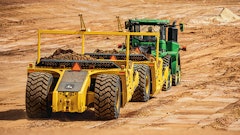
The scraper systems are flexible, with several different size scraper tractors capable of pulling different sizes of pull scrapers as singles, tandems or triples. "When looking at pull scraper systems, you need to take a look at the complete system and what is needed to move the material," says Kent Stickler, product consultant - scraper systems, John Deere Construction and Forestry Co. "In a system like this, you have one operator and one engine consuming fuel. The other benefit is that you can load material, carry it to the fill site, dump and compact material at the site, then return to the cut area all with one operator."
When pull scrapers were first introduced to the construction market, durability was a concern. Pull scrapers originated as farm implements. "We have our ag scrapers and I would never dare sell an ag scraper into the construction market," says Miskin. One of the key points of differentiation between a light-duty ag scraper and a purpose-built construction scraper is the weight, based on the amount of metal used in its construction.
"Our most popular scraper for the construction market is the D19. It weighs 24,000 lbs.," says Miskin. "An ag scraper in that size range is probably going to weigh 16,000 or 17,000 lbs. So it is close to 50% more than an ag scraper would weigh."
Today's construction scrapers from the reputable manufacturers offer impressive durability. "We have them with 30,000 or 40,000 hours on them," says James Hausner, vice president, Reynolds International Equipment Co. "You have five cylinders on a scraper, four tires and you have a blade. There is not much that can go wrong."
Choose the right scrapers for the job
The flexibility allowed by the ability to hook several scrapers together behind a single power unit is a major advantage. "You can pull as many scrapers as you want in a train," says Hausner. "We have a lot of contractors who have three behind each tractor. You take three 17-yd. scrapers and that is a lot of dirt."
He adds, "The distance of travel is what you have to look at when you add scrapers. If it is a quarter mile, then two scrapers is fine." Use one scraper if it is half this distance. "If it is close to a mile, then you need to put three on there."
There are really three kinds of pull scrapers suited for earthmoving applications. "You have the traditional push-off ejector, then you have what we call a tip-out ejector which is half-way ejector/half-way dump," says Miskin. "Then you have the regular dump style."
Ejector scrapers are popular because they can spread loads on grade. "It pushes the material back out in front of the blade," says Miskin. "The operator can set the blade height so it will leave a nice, smooth finish."
Soil conditions may also favor the use of ejector scrapers. "Ejectors are used in conditions where the loaded material is very sticky and needs the ejector to eject the material," says Stickler. "Customers who like a fixed cutting edge will like the ejectors."
The downside to the ejector scraper is cycle time. "Its primary disadvantage is it is very slow to unload," says Miskin. In addition, it is more complicated mechanically. "A dump style is much simpler."
Hausner adds, "We recognize our ejector scrapers as more construction scrapers than our pivot-dump scrapers because they are heavier. They will get the mud out easier; they will push it out over the blade."
Dump-style scrapers have faster cycle times. "They have the advantage that they dump fast, but they usually just dump in a rough pile," says Miskin. "They don't really precision finish while they unload. A lot of them have a reputation of being difficult to unload because they don't dump very steep." This can create a challenge in difficult soils.
"On the other hand, carry-all scrapers dump the material and are less money than their ejector brothers," says Stickler. "On a dollar to dollar basis, the carry-alls are about 10% to 15% less money." Carry-alls also have a slight ground pressure advantage because of their lower weight.
The tip-out ejector combines traits of both. "It will do everything that a push-off ejector will do as far as unloading on grade and precision finishing, but it has the speed of the dump style," says Miskin. "With a 30-gpm flow, the tip-out ejector will unload in 5 seconds. It is going to take 24 seconds for an ejector in the same position."
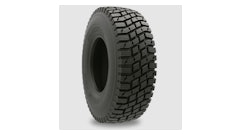
Another consideration is tire size. "Larger scraper tires provide better flotation and less rolling resistance for more efficient use of horsepower when transporting, especially in soft conditions," says Miskin.
For applications where hitch weight must be kept to a minimum, there are dolly wheel scrapers.
"The advantage of the dolly wheel unit is there is very little tongue weight," says Miskin. "If your tractor is not able to handle the tongue weight, then you can use the dolly wheel unit and still get the work done." An example is a crawler dozer with metal tracks. "Most of them can't handle very much extra tongue weight. Hauling around that extra weight, depending upon the dozer, can really shorten the life." The dolly wheels protect the dozer from damage.
The downside of the dolly wheel scrapers includes decreased maneuverability. Darrel Hoelscher, Hoelscher Inc., also notes that the dolly wheels add rolling resistance.
"If the ground is real soft, the dolly scraper will have a tendency to get stuck a little more often than a [conventional] pull scraper because those tires are carrying a third of the weight of the scraper," says Hausner.
Strike a balance
"Balance of the tractor/scraper combination is the main factor in scraper productivity," says Hoelscher. "Sufficient speed is necessary to move material to the back of the bowl."
Maintaining traction is critical to maintaining the necessary speed. "It is important that the scraper transfers weight to the tractor to improve traction as the load is increasing," says Hoelscher. "Ideally, the tractor will run out of power at the same time that it loses traction."
A lot of emphasis must be placed on hitch design. "Hitch design plays a crucial role in the overall performance of a tractor-scraper combination," says Robin Pett, Bell Equipment. "Most importantly, the hitch design determines weight transfer, turning radius and tractor front to rear weight ratio. The height of the hitch can be an important factor, depending on the conditions of the jobsite."
John Deere manufactures both tractors and scrapers. "Our two factories work closely to perfect the performance of the two machines hooked together," says Greg Laudick, Deere division marketing manager - scraper tractors, John Deere Construction and Forestry Co. "We jointly designed and just introduced the AutoLoad system. With one touch of one button, it loads the scrapers. It maximizes the available horsepower and traction of the tractor to efficiently load the scrapers.
"We also worked together on hitch design, which was a critical area," Laudick continues. "Shorter tongues on scrapers transfer more of the weight to the rear of the tractor. This can induce higher than desired loads, affecting long-term reliability of the tractor. Conversely, the hitch design on the rear of the tractor also has an impact on the weight transfer aspects. If the 'pivot point' is designed and placed too far from the center line of the tractor's axles, that can also affect the long-term reliability."
Most pull scrapers require a special hitch on the tractor. The weight of the scraper places too much stress on a standard ag tractor drawbar.
"This is the reason Hoelscher scrapers utilize the lower arms of the three-point hitch," says Hoelscher. "We are able to transfer sufficient weight to the tractor without needing to modify the drawbar, as is necessary with most scrapers that don't have dolly wheels. Our hitch provides for three axis of rotation around a common point. The design prevents excessive wear on the pivot points."
Tractor selection
Every manufacturer offers horsepower recommendations for their specific scrapers.
"It varies a lot," says Miskin. Some scrapers are easier to load than others. "For instance, we have one competitor that makes a 17-yd. scraper that is going to take a 400-hp tractor to load it. Miskin makes a 17-yd. scraper that can be loaded with about a 250-hp tractor in the same time and distance."
The design of the scraper has a lot to do with how easy it is to load. For example, an ejector scraper can require more horsepower to load than a dump scraper. "It is just a different shape on the bowl and its design," says Miskin. Soil conditions also impact the horsepower needed.
"On sizing the tractor, it is really the weight and traction of the tractor that is more important than the horsepower for loading," says Miskin. "A 300-hp tractor that weighs 30,000 lbs. will not pull as well as a 300-hp tractor that weighs 40,000 lbs. For transporting, especially up a steep grade, then the horsepower comes into play more. The most popular configurations are a 400- to 450-hp tractor that weighs 45,000 to 55,000 lbs. pulling double or triple 19-yd. scrapers. This is a good match for most jobs."
Adding weights to the tractor to help it load the scraper is not necessarily the right approach. "There are some economies making the tractor barely heavy enough, so it is not too heavy," says Miskin. "If you buy the largest tractor and weigh it down with optional weights, you are going to burn a lot of fuel hauling the extra weight around. It is also harder on the tractor drive system. The heavier something is, the shorter the life of the entire unit is going to be."
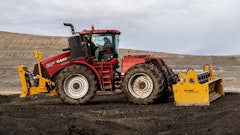
Several manufacturers have modified ag tractors specifically for commercial scraper work. Case offers its STX tractors in scraper versions. "The tractor is tailored for the scraper market," says Roger Lewno, marketing & training manager - HHP tractors and combines, Case Corp. "Our cab is not only ROPs certified as it is for ag, but we are also FOPs certified. We place the scraper drawbar on the tractor and we place a tow cable so that the tractor can be towed in the event that it does get bogged down." In addition, the tractor is fitted with backup alarms and heavy-duty axles with differential locks.
To protect the transmission from operator abuse, the start-up gears have been programmed at lower settings than the ag tractor equivalent, and it has a kick-out default. "If the tractor gets lugged down below a given rpm, we will throw the tractor in neutral," says Lewno. "It saves the transmission from being abused."
The tractors are also ballasted for scrapers. "Let's say the scraper itself is an 18,000-lb. unit," says Lewno. "Approximately a third of that weight is on the drawbar. You need to offset that with weight up front with an empty scraper. If you take 17 yds. of material at roughly 2,000 lbs. per yd., you have a third of that weight also on the back of the tractor."
Laudick explains, "Scraper tractors are normally ballasted somewhat lighter than agricultural tractors due to high spike loads during the scraper loading process, as well as a weight transfer from the scraper tractor. As a scraper is loaded, then raised to the transport position, considerable weight is transferred from the tongue of the scraper to the rear of the tractor pulling it, thus reducing the need for weight on the tractor. For these reasons, typical scraper tractor ballast levels will run 10% to 15% less than a comparable agricultural tractor."
John Deere also offers specialized scraper versions of its four-wheel-drive tractors. "In areas where additional stresses/forces are encountered in a scraping application that are not normally seen in agricultural applications, we focus on adding more size and structure to the tractor components to handle these additional loads," says Laudick. "Areas such as the articulation joint, axles, wheel sleeves and chassis have additional or larger components than the agricultural tractor.
Some companies have introduced purpose-built scraper tractors. "Specifically designed for construction applications, the Bell 4206 tractor converts 422 hp and 1,473-lb.-ft. gross torque into 65,000 lbf. of drawbar pull that will haul up to 56 cu. yds. of material in one pass through the toughest jobsite conditions," says Pett. "The correct amount of horsepower and torque to pull construction-level pull scrapers is essential to move the material more cost effectively. Bell tractors offer the correct drivetrain features and computer controls to move an optimum amount of material at the lowest possible cost per ton."
Most scraper tractors are offered with a choice of rubber tracks or tires. The rubber tracks will go into places a wheel tractor cannot go. "On the same token, a wheel tractor may be more economical to use if conditions are favorable," says Lewno.
With the tracks, you also need to be aware of your speed in uneven terrain to prevent damage to the scrapers. "With a wheel tractor, the operator is forced to slow down in adverse conditions because he or she cannot sit in the seat," says Lewno. The rubber tracks provide a much smooth ride over rough terrain. "Many times, you have to make certain that they keep their speed down."
The advantages to all of these tractors is they can be unpinned and used for other applications, such as to disc in lime or pull water wagons, compactors or other implements. In addition, resale is easier because there is a larger market.