What happened to the good old days of making it hot and black? Customers have become more sophisticated; consequently, hot mix suppliers and equipment manufacturers continue to strive to meet their requirements.
Department of Transportation agencies across the country are specifying mix designs with ingredients difficult to control, like hot aggregate dust, fly ash, hydrated lime and fiber. These ingredients may not be required often, and feeder systems can be rented as opposed to being purchased.
The choices are many and confusing when you take into consideration the ingredient equipment, the asphalt mixing process, the DOT introduction spec, how often you may make this specific mix, the ingredient’s availability, MSDS and handling characteristics.
These ingredients vary in density and flowability depending on aeration, compaction and bridging characteristics, making measurement and control difficult. This problem makes volumetric control unacceptable and gravimetric control a necessity. Just because you know vane feeder speed does not mean you know the amount of material being introduced into the mix. When it comes to stone matrix asphalt (SMA) mixes in particular, precise control of the minus 200s is critical to a successful mix.
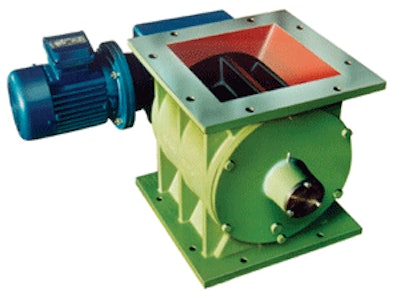
Vane feeder
A vane feeder is much like a cold feed bin in that both are volumetric feeders. The aggregate in cold feed bins is uniform in density. The aggregate in cold feed bins flows easily without mechanical stimulation. One revolution of a cold feed bin might yield 1,000 pounds of aggregate if the bin is not bridging or running empty. If the bin runs empty, it does not take long for the loader operator to visually notice or the aggregate belt flow scale to sense the difference.
The success of the cold feed bin and the vane feeder as reliable volumetric feeders differs sharply. Mineral filler in a silo may be quite uniform in density when the material is flowing through the silo. That changes when material is being aerated over time, or the amount of aeration or vibration changes, or if the silo is being filled at the time. During vane feeder volumetric calibration, one revolution of a vane feeder may yield 10 pounds if the silo is not bridging or running empty. If the silo runs empty, it may take a long time to notice. The vane feeder is totally enclosed and impossible for any plant personnel to see that it is running empty. Unless a gravimetric flow scale is measuring flow down stream, there is nothing to sense the difference. Meanwhile, thousands of tons of mix has been produced, trucked, laid, milled up, trucked back and then recycled. The cost in all this waste is considerably more than the cost of adding a flow measurement device.
Flow measurement devices
The process of blending these materials into mix requires a continuous weighing device that provides an electronic signal like you would get from a belt scale. Belt scales do not work with powders and fibers because of the ease of these materials becoming airborne. Therefore, the scales must be totally enclosed.
Scale types
• Nuclear. Expensive to own and operate.
• Silo on-load cells depletion. Good for inventory control, bad for immediate accurate control.
• Weigh depletion hoppers. Good for flow control of dust, fly ash, calcium carbonate, fiber, but not as good for hydrated lime because the silo hydrated lime flow starts and stops when charging the weigh hopper; the repetitive silo flow interruption sometimes encourages bridging. Aeration is necessary for the pod as well as the silo. Long 60-degree cones are necessary for maintaining flow.
• Continuous flow scale. Good for flow control of hot aggregate dust when temperature is compensated; good for fly ash, calcium carbonate, fiber and hydrated lime. Flow scales are the least expensive to buy and operate.
Anti-strip hydrated lime
Hydrated lime tends to coagulate when allowed to come in contact with moisture. Fiber tends to bridge when dispersed. Fly ash becomes cementitious when exposed to water.
These ingredients are conveyed in enclosed elevators, augers, chutes, pipes and hoses. Sometimes they need to be aerated and vibrated in order to flow. Hydrated lime requires at least a 60-degree slope on the discharge cone. Aerating and pneumatic conveying requires conditioned dry air. Air drying and pneumatic conveying is expensive. Compared to augers and elevators, pneumatic conveying requires higher horsepower, can take up plant baghouse and fan capacity (which could lower plant production capacity) and wears out equipment.
Hydrated lime likes to bridge especially when exposed to humidity. Aeration becomes necessary and requires about 5 psi at 60 cfm per silo. When using plant air, the air must be dried. Drying this compressed air is expensive.
A better alternative is using 5-psi compressed air from a positive displacement blower. The type of aeration produced is a very important item for maintaining product fluidity while reducing energy and equipment costs. The energy it takes to operate a 10-hp compressor to do the work can be done with a 5-hp blower. An air compressor is much more expensive to purchase and maintain than a blower. Plus, the air compressor needs an expensive air dryer. When advised of the benefits, many companies are turning to positive displacement blower for this task.
Hydrated lime has been used in the asphalt mix as a mineral filler, anti-strip and modifier. As an anti-strip, hydrated lime is usually added into a continuous pugmill with water. Water is required to moisten aggregate before the aggregate is to be dried. This process promotes better adhesion to the aggregate. Since hydrated lime is added to the aggregate before the aggregate is to be dried, both batch and continuous mix plants should mix the hydrated lime in a continuous pugmill or belt plow before the dryer.
Baghouse dust
The aggregate drying process inherently separates the fines from the aggregate. When air velocity changes due to production, moisture, temperature variations of the dryer, so does the size and amount of fines separated. Consequently, the loading of the baghouse changes and so does the amount of dust returned.
Complicating the issue further is the baghouse discharging the dust in sags and surges (plus or minus 21 percent over a three-minute period of time). Adding insult to injury is the Hot Stops that allows the bags to relax when the fan is turned off, allowing most of dust to fall and fill the auger below.
When the plant is started again, the dryer initially sees the full auger surge (59 percent). Since the bags released most of their dust, the augers run empty until the bags build up a dust cake again. This situation then causes the dust to go from a surge to sag (59 percent) until it slowly builds up a dust cake over a 5-minute period.
The solution to this problem is the right equipment and correct operation procedure: slowly change from one production rate or temperature to another, keep aggregate moistures consistent, slowly change exhaust damper settings, and invest in a surge bin with flow measuring and control.
Continuous mix plants
Automatic set point – virgin aggregate belt scale required to provide caontinuously changing set point.
Batch plant
Two choices are available when returning dust to a batch plant.
1) Batch plants with a dust bin in the tower can automatically add dust to the weigh hopper in its normal cycle as a separate pull.
2) Batch plants without a dust bin in the tower can automatically add dust by blending the aggregate as it is being introduced to the hot leg. Batch plants that introduce the baghouse dust with the sand should have the dust automatically proportioned to the aggregate, or the plant operator will have to adjust the dust flow rate as the production rate changes.
Mineral filler
Mineral filler as minus 200 makeup, such as dry lime dust, fly ash, calcium carbonate and hydrated lime is often added to achieve desired mix specifications.
In order to make up the difference with mineral filler, especially when producing SMA mixes, the baghouse dust must be accounted for at all times. Controlling the baghouse sags and surges is just as important when adding mineral filler. This can be accomplished by one of two ways:
1) Weigh all the material through one flow scale or weigh pod and vary the speed of the added mineral filler to the proper proportion
2) Divert all dust from the baghouse into the mineral filler silo and weigh the silo output with weigh pod or flow scale. This method reduces the amount of mineral filler storage. This system works well when hydrated lime is being used as mineral filler because the dust dilutes the hydrated lime and makes hydrated lime more flowable.
Many plants do not have equipment to smooth out dust sags and surges. This investment can be absorbed in all the mixes processed by using the mineral filler silo to smooth out dust sags and surges. Dust can be controlled by diverting the baghouse dust through the mineral filler silo for just the cost of transferring the dust into the silo.
The schematic below illustrates how easy it might be to retrofit an existing facility to control dust in all applications, add mineral filler and compensate for baghouse dust differences required for most SMA mixes. Add a silo and hot leg next to the dust incline auger to control downstream flow of both.
SMA dust makeup control
When used to make SMA, a 10-percent total minus 200 is needed in the mix — dust is augured directly to the flow scale and into the drum, the flow scale reports not enough minus 200 is being fed into the drum, the controller increases the feed from the mineral filler silo into the incline auger, the flow scale reports the increased flow, the controller adjusts until satisfied.
Baghouse dust control
When used to smooth out baghouse dust sags and surges — the slide gate under the incline auger is opened to feed the dust into the boot of the 30-tph bucket elevator, the dust fills the silo while the discharge mechanism speed is constantly adjusted by the automatic dust flow controller, the dust flow control is set near the anticipated dust percentage expected, and when the dust silo high or low level indicators report a level extreme, the operator changes the dust flow set point accordingly.
Mineral filler control
Mineral filler is normally added as a percentage of total mix or total aggregate. Therefore, it is important to measure just mineral filler. The same equipment can be used as above by moving the flow scale auger from the discharge of the baghouse incline auger to the silo discharge. The down side to this is the mix is not being protected from dust sags and surges.
Fiber
Fiber is now being added in asphalt primarily to reduce asphalt oil drain down in an open graded friction course. Cellulose fiber (typically 0.3 percent of total aggregate) is more oil absorbent than mineral fiber (typically 0.4 percent of total aggregate). The fiber introduction methods are often dictated by DOT specs.
Batch plant
Fiber is introduced into a batch plant by several methods:
1) Some manufacturers provide pre-weighed bags and the operator introduces a bag into the pugmill directly for each batch.
2) The fiber can be delivered as it is continuously being weighed by a fiber feeding machine into the pugmill. Fiber is normally blown into asphalt spray. Wet mix time will have to be extended if the fiber-feeding machine cannot deliver all the fiber during the asphalt oil discharge time.
3) The fiber can be delivered as aggregate is being charged into the aggregate weigh hopper. Fibers may get damaged and find its way into the scavenge air stream.
Continuous mix plant
When fiber is introduced into a continuous mix plant, it is important to blow the fiber directly into the asphalt spray before it has a chance to become airborne.
Fibers are packaged in smaller 40 to 50 pound bags or in larger bales weighing 600 to 1,600 pounds. A plant running at 200 tph will consume 20 pounds of cellulose fiber a minute making it very easy for a fiber machine loading person to keep up with production. Counting bags every few minutes allows the operator to know his fiber machine is keeping up.
Larger jobs may require bales to be used. A fiber feeding machine holding 2000 pounds would need charging every 100 minutes.
Information provided by Clarence Richard Co., www.clarencerichard.com