Colorado is a state that covers more than 100,000 square miles of land, much larger than England and many other European Countries. Yet, only two major interstates dissect this large state – I-70 from east to west and I-25 from north to south. The state’s only other major artery, I-26, enters the state from the northeast but ends in Denver.
There are only a few thousand lane-miles of interstate, reaching predominantly the northern and eastern territories, for Colorado’s roughly 4.5 million citizens. When sections of these multi-lane expressways are closed, as were the I-70 westbound lanes for several days in August due to rock slides, traffic is left to find alternate routes to get from point A to point B.
Many of Colorado’s drivers rely on its vast network of two-lane highways, winding throughout the Rocky Mountains. These roads are the only means to get to small, out-of-the-way towns like Gunnison and Ouray. In order to move commercial and commuter traffic safely, these roadways must be well maintained.
Deteriorating highway
This is exactly why a 24-mile stretch of Highways 141 and 145 in southwest Colorado is receiving some much needed upgrades. Performing this work is the United Companies, a division of Old Castle, based in Grand Junction, CO. The sand and gravel, ready mix concrete and asphalt contractor is charged with paving 48 lane-miles of Highways 141 and 145 with a fresh two-inch overlay of asphalt. The project required nearly 50,000 tons of a SX75 mix with a 1/2-inch top aggregate size and PG58-28 binder.
Some of the more deteriorated sections of Highway 145 around the city of Norwood were treated with a hot-in-place recycling method in order to increase the new mat’s longevity. “Through this process we are improving the road’s old surface and eliminating the chance for any reflective cracking to show through the overlay,” says Ken Dobey, paving superintendent for United.
Mixed by United’s portable asphalt plant strategically located in the middle of the 24-mile project, the hot asphalt was delivered to the paving train by 10 belly-dump trucks and laid in a windrow. “There is a shortage of trucks in western Colorado, and the belly-dumps reduce the number of trucks we need to deliver the asphalt,” says Dobey. “We would need 20 to 25 tandem axles to keep the same production.”
The windrows offer the side benefit of allowing the paving crew to develop a continuous paving process, so they can lay a higher quality mat. It helps United to achieve the density and smoothness specs required by the end-result contract.
Smoothness requirements fell under the Colorado Department of Transportation (CDOT) Category 2 standards of 8-16 inches per mile. The tough density specs demanded that the contractor achieve 93 to 96 percent compaction across the mat and 88 to 92 percent at the joints. To aid in achieving these specifications, United rented a new “smarter” roller that has the power and intelligence to quickly meet density specs without over-compacting.
Intelligent design
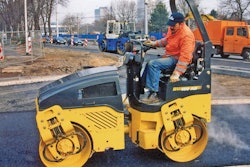
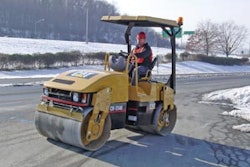
Covering miles at a stretch, the paving train consisted of a Barber-Greene windrow machine, a Cat paver, HYPAC pneumatic-tired intermediate and tandem drum vibratory finish rollers and a BOMAG BW190AD-4 breakdown roller with Asphalt Manager, a unique intelligent compaction system.
The new Asphalt Manager compaction system helps to automate the compaction process and is part of a growing trend in roller technology. The intelligent compaction system not only senses but automatically reacts to the stiffness, or density, of the material being compacted.
This “intelligent” roller employs accelerometers to measure the horizontal and vertical reaction of the drum in correlation to the material it’s compacting. Once the system senses an increase in the mat’s density, it automatically adjusts the roller’s compaction output by vectoring, or redirecting, the drum’s energy, which helps to avoid over-compaction.
When the roller encounters fresh, uncompacted asphalt, the drum’s vibration angle is at a straight up-and-down trajectory, which exerts maximum compaction energy into the mat. As rolling progresses and density increases, Asphalt Manager automatically changes the direction of the vibration, vectoring the drum from full vertical to eventually full horizontal vibration upon approaching optimum density.
“Throughout the process, amplitude remains constant and only the vibration angle of the drum changes,” explains Steve Wilson, manager, marketing services/product manager for BOMAG Americas Inc. “When the drum vibrates horizontally, minimal vibration is exerted on the mat but additional density points are achieved.”
Dobey adds a side benefit to the back-and-forth drum motion. “When we have time to work the mat in full horizontal vibration, we seem to achieve a smoother ride and better profilograph readings.”
Versatility
At first, United ran the BW190AD-4 as the intermediate roller during test strip evaluations. “Our initial goal was to run the BOMAG in horizontal vibration mode to meet the compaction densities at the joint,” explains Dobey. “It did such a good job, that we had to be careful not to over-compact the mat with our finish roller.”
While the roller easily achieved joint specs, Dobey’s crew discovered the mix had a tender zone that required compaction with a pneumatic-tired roller. “The tender zone is between 180 to 200 degrees F, right when we need to have the intermediate roller on it,” says Dobey.
So Dobey inserted a HYPAC C530AH pneumatic-tired roller as the intermediate roller to get the manipulation and kneading effect the paving crew wanted to achieve with the desired mat quality. This move did not sideline the BOMAG roller. Rather it enabled United to reap the full benefits of the Asphalt Manager system by using it as the breakdown roller.
While the BW190AD-4 had the finesse to maximize joint densities, it also had the power to quickly compact the mat, nearly reaching spec densities during breakdown.
“Density readings behind the BOMAG are 90 to 91 percent,” says Dobey. “We are very happy with these numbers.”
The roller operator set Asphalt Manager to full automatic, which unleashed the front drum’s 55,575 pounds of centrifugal force on the mat. As with any roller, the higher the centrifugal force, the deeper the lifts the drum can compact. On Highways 141 and 145, this high compaction energy allowed the two-inch overlay to be quickly compacted to desired densities.
The breakdown pattern with the new roller included five passes. Only two passes on the edges were made with vibration, and vibration was on for the pass towards the paver and off while rolling away. In full automatic mode, Asphalt Manager vectored vibration angle away from the full vertical position as density increased. “This BOMAG is a hard pounding roller,” comments Dobey.
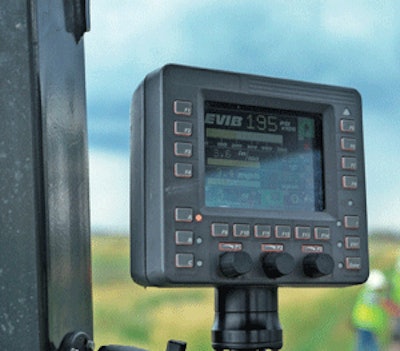
With this intelligent compaction system, it’s not just operator experience that determines if the roller is achieving optimum densities. Asphalt Manager assists the operator by displaying the changing vibration output values on the cab-mounted microprocessor.
The system also features an on-board printer that provides documentation of jobsite results. “Asphalt Manager gives contractors written proof of the compaction results,” says Wilson. “It’s not just in one spot like with core samples or nuclear gauges but every inch of the mat that the roller covers.”
But for Dobey’s crew, the roller’s versatility is a key component to United’s success on Highways 141 and 145. With the unique compaction management system, the BW190AD-4 could be manually set to full horizontal vibration for working joint density or left in automatic vibration mode to quickly achieve breakdown rolling density goals.
Dobey sums up the roller this way. “The BW190 gives us more options for getting the job done.”