Economist predicts double-digit rise in 2006 construction material prices in wake of Hurricane Katrina
At AGC’s Midyear Legislative Conference in Washington, D.C., Ken Simonson, chief economist for the Associated General Contractors of America (AGC) discussed the impact of Hurricane Katrina on construction activity, materials, and labor, and believes construction materials prices will rise at least 10 percent next year, instead of the 6 to 8 percent rise he had expected before the storm.
Drawing on first–hand accounts from AGC’s member companies, Simonson says, “Contractors can expect increased diesel fuel costs to operate off-road equipment. Fuel cost increases will also show up as freight surcharges on the thousands of deliveries to a typical construction jobsite.
“Most of the increased costs in construction materials throughout the country will result from a reduction in oil and natural gas production, and not from higher demand for those materials for the reconstruction projects in the devastated areas,” Simonson continues.
“Lost production and imports due to the storm will result in higher prices and/or supply disruptions for PVC pipe, other construction plastics, tires for large off–road equipment, galvanized steel, gypsum products and cement.
“The New Orleans customs district led the nation with 12 percent of total imports, which accounted for more than three percent of the nation’s cement shipments during the first six months of 2005,” Simonson notes. “Therefore, cement shortages are expected to worsen in some of the 32 states that were already experiencing shortages and spread to new states. Cement prices are likely to rise even more steeply than the 12.7 percent increase that occurred between August 2004 and August 2005.”
AGC sent a letter to the U.S. Department of Commerce urging the Bush administration to provide an immediate suspension of the anti-dumping duty on Mexican cement and allow imports of cement from all countries without duties or quotas in light of the emergency created by Hurricane Katrina.
“In light of the lost supply, it’s imperative that other supply sources be made available as soon as possible,” Simonson says. “Without it, construction projects and manufacture of concrete products in many states will have to halt, potentially laying off thousands of workers. Moreover, vital infrastructure repairs and reconstruction in the hurricane zone could be imperiled. One alternative is to import cement from Mexico by barge to all of the Gulf states and by rail into the Southwest. Such cement could arrive more promptly than cement from most of the current leading sources of imports, such as South Korea, China or Greece. But the current 55 percent anti-dumping duty makes Mexican cement prohibitively expensive.”
Final Rule on Work Zone Safety and Mobility fact sheets available
The Federal Highway Administration (FHWA) has adopted new rules on work zone safety and mobility, which become effective on October 12, 2007. The rule updates and broadens the former regulation at 23 CFR 630 Subpart J to address more of the current issues affecting work zone safety and mobility. The changes to the regulation will encourage broader consideration of the safety and mobility impacts of work zones across project development, and the implementation of strategies that help manage these impacts during project delivery.
FHWA has published a brochure and four fact sheets related to the rule. These materials were developed to support state DOTs, other transportation agencies, consultants and contractors in their efforts to comply with the requirements.
- Implementing the Rule on Work Zone Safety and Mobility (HTML, PDF 1.3MB). This document provides a general overview of the rule, as well as guidance, examples, best practices, tools, and resources to help implement the rule’s provisions.
- Final Rule Language provides the final text of the rule, as well as the various notices of proposed rulemaking.
- Informational Materials provide background information, an overview of the rule, and information on various aspects of the rule.
- Presentations offer links to presentations on the rule given at various meetings and conferences.
- Examples provide information on what some agencies are currently doing to support rule implementation.
The brochure and fact sheets are available at www.ops.fhwa.dot.gov/wz/resources/final_rule.htm.
ARTBA elects chairman, announces 2005 winners
Eugene R. McCormick, senior vice president and chairman of the board of Parsons Brinckerhoff Quade & Douglas, has been elected 2005-06 American Road & Transportation Builders Association (ARTBA) chairman. McCormick, a registered professional engineer, has more than 40 years of varied transportation experience, encompassing planning, design, construction and operations in both the public and private sectors. He has been Parsons Brinckerhoff’s (PB) principal-in-charge or project manager on highway, bridge and airport projects in Illinois, Ohio, Kentucky, Virginia, Maryland, District of Columbia, Oklahoma and Argentina.
In other news, Senator Charles Grassley (R-Iowa), former Federal Highway Administrator Mary Peters and Wisconsin Transportation Builders Association (WTBA) Executive Director Tom Walker are the recipients of ARTBA’s highest honor. Established 45 years ago, the “ARTBA Award” recognizes individuals for outstanding contributions that have advanced the broad goals of the association.
The ARTBA selection committee cited Sen. Grassley’s outstanding leadership in reforming federal ethanol tax policy in the 2004 tax bill. The law not only makes the federal highway user fee collection process fairer, it also made possible virtually all of the funding increases for surface transportation investments that will be authorized under the 2005 federal highway and transit act — known as SAFETEA-LU. It will help generate an additional $19 billion over six years for important federal transportation improvements.
Mary Peters was recognized for her exemplary career in public service at the Arizona Department of Transportation and the Federal Highway Administration. She has been a long-time champion for improving transportation program efficiency at the federal and state levels, and for measures aimed at improving roadway work zone safety. She was a key proponent for SAFETEA-LU’s provisions which will help streamline the transportation environmental review and approval process for transportation projects.
The ARTBA selection committee noted Tom Walker’s distinguished career in both public and private service and his extraordinary contributions to policy making at the federal level that have directly benefited contractors in Wisconsin and across the country. He is an expert on transportation financing issues, the regulatory environment and the state and local transportation planning and project selection process. He has presented testimony on ARTBA’s behalf before congressional committees and represented the association in meetings with top officials at federal agencies. He has also been chairman of the ARTBA Council of State Executives.
Durex celebrates 40th anniversary
Durex Products Inc. is celebrating its 40th anniversary as a supplier of screening media and wear parts solutions to the aggregate, mining, concrete and asphalt industries. Durex offers wire cloth as well as urethane or rubber screening media and wear parts. Since its inception in 1965, Durex Products has grown from a regional supplier to an international operation with distribution worldwide. The Durex outside sales force averages 25 years or more of field experience per person, while each member of the inside sales group has served customers for more than a decade.
Appointments
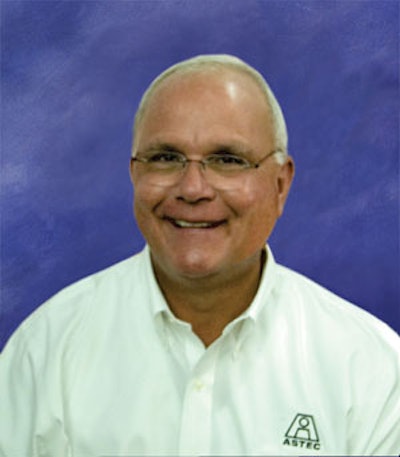
Astec announces its newest regional sales manager, Bill Schorer (photo above). His territory will include Arizona, California, Hawaii and Nevada.
Highway Information Systems Inc., a member of Quixote Transportation Technologies Inc., names Frank Fisher to its sales team as a sales engineer.
Quixote Transportation Technologies Inc.names Chander Sehgal engineering director and Greg Friend senior international sales manager.
Ingersoll-Rand announces three executive appointments. Terry Dolan is named vice president of Company Owned Stores. Scott Krull is appointed vice presdient and general manager, China for Ingersoll-Rand Construction Technologies and Compact Vehicle Technologies. Shawn Sweet is the new vice president of sales for Ingersoll-Rand brands.