It’s only a 2.8-mile long project, but the reconstruction of I-465 on the Northwest side of Indianapolis is a massive undertaking requiring 360,000 tons of hot mix asphalt; and paving contractor E & B Paving Inc. expects to complete laying the new road by November.
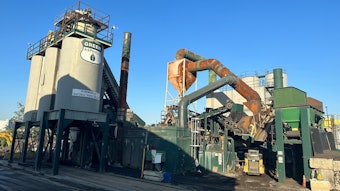
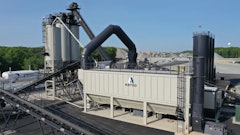
The Anderson, IN-based road contractor, which generates 70 percent of its annual revenue through paving projects, added crews and a portable Astec double-barrel plant at its Indianapolis batch plant location to accommodate the average daily placement of 6,000 tons of HMA. E & B began work on the project in April by placing crossover lanes to reroute traffic from the divided interstate. The project called for expanding the three northbound and three southbound travel lanes to four travel lanes in each direction, along with adding a fifth and/or sixth lane at major interchanges to accommodate a smooth flow of traffic entering or existing the interstate.
By July 4th, three southbound travel lanes of the project were completed and traffic was rerouted back onto the new road. Work on completing the center divide and the fourth travel lane will then be completed before reconstruction of the northbound side of the project begins. Final pavement is expected to be completed by the end of November, with final lighting and signage work to be completed by May 2006. Walsh Construction of Illinois is the general contractor on the warranty project and expects to receive an early completion bonus if the entire project is open to traffic by the end of November.
Total reconstruction of the project called for removal of an asphalt overlay before rubblization and removal of the original Portland cement concrete road. After new aggregate was added to the base and final grading completed, E & B Paving’s crews began placing new HMA around the clock to keep pace with demolition and grading crews. The new 20-inch-thick asphalt road consist of a 5.5-inch base course, followed by a 5-inch open graded drainage course, followed by another 5.5-inch base course, then a 2.5-inch intermediate binder course and finally a 1.5-inch steel slag SMA surface mat.
“The biggest challenge we have with this project is the volume of work that it entails,” says John McCurdy, project superintendent who’s been in the paving business for over 30 years. “The longest section we worked on in one shift was 1,700 feet. When we get to the binder course, we run it from bridge (an overpass constructed of concrete) to bridge to avoid any noticeable breaks in the mat and maintain a smooth ride from bridge to bridge.”
E & B frequently runs two paving crews during the night shift when placing binder and surface courses to facilitate longer and smoother placements. Trucks delivering mix from the plant are also able to keep pace with the paving crews because of the reduced traffic during the night. All courses, with the exception of the OG drainage and surface courses, utilized 25 percent RAP (reclaimed asphalt pavement). The drainage course design called for virgin aggregate and the surface course called for steel slag for friction and durability. The steel slag had to purchased and stockpiled from an outside source.
Placement densities on all courses have exceeded requirements set by the Indiana Department of Transportation. Using a Roadtec RP 190 paver and an Ingersoll-Rand DD-130 breakdown roller, E & B achieved a 92 to 93 percent (90 percent required) density on all base courses and 94 percent (92 percent required) density on the SMA surface mat. The paving contractor also purchased an additional Roadtec shuttle buggy, SB-2500, to control thermal and aggregate segregation, as well as maintain high production runs.
“When we put the bid together we estimated that it would take eight weeks working 24 hours a day, seven days a week to complete the southbound portion of the project,” McCurdy says. “We haven’t had to work seven days a week, and we’re on target to complete this portion of the project according to schedule. So, we’ve been exceeding our production targets so far.”
Warranty specifications
Under the contract, E & B is responsible for the HMA/SMA pavement for five years after all pavement is completed and open to unrestricted traffic. All mix placed on the project must be designed for 130,000,000 ESALs. E & B is responsible for establishing the Job Mix Formula (JMF) for the project, which must meet requirements of AASHTO M 323-04 for HMA or MP 8 for SMA; as well as selecting all materials to be used in the mix design.
During the warranty period, INDOT will monitor pavement performance and distress indicators — friction, International Roughness Index, longitudinal cracks, rut depth and transverse cracking — to evaluate whether or not corrective action is required by E & B to fulfill warranty obligations.
Corrective action for the following distress factors includes:
- Alligator cracks — Remove and replace distressed layer(s).
- Flushing — Remove and replace distressed area the full lane and depth.
- Longitudinal cracks — Repair by routing and sealing.
- Transverse cracks — Repair by routing and sealing.
- Longitudinal distortion — Remove and replace distressed layer(s).
- Potholes, slippage areas, raveling, segregation and other disintegrated areas — Remove and replace distressed layer(s).
- Rutting — Remove and replace distressed layers full lane width.
- Low friction — If average friction number is less than 35, remove and replace the distressed layers full lane width using originally specified SMA mix design.
Quality control
Controlling quality of mix and pavement placement on this fast-track project has required a detailed quality control plan. The plan was put together to not only satisfy INDOT’s needs, but also insure consistent methodologies in the design and placement of the HMA and SMA pavements required for the project be used by the different E & B associates who would make up the two different operating shifts each day.
Starting at E & B’s Harding St., Indianapolis plant, where all HMA and SMA mixes were produced, procedures were put in place for handling the asphalt produced, including stockpiling of aggregate and RAP, storage of different grades of asphalt binder, operation of surge bins, application of anti-adhesive agents, loading trucks, and use of truck bed covers. Plant managers and operators also followed specific quality control measures for calibration the plant for each mixture produced, calibration the return of baghouse fines. Compaction of design specimens and determination of maximum specific gravity, conducting tests necessary to adjust and control the mixture at the plant, and maintaining control charts were outlined in the quality control plan. Mix properties at the plant and at the pavement site were monitored for asphalt content, aggregate gradation, temperatures, aggregate moisture, field compaction and surface smoothness. Samples from the pavement were obtained with plates and/or molds for each Quality Assurance mixture.
An Incat ignition oven was used to determine binder content in accordance with ITM 586. Pyrometer charts of the mixture temperatures at the plant were recorded each day of production, and mixture temperature at the paver was recorded behind the paver every two hours. Density was monitored and controlled using a Transtec PQI, and cores were taken and tested in accordance with AASHTO T166 and AASHTO T275. Pavement smoothness was checked using a profilagraph in accordance with ITM 901.
All mixes were sampled every 1,000 tons of mix placed and tested for air voids volumetrics and binder content.
Quality control measures for the paving and compaction operation were also implemented to facilitate a continuous placement of a quality mat. The paving train for the mainline paving operation consisted of a Roadtec SB 2500 material transfer vehicle, a Roadtec 190 paver, an Ingersoll-Rand DD-130 vibratory roller, an IR DD-110 vibratory roller and an IR DD-90 vibratory roller. The pavers used on the project were equipped with a feeder control system for an uninterrupted flow of material to the screed. The system not only controls the on-off action of the dual feed systems, but also the speed at which the feed systems operate.
Paver speed is controlled by the delivery of mix and ability of roller operators to achieve required density on the mixture being placed. Automatic grade and slope were controlled with a Topcon automatic dual grade control system on the paver.
With the quality control plan E & B put in place, production and paving crews have been able to achieve or exceed all specified project requirements and complete the southbound portion of the project on schedule. Work on the northbound portion of project should also progress as smoothly as E & B anticipates completing its work later this fall.