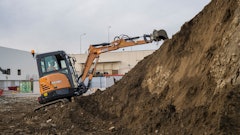
Through an emphasis on zero tailswing and the advent of GPS technology, compact excavator manufacturers aim to increase productivity and lower operating costs. Following is a look at some of the latest high-tech features available.
Zero tailswing
Zero tailswing (ZTS) is a popular feature on many of today's compact excavators. ZTS describes the ability of the excavator to rotate the upper structure within the width of the undercarriage. When the machine rotates, the rear of the machine will not extend beyond the edge of the track. This allows the machine to operate very closely to vertical objects, such as a wall or tree, without damaging the object or the machine.
"One of the reasons this is popular right now is that at the jobsites, you're getting much smaller, more confined, more restricted areas," says Dan Rafferty, compact products manager at JCB Inc.
Mark Wall, product marketing manager, John Deere Construction & Forestry Co., adds that ZTS allows operators to concentrate on the front of the machine without worrying about the tail of the machine, which makes them more productive.
ZTS also helps eliminate damage to the rear of the excavator, which keeps the machine looking good and reduces repair costs, says Wall. In turn, you will also have a higher resale value.
Raymond Vest, owner of MK & R Excavating in Waldorf, MD, appreciates the ability to work in tight areas without damaging his equipment. Vest purchased a Gehl 753Z zero tailswing model at the beginning of the year. He uses it for site maintenance jobs and minor grading, in addition to building bio-retention ponds and retaining walls. He also occasionally finds himself in remote wooded areas where the ZTS is especially beneficial.
"With the zero tolerance, the machine can swing on top of itself and not cause any problems in close-knit areas, such as when I'm in the woods," he says."It allows me to swing without hitting trees. And with the knuckle boom, I can get right on top of it."
The 753Z is also equipped with a blade. According to Vest, this eliminates the need to bring in additional machines for backfilling.
Instead of the traditional ZTS, Bobcat Co. offers two"Zero House Swing" models, the 430 and 435. These models enable operators to slew or turn the house up to 320° without extending beyond the width of the track. Traditional ZTS models usually do not reach this degree before extending beyond the tracks, says Tom Connor, Bobcat compact excavator product specialist.
Some compact excavators are not equipped with ZTS, but do offer minimum tailswing, where the rear of the machine extends from 10 to 14 in. This is still an advantage over a conventional tailswing, which extends between 22 to 30 in. beyond the track.
Security and GPS
GPS is an up-and-coming technology for compact excavators. In March, Bobcat introduced a global positioning system, theft recovery and equipment management package. Other companies are contemplating GPS as a full-time option.
Bobcat's GlobalTRACS system collects, manages and transmits equipment operating status and location data, which is accessed via an easy-to-use Web-based application or integrated into existing software. The system reports engine hours on-demand or at automated intervals, giving you a complete record of when equipment is being used.
Security management is another key feature. You can create virtual boundaries, or geo-fences, with entry and exit alerts. You can prevent theft of a machine at a publicly accessible jobsite, for example, and control the areas of operation.
By having theft protection, you can benefit from lower insurance premiums. The GlobalTRACS equipment management system also offers fleet management and cost savings.
Do more with less
Bobcat also offers a FastTrack drive system on its 430 and 435 compact excavators. The units are equipped with an all-hydrostatic drive system, which provides improved maneuverability, grading capabilities and a travel speed of 5 mph or more.
John Deere 35D and 50D models also increase productivity via faster operating speeds and more drawbar pull. Specifically, drawbar pull has been increased by almost 35% on the larger model, and faster cycle times allow operators to dig more each hour, Wall says.
Carl Kleeman is profit center vice president of the Savannah, GA, location of TIC-The Industrial Co., which specializes in marine and civil construction. He agrees that his two 35Ds and one 50D are pretty quick machines. But it's the compact, lighter weight that he appreciates most.
Kleeman rented the machines prior to purchasing the first one two years ago."They kept us from having to have loader-backhoes," he says."A loader-backhoe is much longer and heavier, and those factors are critical in the way we use the machine."
On a current jobsite that entails excavating a 6,100-ft.-long drainage system, Kleeman is able to lower the compact excavators 20 ft. down into a 32-ft.-wide by 400-ft.-long trench via a crane."With the compact size and zero tailswing, these machines are so much more versatile for us than a loader-backhoe," he continues."We can maneuver all the way around the hole. And since we have cranes at most of our jobsites, we can set the machines in and take them out of the hole pretty much at will and without much effort."
Equipped with attachments such as a vibratory compactor on one end and a blade on the other, the compact excavators can also simplify tasks previously done by hand or with additional pieces of equipment."Before these mini-excavators we didn't really have a good plan for tasks such as tamping, which we used to do by hand with vibratory plate compactors," says Kleeman. And with the blade, he can eliminate the need for a skid steer previously used for spreading fill and rock.
Less hand labor
A new feature offered by both Gehl Co. and Mustang is house leveling. It allows the superstructure of the machine to be tilted from 0° to 15° in order to dig a vertical hole or trench on a slope. This saves time because an operator can dig without first needing to level the slope, says Brian Rabe, product specialist at Gehl Co.
For Ben Saenz, B-C Construction, the ability to tilt his Mustang 3705 compact excavator significantly improves the efficiency of digging basements, footings and even swimming pools in the hilly terrain near his Rogers, AR, location.
"The 15° tilt is more than I could achieve with a backhoe and outriggers," he states."In some areas here in northwest Arkansas, there's nothing but hills, so a machine with this option works pretty good for me."
Prior to purchasing the compact excavator about five months ago, Saenz admits he didn't have an efficient approach to digging footings in hilly areas."Footings were really difficult to get level. We'd have to turn the machine a bunch of times to get it to come out right," he says."And when you dig off level, you end up doing a lot more hand work. When you bring the bucket up, the ditch ends up being wider than it has to be, so there's more erosion that the workers have to shovel out. Plus, workers had to use a shovel and flatten the trench by hand. With this house leveling feature, we just tilt the machine to whatever degree is necessary to level the bucket, then dig.
"I'm amazed at how quickly the job goes with the house leveling feature," he adds."It's just so much more efficient. I can't imagine how I got along without it. It saves us time and money."
Automatic control
The larger models in the John Deere D-Series incorporate an auto-idle feature, which is designed to reduce noise and fuel consumption. When the auto-idle switch is engaged and the operator does not move a pilot function lever for four seconds, the machine will automatically reduce the engine rpms to low idle. Once the operator activates the function, the machine automatically returns to the preset engine rpm.
In addition, John Deere, Gehl and JCB all offer automatic shifting on their larger compact excavators. In this case, when the travel switch is engaged in the fast (rabbit) position, the excavator will travel in high-speed propel. When a load is applied, going up a hill or turning, the machine will automatically shift to low-speed, high-power propel. This enables the machine to continue traveling without the operator taking any action. When the load is removed, the machine will automatically shift back to high-speed travel.
Future features
Manufacturers continue to refine the performance features of their machines. For example, a new hydraulic system on the Bobcat 331, 334, 331E (extended arm) and 430 models incorporates a dual-outlet piston pump, closed-center control valve, high-pressure hydraulic system and pilot-control travel system. The result is better operating performance, a smoother ride and better fuel efficiency.
Gehl's compact excavator lineup also features advanced hydraulic systems that enable the machines to maximize available engine horsepower with even greater efficiency.
And on JCB models, one of the highlights is precise, easy-to-use controls."On our machines, when you stop your motion with the hand control, the motion of the machine stops. It becomes a very easy machine to become very precise with," says Rafferty.
Advanced technologies will continue to play a major part in the future of compact machines. As with the automobile industry, Rabe believes electronics, as well as GPS, will be instrumental in meeting ever more stringent emissions standards. He also foresees computers being used in more units for quick troubleshooting and diagnosis of machine performance and efficiency.
Connor anticipates we'll see more advancements in operator comfort, such as lower sound levels, less vibration and more amenities like air conditioning and radios. He also predicts additional refinement of hydraulic systems, as well as the balance of desired cycle times with power output, to further create a smooth, controllable machine. ¦
When Does It Make Sense To Rent?
When it comes to foundation work, light demolition, small earthmoving jobs, utility installations, etc., a compact excavator is a valuable piece of equipment. But how valuable is it in terms of real dollars?
Let's figure an average purchase price to be about $30,000. Add up the tangible out-of-pocket expenses, including taxes and insurance, plus interest if you borrow the money. Next, consider ongoing regular maintenance (parts and labor), plus bigger repairs later on. You also need to include warehousing, transportation, etc. Assuming an equipment usage life of five years, you're conservatively looking at a cost of about $10,000 a year to own a compact excavator.
Now compare these numbers to a typical renting scenario. For most jobs, you will probably need the compact excavator on site for no more than a week or 10 days at a time. Based on a standard rental rate of about $620 a week, you could do eight week-long projects a year with a compact excavator for less than half the cost of owning it - $4,960 vs. $10,000. If you need it fewer than eight times, your savings are even more impressive.
Using these figures, renting would save you roughly $25,000 on that machine over a five-year span.
"It's just not cost-effective to own," says Barry Reeck, general superintendent, Weis Builders Construction Co., Minneapolis, MN. "Our rental company provides us with the equipment we need, when we need it - near-new, well-serviced equipment. It's a big benefit to us."
The rental company is also responsible for parts, maintenance and transportation, enabling you to gain the benefits of a premium machine without the costs or responsibilities of ownership. If the compact excavator needs service or repairs, someone else does the work. When you're finished with it at your jobsite, just send it back. You don't have to worry about how to dispose of the machine at the end of its usable life.
In addition, renting the equipment enables you to gain flexibility by ordering the exact size and model needed to fit each job. "Compact excavators often need attachments, too, like a breaker or hammer or different size bucket," says Bill Strickler, an area fleet manager for RSC. "Whatever it is that a project may call for, it can be conveniently rented here, as well."
This can include special requests for certain features. "One of our foremen wanted a skid steer with a scrubber on the exhaust, which is a pretty rare request," notes Butch Satterwhite of Mobley-Speed Cement Contractors in Dallas, TX. "Fortunately, our (rental) rep got it for us. He comes up with about anything I need."
Working with rented equipment also simplifies the bidding and billing processes. It can be tricky to gauge the true owning and operating costs for owned equipment, but the price of a rental is clear because there is only one accountable cost figure: the rental invoice.
Various reports and studies have been produced to help users weigh the costs of renting vs. buying. Standard industry guidelines and accepted computation formulas include the Rental Rate Blue Book and Custom Cost Evaluator. There is also a statistic known as Cost of Facilities Capital, which is a government-created formula that factors the cost of money invested in machinery.
Of course, every situation is different. But the next time you need equipment, evaluate your alternatives to see just how big a difference renting could make on your bottom line.
Information supplied by RSC Equipment Rental.