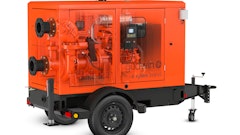
A trash pump's life is not glamorous. In fact, you would be hard pressed to find a piece of equipment whose duties are more humble. Because the nature of their work requires them to take a lot of abuse, trash pumps can use a little TLC to achieve the longest and most productive life.
A pump is a pump?
To the uninformed, one trash pump is like any other; but in reality, there are differences. For starters, pumps can be easily separated into smaller and larger categories. Smaller models, typically with 2- to 3-in. capacities, are powered by gas engines, while larger pumps, which run around 4- to 6-in. capacities, are powered by diesel engines. There are also submersible trash pumps, but they are much less common than engine-driven versions.
In addition to size, trash pumps can be classified as recirculation priming, or wet-prime pumps and vacuum-assist pumps, which require no priming. According to Jim Widrick, manager of national rental accounts at Gorman-Rupp, an advantage of vacuum-assisted pumps is they can be allowed to run dry without fear of damage to the pump.
Maintaining a long, productive life
The key to long life and productivity from your trash pumps is diligent maintenance. Pumps made by reputable manufacturers are built for the rigors of extreme usage, but all will benefit from regular service and preventive maintenance. And for the most part, the care of trash pumps is quite simple.
"The oil levels in the mechanical seal and the bearing cavity should be checked every 200 to 250 hours," notes Widrick. "The engine oil level should also be checked regularly, around every 250 hours. A simple glance at the site gauge should help you maintain the right levels."
Widrick suggests checking for wear after each use. "Take a blind flange test on the suction and discharge of the pump," he suggests. "Then take a suction and discharge gauge reading, which will tell you how much wear the pump has taken." This test requires a vacuum gauge for the suction and a pressure gauge for the discharge.
Widrick further suggests, "Make sure you buy a pump with an easy-access cover. This will make it simpler to clear in the event it gets clogged."
The pump's impeller is another area of concern. Since trash pumps often pass solids of significant size and density, the impeller can take a beating. If it gets worn beyond the point of effective usage, Widrick says it's time to say goodbye to the pump. "Some will try to 'jerryrig' it, but when it gets out of balance, the seal assembly and bearing will fail prematurely," he says. "It's the same as the wheels on a car getting out of balance."
The most vulnerable part of a pump is the mechanical seal. Most pumps are designed to work only when pumping liquid. When they pump dry, the mechanical seal will be damaged and the pump will no longer prime.
One way to combat this problem is to invest in wet-prime pumps with automatic float control. This is often an optional feature on some smaller pumps, and standard on larger ones. According to Widrick this feature tells the pump to shut off when the water level gets to a preset point. This can save the pump from running dry for a long period of time and potentially damaging the mechanical seal.
Marc Leupi, product manager, pump, power and light at Wacker Corp., agrees that the mechanical seal is vulnerable, but also suggests that the engine takes a beating as well. "Damage most often is a result of physical abuse, such as dropping the pump or it actually getting run over by larger mobile equipment on the jobsite," he notes. "Bad gas is another cause of engine damage."
Protect your pumps
According to Leupi, there are some basic steps you can take to ensure your pumps remain in good working order for as long as possible.
- Secure the pump and keep it out of the path of large, mobile equipment.
- Locate the pump as close as possible to the liquid to keep suction lift to a minimum. The shorter the distance a pump has to move liquid, the more volume it will deliver. Longer hoses produce more friction and less volume.
- Check the suction hose for leaks and secure all fittings. Many pump failures are due to a faulty suction hose connection.
- Use the proper hoses. Reinforced hose on the suction side will prevent collapse. Flexible hose is recommended on the discharge side.
- With wet-prime pumps, prime the pump before starting the engine. Even a tiny pinhole in a hose could cause the pump not to prime. When the discharge hose is pinched or clogged, air cannot escape and the pump will not prime.
- Only pump liquids for which the pump is designed.
- Use the proper strainer to prevent clogging and damage.
- Drain the pump before freezing weather.
- Check the suction strainer regularly and keep it clean.
- Pumps should be run at the specified rpm. Higher rpms only provide temporary performance advantages until the engine is damaged.
- Monitor the pump while it's in operation.
Another way to ensure long life from your trash pumps is to invest in quality. "A higher quality construction really makes a difference in the overall life of the pump and how it will withstand the rigors of the jobsite," says Leupi.
Widrick agrees, noting it's important to think long term. "You should invest in high quality and what will have a good resale value down the line," he emphasizes. "Working with a reputable manufacturer is a good start."










![Woc 2021 Banner 2 Hires[33]](https://img.forconstructionpros.com/files/base/acbm/fcp/image/2021/06/woc_2021_banner_2_hires_33_.60b943bc31158.png?auto=format%2Ccompress&fit=crop&h=135&q=70&rect=84%2C0%2C1749%2C984&w=240)