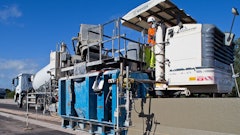
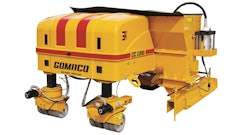
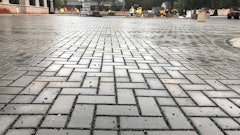
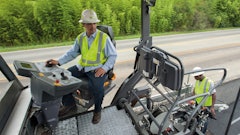
Following its introduction in the late 1940s, slipform paving literally revolutionized the way concrete was placed. Nearly 60 years later, it is now the standard for most large concrete paving jobs. Yet, it is also finding increasing use on small or tight-radius pours thanks to advances in paver designs and mold configurations. Even some larger pavers are finding a place on projects once relegated to screeds and forms.
The biggest benefit to slipforming is clearly its ability to reduce or eliminate hand labor. "The cost differential is dramatic," says Tom Zignego, president, Zignego Co., Waukesha, WI. "The machine work is probably a third the cost of the hand work."
Although it performs many large interstate projects throughout southern Wisconsin and northern Illinois, Zignego Co. also works with municipalities to complete street work and other smaller jobs. For these projects, it uses its two GOMACO Commander III curb and gutter machines whenever specs and jobsite conditions allow.
Metro Pavers in Iowa City, IA, has a similar philosophy toward its paving projects. The contractor uses three Power Pavers slipformers for jobs such as development and city work, medium to large parking lots and even county secondary roads. "We use them wherever we need them," says Nick Kempf. "We might go out and pour a 400- or 500-ft. street, then go pour for three days on one job.
"You still have to build intersections and tie in streets," he adds. "But we try not to. We try to do slipform."
Adapting to the application
Intermediate pavers typically deliver maximum paving widths anywhere from 18 to 24 ft. Though they are frequently used to pave a set width throughout the work day, this is not always the case. As such, manufacturers are making it easier and less time consuming to change from one width to another.
"It's very easy to change the machine — to put 1 ft. in or take 1 ft. out," says Kempf of the Power Pavers units. "If you're just moving it a foot, you can do it in a few hours."
The telescoping frame on GOMACO's GP-2600 paver extends on the left side, providing widths from 12 to 18 ft. 6 in. And the GHP-2800 allows for widths from 12 to 25 ft. with no frame inserts added. "It's a matter of selecting the right machine for your paving projects," says Kent Godbersen, GOMACO's vice president of worldwide sales and marketing. "If you're doing mainline paving, you need the size, weight and horsepower to work with the concrete volume at 24 ft. wide or wider."
For those seeking even faster width changes, Terex Roadbuilding offers its TEREX/CMI SF2204B HVW (hydraulic variable width) paver. These premium units can adjust from a roughly 8.5-ft. transport width to a 20- to 22-ft. maximum width in under an hour.
"The tractor and paving kit, along with the plow and final finisher, are all variable width — it's all done in unison without disassembly," explains Tom Devonshire, product manager for concrete mobile products, Terex Roadbuilding. This gives you the luxury to pave several jobs of varying widths in a single day, he adds.
Though the HVW design is not a new concept, some of the applications it is being asked to perform are. "What we're doing now is introducing the HVW into a new market segment. We want the contractor to know that he can utilize the HVW in several different applications — which include barrier/parapet, curb and gutter, specialty work, 10- to 12-ft. shoulders — with a specific kit that's available," says Devonshire. "Its versatility allows the HVW to be configured to meet the contractors needs, including mainline paving."
Paving kits and molds are enabling pavers in this class to engage in pours with more complex geometric designs. For example, the HVW machines are available with an offset mold that adjusts anywhere from 4 to 10 ft. incrementally; a median barrier and parapet wall mold for wall heights exceeding 42 in.; a kit for paving paths or shoulders from 5 to 12 ft.; and even a zero clearance kit for slipping shoulders right up against an obstruction.
Intermediate pavers can also be set up for integral curb and gutter, eliminating the need to bring in specialized equipment. "They have a multitude of curb pans depending on what the job calls for," Kempf notes. "If the job would happen to call for a drive-over curb, a 6-in. integral curb or a standard state sloped curb, we just change the pans."
Of course, adapting the pavers for multiple tasks requires an investment in attachments. Paving kits can range anywhere from $30,000 to $75,000. But the flexibility gained can be well worth it.
"The intermediate pavers give you so much versatility," says Dan Napierala, national accounts manager, Power Pavers. "They allow you to go after work that you normally wouldn't have the capability to do without it. That's going to increase your bidding capabilities."
Beyond curb and gutter
Though commonly known as curb and gutter machines, multipurpose slipform pavers are capable of much more than the name implies.
Ironically, Metro Pavers rarely uses its Power Curber 5700-B for curb and gutter applications. "We don't use it very often for curb and gutter because we usually put the curb and gutter on with the bigger machines in one pour," Kempf says. "Usually, we use a big Power Paver machine on a project. Then if the project calls for some trails, we'll pour 6- or 8-ft. trails with the Power Curber."
GOMACO has also designed its four-track Commander III with versatility in mind. With a 20-ft. maximum paving width, it can be used on airport runways, primary and secondary roads, highways, city streets and ramps, in addition to the more typical shoulders, cart paths, trails and barrier/parapet wall. "The Commander III is a multi-application machine that is ideal for shoulders, ramps and municipal paving," says Godberson. "With the new V2 mold, not only are width changes quick, but it can make width changes on the go."
Of course, with these multipurpose machines, attachments are crucial. Zignego Co. has 30 to 40 different molds for its Commander III pavers. Most of the molds are needed to accommodate the varying curb specs in communities throughout Wisconsin.
"We buy molds all the time based on the work we get," says Zignego. For example, one mold the company owns allows for a 5-ft. "curb" section. "Instead of having 30-in. curb and gutter, there are a lot of municipalities going with 60-in. curb and gutter, and they use that as a bike path. I bought the mold because one year I had three or four projects that required that."
Another of its molds enables pouring large integral curb sections within a 2- to 3-in. clearance. This mold was essential for completing a project last summer.
"The city of Milwaukee didn't want to widen the street because they didn't want to tear down trees," Zignego explains. State requirements called for two through lanes. "The city only had 11 ft. to the face to work with. They couldn't put a curb joint in there, say, a foot off because you would only have a 10-ft. lane and the DOT requires 11 ft. So on that job, the city spec'd 11 ft. to the face, integral mandatory."
Having the mold on hand enabled Zignego Co. to use a Commander III to easily slipform this job. "We're one of the few contractors in the state I think who can do it," says Zignego.
Slip into a compact niche
Even small curb and gutter units aren't limited to a single application.
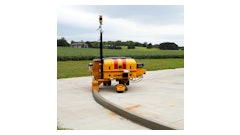
For example, Messinger Inc. offers its Curb Fox slipformers in three sizes. The smallest weighs a mere 2,000 lbs., measures 60 in. wide by 100 in. long and can pour 14-in.-high by up to 18-in.-wide shapes. The largest model is 5,000 lbs., measures 100 in. wide by 144 in. long and can place curb and gutter to a 36-in. width.
Despite their compact dimensions, the Curb Fox pavers are still capable of performing sizable tasks. "You have to do grade preparation ahead of time with a small unit like ours. But a small machine can still pave a large job," asserts Tim Messinger, president of Messinger Inc. "You could still go out and do 3,000 ft. in a day on a subdivision. So it ends up being a trade-off for the contractor. What's more important to him — having the high-production capability or more of the practicality going into a smaller job."
For Concrete Paving Contractors, Redlands, CA, the choice was easy. The contractor specializes in commercial and industrial paving projects, with jobs ranging from truck docks and highway medians to cart and bike paths and shopping center curbing. For the larger, longer runs, it uses an Easi-Pour 1000 rubber-tired slipform trimmer/paver from Huron Mfg. But for smaller jobs involving tight radii, it uses a Curb Fox. "It is probably one of the smaller machines on the market that has the capability to do the confined areas," says Dave Wallace.
The compact paver is frequently used for bike and golf cart paths, as well as curbs and islands in shopping center parking lots. "It makes us that much more competitive because we don't have to form them," says Wallace. "You take a form crew out and pour 30 yds. a day. You can take the Curb Fox out there and pour 70 or 80 yds. and double your productivity."
The paver's light weight is a particular advantage when working on existing pavement. "On some truck docks, they have pin-on curb they want to float on top of the concrete. I take the Curb Fox, dowel into the concrete and we can go right on top of the rebar with it and pour the curb," says Wallace. "We also have some sidewalk where they want to put in a curb behind it. We've run the Curb Fox on the sidewalk to put in the curb."
The unit is also light enough to be pulled behind a pickup truck. "With a large paver, you're going to have to bring it in with a lowboy. That sets a level of the amount of footage you have to do to justify bringing it in," notes Messinger. "Our machines are typically used for 200- to 300-ft. jobs. It would not be practical to bring in a larger machine for probably less than 800 or 1,000 ft."
Despite the potential benefits, you may question why you would want to invest $30,000 to $80,000 in such a specialized machine, particularly if you have existing pavers in your fleet. Messinger believes it comes down to efficiency. "At a certain point, if a contractor has enough work that his large machine is busy, then he'll look for a smaller machine to do the smaller work," he states. The alternative is to subcontract the smaller jobs or hand form. "That helps make the justification for using a machine easier because nobody likes to hand form work of any size. And nobody likes to subcontract if they can do it themselves."
In the case of Concrete Paving Contractors, Wallace says the compact slipformer has saved thousands of dollars in time and labor. He cites a typical shopping center project, which can take up to eight days to hand form. "We can take it down to five days with the Curb Fox," he says. "It starts adding up quick when you have 15 men out there [hand forming]. You can account for that real fast."