Milling asphalt pavements prior to repaving them with HMA (hot mix asphalt) is commonplace today. It’s one of the most economical ways to bring a roadway back into an acceptable smooth ride condition. What’s more, it’s not only the major thoroughfares that need to be milled in order to bring an asphalt pavement back into specification. All types of asphalt pavements that have deteriorated must often be either milled or completely removed prior to repaving.
Pavement-milling projects are not necessarily extensive. Many small-size paving contractors who cater to the “no-job-too-small” say there are countless repaving projects that require the existing surface to be milled before the repaving process can commence. That can be good for the contractor, for it means additional business per project. Nevertheless, there is a host of potential problems associated with the milling process. Here is a short list of problems that can beleaguer many small paving contractors that are or want to get involved in milling-repaving projects.
- First and foremost, unlike the major roadway repaving projects that are usually carried out by the bigger paving contractors, many smaller contractors tend to pursue and get contracts for small projects such as suburban-area streets, small parking lots and short stretches of secondary roadways.
While the medium to large capacity cold planer milling machines are highly productive and fit the big road projects requirements for efficient milling, their footprint is often too large for the short and narrow areas to be milled on small projects. Then too, the big planers are costly to transport from one project site to the next, often requiring special road permits. These mobilization costs can hardly be justified for small milling projects that sometimes require a couple of hours to complete.
- There are contractors with compact cold planer milling machines that offer their milling services to other paving contractors, which is good. However, such contractors are few and far between, which is bad. In many areas of the country, the demand for compact milling machines is greater than the supply, which often results in poor milling services, including tardy deliveries of the milling machine. That usually holds up the contractor’s paving schedule.
- Some paving contractors consider buying their own milling machine to avoid all the above problems but consider the cost of its ownership too high.
While these problems can be obstructions for some contractors to either get into or stay in the milling business, there are others who have found ways around the obstacles.
A contractor overcomes
One contractor who has overcome the problems associated with milling is Chip Reid, president of Reid Paving Contractors Inc. He is highly motivated to make the milling services work for his company because there are fewer competitors, which has led to a very viable part of the company’s business.
During much of the past 10 years, he has experienced many of the downsides associated with milling and in recent years has eliminated these shortcomings, thus making this activity extraordinarily profitable.
Reid started his paving company in 1983. Since the beginning, he prefers to have one paving crew do all the company’s paving projects. By providing high quality paving services, the company has been very successful. Thanks to a good performance reputation, most of Reid Paving’s work is conducted within a 30-mile radius of the corporate headquarters in Gilbertsville, PA.
This year, 80 percent of the company’s revenue comes from the private sector and the balance from the public sector. The ratio of private- to public-business varies from year to year, depending on how much private work is available. If private work is down, Reid takes on more municipal and PennDOT projects.
Since the mid to late ’90s, Reid encountered an increasing number of paving projects calling for milling as a prerequisite to the repaving. With such projects available, Reid took on contracts where milling was part of the paving process. He subcontracted out the milling part to a third party. Another reason to include milling services was that some customers wanted him to be responsible for both the milling and paving.
Unfortunately, Reid found that using milling contractors often met with disaster. He says, “It was a failure in more ways than one. Often the milling machines were poorly maintained and they would break down during the middle of the work. That brought the whole paving process to a halt. Many projects call for us to repave any milled out sections before the day’s end and with a milling machine broken down, we would fall behind schedule. Reliable milling contractors who supply reliable compact milling equipment are difficult to find, so I hired whoever I could get.”
After five years of subcontracting out the milling and all the problems associated with it, Reid took bold steps to rectify the problem. “I didn’t want to lose the milling-paving projects, yet I knew I had to do it differently,” he says.
“Frankly it was a potentially good profitable business.”
Time to buy
Reid did not relish the idea of investing in a cold planer milling machine because he was not sure he could justify such a large investment. Equally challenging was to find a compact milling machine that was suitable for his milling needs.
He decided on the Marini model MP 1300 cold planer milling machine marketed by Marini America Inc., based in Downingtown, PA. Marini America is now under the management of BOMAG Americas Inc. in Kewanee, IL. Both companies are part of the Fayat Group, a French company that purchased BOMAG in January 2005.
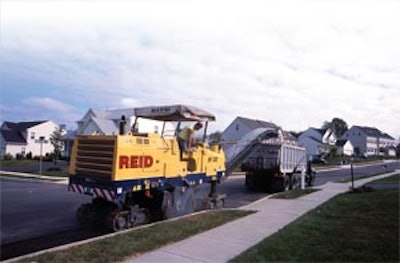
The compact MP 1300 has an overall nominal length, less its extending overhead conveyer, of only 213 inches. The overall width of the MP 1300 is 81.7 inches.
Reid says that existing asphalt pavements in very tight or narrow areas are easily milled using the maneuverable MP 1300; another benefit of this compact machine is that special road permits are not required to haul it on an ordinary lowboy. It is so simple to load/unload that the operator singly loads/unloads and hauls the MP 1300.
“Its compactness was a main reason why I bought the Marini machine. I don’t know of another machine that is as small as this one. Yet, it’s very productive to use on many different projects from small-diameter cul-de-sacs to milling or reprofiling shoulders on secondary roads,” he says.
Despite its compactness, the MP 1300 can mill to 51.4 inches wide in a single pass. On small projects, one or two passes often is sufficient.
For example, Reid recently had a paving job in an exclusive residential area where another contractor already laid the base and binder courses incorrectly by not meeting the streets’ specified lateral pitch. It’s not the first time Reid has been called in for reprofiling another contractor’s paving.
“I can’t lay a wear coat over a poorly laid base and binder,” he explains. “Some of the street areas were paved with small area lows in them or they were poorly pitched so surface-water gathered in puddles after a rain instead of running off to the gutters. This remedial work calls for reprofiling the binder by milling out the high areas and putting on an acceptable pitch before we could pave.”
Other applications Reid finds for his milling machine are in revamping golf course paths that are constructed with asphalt paving. A recent project was the Skippack Golf Course. It’s an 18-hole golf course that had an existing 6-foot-wide cart path. The project called for widening the path to 8 feet and repaving it. Since the pavement was degraded by weathering, it was more cost-effective to first mill it to a 6-in depth. The aggregate pavements milled were 23,000 feet long by 96 inches wide.
“Our milling machine was ideal for this job,” says Reid. “Its narrow overall track width was close to the width of the new pathway so none of the immediate surrounding landscape was disturbed. The milling machine was used for both milling out the existing pavement and the adjacent ground that had to be excavated for the widening.”
Compact milling machines are a good fit for other types of applications, according to Reid. For example, doing asphalt pavement patch-work on airport runways and aprons where areas of the pavement have structurally failed is easily accomplished. These areas are first milled prior to the patching process. A recent project for Reid has been the extensive milling and patching work at the Doylestown Airport. The work was carried out at night when no air traffic was taking place.
Still another good application is the milling and paving of existing parking lots, no matter how small they might be. Reid undertook the Montgomery County Eagleville Correction Prison parking lot remedial project, where 5,000 tons of existing paving was milled out and replaced with new HMA. Reid says on projects like this, where continuous milling can be done, the hourly production averages 100 tons.
The economics
If Reid temporarily doesn’t have work for the milling machine, he rents it to other paving contractors for added income. He supplies both the machine and the operator. “Operating one of these machines correctly requires a trained and experienced operator,” he says. “If a good operator isn’t used, the machine might prematurely breakdown or the quality of the milling is unacceptable. In either case, it’s due to the ineptness of the operator.”
Reid justifies the investment of the Marini machine by operating it about 500 hours a year. He figures his gross return is $300 per hour, whether operated on one of his projects or on rent to others. The gross income is $150,000 per year, plus the charges he makes for moving the unit to each project. He bought his planer over two years ago but points out that despite a purchase price in the $300,000 range, the Marini machine can be a very profitable investment.
Besides the machine’s direct financial return, there are additional benefits in owning a milling machine, according to Reid. One is having far better control on the quality of milling performance and the control on scheduling its use at a project that leads to more efficient production. Gone are the days when he would flip coins to see when the milling would be completed and the hassle of dealing with other contractors.
Reid puts the milling business and the milling machine ownership into perspective when he says, “The only thing I regret is that I didn’t buy one earlier than I did; it sure is a good money maker.”