California motorists and taxpayers were big winners when the cutting-edge cold-in-place (CIP) pavement recycling was used to rehabilitate a major portion of busy I-80 from Auburn to Colfax, north of Sacramento.
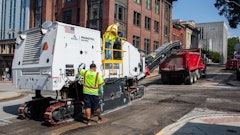
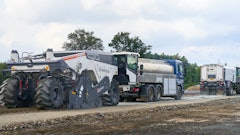
The California Department of Transportation (Caltrans), Teichert Construction and Valentine Surfacing — with the participation of Wirtgen America Inc. — reconstructed I-80 this past summer using the unique CIP foamed asphalt recycling process. A massive 1,280-hp Wirtgen WR 4200 milled up the existing pavement, mixed it with asphalt foam, then mixed it with a cement-water slurry from an accompanying Wirtgen WM 1000. This new innovative material was placed and compacted on the roadway, all in one pass.
The recycling process resulted in direct savings to California taxpayers of well over $1 million compared to conventional reconstruction.
This project combined the asphalt reclaiming and foamed mix capabilities of the WR 4200 with the cement slurry capabilities of the WM 1000 to recycle in-place nearly 27 miles of traffic lanes (approximately 188,950 square yards), and nearly 49 miles of shoulders, (approximately 315,525 square yards). It represents the first use of the WR 4200 in the United States and one of the largest such projects in the world to date.
“We thought it was a great success,” says Larry Rhoden, vice president and manager, Teichert Construction’s Heavy & Highway Division. “More importantly, because it was Caltrans, it’s really encouraging for the recycling industry as a whole. It’s really the tip of the iceberg of what can be done. It’s the future, without a doubt.
“There are so many reasons for recycling,” Rhoden continues. “Raw resources are becoming very constrained; it’s getting harder and harder to permit new aggregate extraction sites. With the price of oil being what it is, recycling just makes sense using this method.”
The quality and the environmental aspects of the project were such that the project was entered into the annual Globe Awards program of the American Road & Transportation Builders Association, which recognizes a project’s contribution to environmental protection and impact mitigation.
“The I-80 project was extremely challenging, an application that had never been attempted before on an Interstate highway,” says Wirtgen recycling specialist Mike Marshall.
Foamed asphalt and I-80
Foamed asphalt is a cost-effective way of stabilizing road bases that’s gaining interest from coast-to-coast. Foamed or “expanded” asphalt is created by carefully injecting a predetermined amount of water into hot penetration-grade asphalt in the mixing chamber of a pavement remixing unit, and offers a cost-effective alternate for road base stabilization.
The expanded asphalt has a resulting high surface area available for bonding with the aggregate, leading to a stable road base using 100 percent of the existing in-place materials. The benefit is substantial cost savings over use of asphalt emulsions for base stabilization, and complete elimination of the cure or “break” period.
On I-80, the foamed material was paver-laid, with an integral Vögele high-density, variable-width screed and compacted, and could accept traffic — including heavy trucks — almost immediately.
Foamed asphalt is produced by adding small amounts of water (approximately 2 to 3 percent by mass of asphalt) to hot liquid asphalt, typically 320 to 350 degrees F. The liquid asphalt used for the process can be straight penetration grade; in the I-80 project, it was PG 64-22.
When injected into the hot liquid asphalt, the water evaporates abruptly, thus causing extremely rapid expansion of the liquid asphalt in the saturated steam. Typically the liquid asphalt expands 15 to 20 times its original volume. The intensity and effectiveness of the foaming process can most effectively be governed by controlled operation of the basic physical conditions, such as pressure and temperature.
In Wirtgen recycling machines, this process takes place in individual expansion chambers where the water is injected into the hot liquid asphalt, which has a temperature of 350 degrees F and a pressure of 75 psi. Precise addition of water allows control of the rate and amount of expansion.
When using foamed asphalt as a binding agent, the content of fines in the aggregate is very important. The foaming process results in a surface expansion of the liquid asphalt and a simultaneous reduction of its viscosity. The dispersion properties of the liquid asphalt are greatly increased ensuring that the fines (0.075 sieve) in the aggregates are coated.
This filler and the foamed asphalt together produce a mortar, which binds the coarse aggregates. On the I-80 project, the recycling depth was limited to a maximum of 4 inches, so only the asphalt pavement was to be recycled, instead of pavement plus base. When this occurs, insufficient fines are generated (10 to 20 percent 0.075 minimum) and it’s necessary to add fines, in this case in the form of Portland cement slurry produced by the WM 1000.
The Caltrans Materials Laboratory determined the optimum mix design for the shoulders as being 2.5 percent foamed asphalt by mass (+ or -0.5 percent), with 1.5 percent cement, and recycling depth of 2.5 to 2.75 inches. For the driving lanes, 2.5 percent foamed asphalt by mass (+ or -0.5 percent) was indicated, with 1.5 percent Portland cement and a recycling depth of 4 inches.
As the cold recycling mix design called for 1.5 percent cement, it was decided to use the Wirtgen WM 1000 cement slurry mixer — a totally dust-free and accurate system — in conjunction with the WR 4200. The cement/water proportions for the slurry and the percentage values are entered into the onboard microprocessor which then regulates the mix and pumps the correct amount of cement slurry into the recycler’s pugmill mixer. This system of producing cement slurry on site is totally environmentally friendly and extremely safe, and no free cement dust is created to contaminate traffic, bordering vegetation or adjacent livestock.
Change to foamed asphalt
Use of the WR 4200 was the result of a contractor change. A section of I-80 California from Auburn to Colfax had been designated for rehabilitation by Caltrans, and the original contract requirements were for a mill-out of the existing pavement to a depth of 4 inches, and virgin repave, with an estimated contract value of over $40 million.
In prior years, Caltrans had used Wirtgen foam process with the WR 2500 with great success on secondary roads, and had developed a comfort level with the process.
“This job was different from the rest of our jobs in which we used foamed asphalt as a stabilizing agent, because they have been full-depth reclamations,” says Joseph Peterson, P.E., Caltrans District 3 materials engineer. “Here we decided to use foamed asphalt as a recycling medium and went down 4 inches on the main line and 3 inches on the shoulder using foam as the stabilizing agent.”
During discussions with Caltrans, Sacramento’s Teichert Construction, Valentine Surfacing and Wirtgen America Inc. presented a Cost Reduction Incentive Proposal (CRIP), enabling part of the project to be changed from conventional mill-and-fill to CIP recycling. The change of rehabilitation method to cold in-place recycling would provide a number of benefits, including a relatively high reduction in traffic congestion, or avoidance of congestion, during the in-place, moving construction, as well as a reduction in costs.
The CIP recycling process that most closely matched Caltrans’ benefit criteria was foamed asphalt. The agreed CRIP included recycling a total of 26.84 miles of traffic lanes (about 188,950 square yards), and recycling a total of 48.68 miles of shoulders (added later, about 315,525 square yards).
“Originally the contract called for us to mill out 4 inches of existing asphalt, and replace with new asphalt,” Teichert’s Rhoden says. “With virgin asphalt, the average mix design will incorporate 5.5 to 6 percent liquid asphalt. But the recycle method used only 2.5 percent liquid asphalt, so there was a huge savings in liquid asphalt alone. And the elimination of truck trips was a substantial benefit, both financially and environmentally.”
Recycling full width in a single pass
The recycling train — consisting of WR 4200 and WM 1000 slurry mixer — recycled the Interstate across the full lane width in a single pass, at the average recycling depth of 4 inches. Generally, the hard shoulders were recycled during the day and the driving lanes always at night. The recycled lanes were immediately opened to traffic the following morning. After the completion of project sections, the recycled base layer was to be overlaid with 75 mm (3 inches) of dense-graded asphalt, and later, 70 mm (2.75 inches) of open-graded friction course, resulting in a completely new driving section.
The recycled base material makes a very high quality base course, and the mixing results can be compared to those of stationary mixing plants. That’s due to the WR 4200’s integrated twin-shaft pugmill mixer, which produces a homogeneous construction material mix from the crushed pavement material and binding agents. The mixing capacity is approximately 400 tons per hour.
The recycling train had an average working speed of 15 to 20 feet per minute. An average of 1.2 miles of CIP pavement was completed each night shift.
Because there were no intrusions into adjacent traffic lanes, disruption to traffic was kept to a minimum. And the cutting width of the recycler is variable from 9-foot 8-inches to 13-foot 9-inches, so the entire lane width - including overlaps — could be recycled in one pass, eliminating longitudinal joints in the traffic wheel paths.
“This feature was especially important when recycling the shoulders, where the width was not constant,” Wirtgen’s Marshall says. “The ability to vary the recycling width on the move allowed changes in pavement width to be accommodated on the near side, while maintaining a constant and straight joint with the offside traffic lane. This feature meant that the recycling equipment remained in one lane, minimizing traffic disruption.”
On I-80, the WR 4200 cut the existing pavement to the required depth and width, and the milled material was fed into its pugmill, where the binding agents, foamed asphalt and cement slurry were injected, along with a water spray, to bring the recycled material optimum condition for compaction.
On exit from the pugmill, the homogeneous material was then fed into a tamping, vibrating screed unit directly attached to the WR 4200, which placed the recycled material as a new traffic lane. Each of the three spray systems — foamed asphalt, cement slurry and water — were regulated by a microprocessor on board the WR 4200 to ensure that the correct values were delivered to the mixing chamber, in accordance with the mix design, relative to forward speed.
Following the CIP recycling, the reclaimed, stabilized base course material was compacted with a combination of a steel drum vibratory roller and a pneumatic roller. Once the required compaction was achieved, the recycled lane was opened to traffic immediately following the construction shift.
Meeting environmental, construction needs
The I-80 CIP project clearly met the initial project objectives of Caltrans and contractor Teichert.
Caltrans’ foamed asphalt design strengths and required densities were based on what it had experienced with full-depth projects. “We’re very, very happy that our preliminary falling weight deflectometer testing showed the in-place material being stronger than our design material,” Peterson says. “We will continue to test every six months for the next three to five years.”
There was a substantial reduction in traffic congestion on this heavily traveled route, which connects San Francisco with Reno, and follows the Donner Pass over the crest of the Sierra Nevada range. Restriction of the recycling equipment to one lane, with only two deliveries of materials per shift (liquid asphalt and water), meant the adjacent traffic lanes were not affected by the recycling process. The ability to open the recycled lane to traffic at the end of the production shift greatly reduced lane closures and resulting traffic congestion.
The quality of the foamed asphalt pavement was such that it gave Caltrans and the contractor flexibility in getting final driving surfaces on the recycled base course. “We left some of the recycled asphalt exposed to auto and truck traffic for up to two months, and never had any problems,” Rhoden says.
“We initially found that, given enough time — typically about four hours — we could run fairly high levels of traffic, uncontrolled, including trucks, on the roadway with no problem at all,” says Caltrans’ Peterson.
Also, the cost of reconstruction was radically reduced, with an approximate 20 percent savings on the CIR sections.
There were firm environmental benefits as well. The I-80 project resulted in a saving of over 130,000 tons of virgin aggregates, as reclaimed aggregate was used in-place, taking pressure off local quarries. Associated energy cost savings in production and haulage of over 130,000 tons of virgin hot mix asphalt were enjoyed.
While there were a number of locations from which the contractor could have brought virgin HMA, due to local constraints and permitting, it was necessary for all asphalt to come from Sacramento. This excessive truck traffic was eliminated by the CIP recycling process.
And the elimination of hauling helped prolong the life of local roads, and greatly reduced overall project emissions by haul trucks and stalled traffic caught up in construction congestion. Lastly, emissions from hot mix asphalt plants for the project were avoided, and the in-place recycling process was totally environmentally friendly, with no dust or waste heat produced.
“The I-80 project utilized a highly innovative and cost-effective process, and environmental impact mitigation techniques,” says Wirtgen America’s President Stu Murray. “I-80 set a new standard for cold in-place recycling, opening up an entirely new application for recycling with all the associated environmental benefits and cost savings.”
Peterson is confident that in-place recycling will work for Caltrans in the future. “Our first project utilizing foam is going on its fifth year, and it’s performing wonderfully. If the I-80 reconstruction behaves the same way, it will be a success and we will have a way to foam-recycle asphalt pavements at a shallow depth on high ADT roadways. We look forward to reusing this process again as candidate project become available, and we won’t want to wait five years.”