In 2003 Randy Foster had a situation. His three-year-old commercial pavement maintenance company wanted to grow, but expansion was restricted by factors outside of Foster's control — he was getting asphalt mix from a competitor, but only about 10 days out of the month. Since he had more demand for services than he could supply because of his limited asphalt availability, Foster took action.
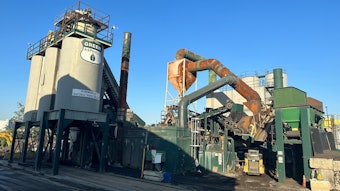
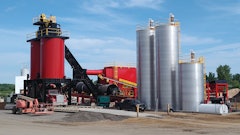
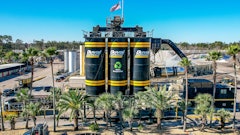
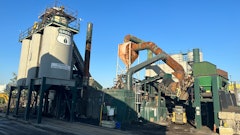
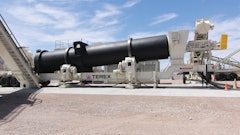
"I did as much research and read as much material as I could get my hands on about asphalt plants, how they work, and the components," says Foster of his decision to take his destiny into his own hands. "We decided to put up a plant, decided on the size we wanted, and we bought an old 1965 model Barber Greene plant, a small one, and brought it into our shop and rebuilt it. We modernized it to meet all the federal specs by putting a baghouse and a modern control house on it."
Foster's decision turned out to be more beneficial for Asphalt Maintenance Co., based in West Plains, MO, than he had imagined.
"Having the plant absolutely helped us out a lot last year," he says. "We were able to double our business from the previous year. It also made us a lot more competitive on jobs and helped us get control of our schedule."
Foster's head-first dive into hot mix production shows the determination he has to be successful in this industry. In 2000, Foster was working for a family business which had nothing to do with the pavement maintenance industry. He noticed there was a need for sealcoating in his area, so he bought some equipment and started sealcoating.
"Then I started to notice that two out of every three calls that we got were people wanting paving. So I got into the paving business the following year," he says. "Paving eventually came around and has turned into the mainstay of our business."
Running the business
AMC currently does about 65% of its work in paving and about 35% in sealcoating. 2005 will be the first year the company will have full time sealcoating and paving crews. They do about half residential and half commercial work in both their paving and sealcoating markets.
The company has 12 employees. There's a full-time sales person; superintendent Greg Collins takes care of scheduling and outside work for the paving operation; Foster runs the hot mix asphalt plant; and his wife, Jennifer, runs the sealcoating operation. Foster depends a lot on organization to make his business run smoothly. One example is the way in which he has systematized many of the operations at his company.
"We've broken a lot of our systems into Standard Operating Procedures, we call them SOPs, where things are done a certain way, and that system is repeated each time it's done. An example would be the way we load up in the morning before we leave. Everything has a place and equipment is loaded and unloaded in a certain way," he explains. "We also have SOPs for turning in paperwork for job costing and other office tasks. We found there are great efficiencies in doing that — it puts an end to confusion and lost productivity."
Part of the systemization process is communicating these ideas to employees. Foster is dedicated to working with his employees to make sure everyone is on the same page. He recently implemented training programs for his workers — a day and a half in a classroom setting and one day out in the field. Collins runs the program, the inside part of which includes working through the employee handbook, reviewing pay scales, and watching National Asphalt Pavement Association training videos about rolling techniques, paving, and similar topics. Collins quizzes the employees on subjects they talked about in depth. Outside, employees receive hands-on training, including paving a test pad, reviewing paver operations and rolling patterns, sealcoating the pad, and reviewing equipment safety.
"We had some new guys on board this year, so some of the information was new to some people, but a refresher to others," Foster says.
Plant talk
Last year AMC used nearly all of the hot mix it produced on its own jobs. Foster says that this year he anticipates doubling production and selling more hot mix to other contractors and a few government agencies. Paving production will also increase, since Foster reports that as of April 1, AMC had booked almost as much work as it did all last year.
Foster was very independent in his acquisition of his asphalt plant. He did extensive research into what type of plant to buy, and depended on in-house work to update it. He even took the driver's seat when it came to acquiring permits to run the plant.
"I did some checking to see what a consulting firm would cost and they wanted a lot of money just to get you set up to be permitted, so we did all our permit work in house," he says. "It took us about a month, but we were able to get the permits and everything else we needed for startup. But there was a lot of research and we had some assistance from the Department of Natural Resources in filling some of the forms out."
AMC keeps operations simple. They have their own mix designs and generally don't need to produce more than two or three mixes. Things are simple yet have proven to be very beneficial to the company. Foster admits, however, that his delve into the asphalt plant world wasn't the most conventional, and that his way might not be the best way for everyone.
"I took an odd route around doing it," he says. "Buying an old, rusty, junky plant and totally rebuilding it is not necessarily the cheapest way to do it and I'm not sure that's the way I'd recommend for people to do it, but it has been a very, very good thing for us and we have benefited well from having the plant. It's not perfect, it has its flaws, too, but it has really helped our business a lot."
Foster says he plans to have his investment in the asphalt plant back in his pocket in the coming years. And as his company grows, he plans to upsize the plant or buy a new asphalt plant, take on more work, and expand the list of people he sells mix to.
The paving crew
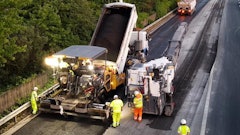
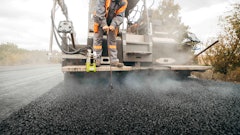
AMC's focus is paving, and much of the company's work involves smaller-end commercial paving jobs and residential driveways in the 150- to 200-ton size. The larger end jobs they take on are in the 1,000- to 1,500-ton category. The work is split evenly between residential and commercial customers. AMC also do a fair amount of repairs where the crew goes in and digs out the old asphalt, repairs any base problems, and puts new asphalt in.
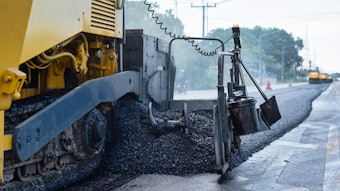
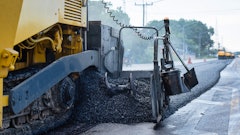
In addition to boosting sales through the purchasing of an asphalt plant, Foster was able to meet those growing demands with a Mauldin 1750-C paver that he bought at auction in early 2004, a decision he made when he knew the asphalt plant plans were coming along.
"Without expanding our crew, we've upsized our paver," he says. "It has allowed us to move a lot faster and pick up more work."
AMC uses a Rosco Vibrostat 3 for their breakdown roller and a Beuthling B-100 as their finishing roller.
"We use small rollers because we get into a lot of jobs that are really cut up, and those cut-up jobs are hard to get big rollers into," Foster explains. "The smaller rollers are great for a small parking area with curbing in it, places where you would have a lot of starting and stopping with the paver."
AMC is also involved with asphalt patching. They have an infrared patch machine, which Foster says is helpful to have around under the right conditions.
"If you have good material, the infrared is nice because you can heat the asphalt up to full depth, but I've found if the asphalt is bad or thin, it's hard to do anything with it. But for potholes and low and high spots, the infrared machine works great," he says.
Customers
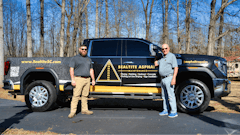
Foster says his company's uniformly painted and stenciled equipment has played a big role in garnering customers. He also advertises in the local newspaper and yellow pages, and strives to build relationships with contractors in his area who are involved in non-pavement services who he could do subcontracting work for.
Foster sees a trend with customers in the asphalt industry that everyone in the business will have to address, and perhaps some are dealing with right now.
"I think one of the main things we're going to see is tighter quality control specs — I think we'll see a lot of those on any public jobs we do," he predicts. "Already, some of the private jobs, such as chain stores, have pretty strict compaction requirements and things like that."
Foster also says he sees his customer base asking for more guarantees on the work they pay for. He says that as customers become more educated about the services asphalt maintenance companies provide, the more demanding they will be of guarantees and quality. But he doesn't mind an educated customer base.
"We try to educate our customers as much as we can. We send out a nice bid package with a folder, a cover letter, the bid sheet, a reference page, and an informational page about the service the customer requested — it helps us educate our customers on what we're doing and why we're doing it, especially when it comes to maintenance issues," he says. "A lot of people want to get some paving done, but when you're trying to sell someone on maintenance, that's different. You really need to educate them to make a good customer out of them."
Foster says the future looks bright for AMC. The acquisition of a hot mix asphalt plant has opened up opportunities that weren't available before, and the company looks to expand.
"Of course, we're going to grow as the market lets us," he says. "We eventually would like to grow into three paving crews and a couple of sealcoating crews."
The sealcoat operation
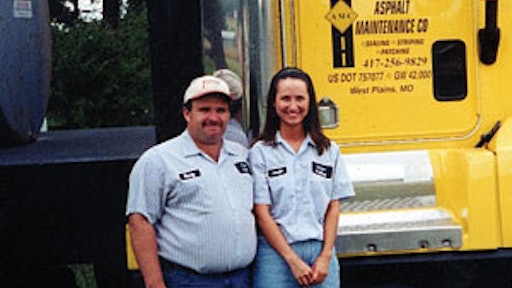
Asphalt Maintenance Co. was started in 2000, the same year Randy and Jennifer Foster married. Together, they've built the company into a profitable, growing business. While Randy controls the asphalt plant workings and superintendent Greg Collins runs the paving operations, Jennifer runs the sealcoating operation.
Jennifer works with another woman, Kim Parrish, who just started this season. In past years, Jennifer worked on the sealing crew, but this is the first year she is heading operations. The jobs are usually small — churches, residential driveways, small parking lots, and gas stations. When Asphalt Maintenance Co. takes on larger jobs, the paving crew helps out.
Jennifer explains that the sealcoating operation runs smoothly and simply. She and Parrish clean the pavement, apply primer where needed, do the edging, then spray.