Superpave is renowned for holding up to heavy traffic loads, and that's why the Kentucky Transportation Cabinet (DOT) specified its use on a rural two-lane highway, U.S. 127 near Albany, KY.
Though traversing a rural, mountainous area just north of the Tennessee border, heavy truck and local traffic indicated use of a durable Superpave mix. The jobsite is located only 16 miles north of the Alvin C. York State Historic Area, home of the Tennessee World War I hero immortalized in the 1941 Gary Cooper classic film, Sergeant York.
"It's not unusual to put Superpave on a rural road like this," says Doug Beard, who with his brother Roy, is co-owner of asphalt producer and contractor Gaddie-Shamrock LLX, Columbia, KY."It's a very heavily traveled highway, which runs way to the north and south of here. Superpave is used for high-volume type roads and is needed for the two-lane roads as well as the four-lanes."
PG 76-22 Superpave mix used
Under construction in May 2005, U.S. 127 in Clinton County was a four-mile, two-lane project, using a PG 76-22 Kentucky Class III Superpave mix. The leveling or"scratch"course also was a PG 76-22 mix."This is a little bit coarser mix than we normally run, for strength,"Beard says."The commonwealth has gone to certain projects with the 0.50-size mix to help maintain stability. It has a fair amount of fines in addition to the coarse aggregate."Straight virgin mix was used, with no RAP included.
"We put a half-inch 'scratch' level or leveling course down, and are laying asphalt approximately 1 3/4 inches loose, compacted to 1 1/2 inches of surface overlay,"Beard says. The road was not milled prior to the overlay, but the scratch course served to smooth the underlayer ahead of the friction course.
"The scratch course varies in depth," Beard says. "If there are lower spots we will thicken up the course to make it level." The surface course is being compacted from 94 to 96 percent compaction, which is being checked with a Troxler nuclear density gauge."We're trying to compact the mix at about 315 to 320 degrees F, and are using twin articulated rollers right up to the screed. The whole idea is to hit it as soon as it comes out from under the screed. We see a tender zone every now and then, but our experience generally -and on this project -is that we just don't see the problem that much."
Final compaction was achieved with a 10-ton static roller."Once the mat gets under 150 degrees you're not going to compact it any more,"Beard says."That back roller will put the finishing touches on, eliminating marks from the breakdown rollers, and smoothing the surface nicely."
About 5,400 tons of HMA were being placed on this project, including leveling course and friction course. "We're also adding a pavement wedge, a foot-wide shoulder with formed rumble strips,"Beard says. As the main line was 21 feet wide, the total project width was generally 23 feet.
Uses rubber-tired exclusively
Gaddie-Shamrock uses rubber-tired pavers exclusively."Most of the big tracked pavers are for larger applications,"Beard says."The rubber-tired pavers are especially useful in commercial work, because they permit us to move the paver without trailering it. We can ‘walk' it to the next job if it's reasonably close. It's a lot quicker than loading and unloading the equipment, it happens quite often."
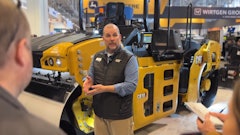
The contractor was using a new paver - the new 2116W with HF400E screed from Vögele America Inc. Introduced at ConExpo/ConAgg 2005 in Las Vegas, the 2116W has an overall width of 8 feet, 6 inches with maximum paving width of 21 feet, 6 inches, and replaces the former model 880 WB. The machine used by Gaddie-Shamrock has a maximum width of 15 feet, 5 inches. The HF400E screed, also new in 2005, is an electric-heat, 8-foot main screed with hydraulic-extendable front-mount extensions.
“We've had the machine for two and a half months, and it's one of the first in the country, and certainly in Kentucky,"Beard says."We put it into action the first week in April. The Vögele America line performs very well for us, with a Cummins engine that's very strong. It lays a very nice mat for us, very uniform with no ‘shadows'. It does a great job and the workers like it."
The 8-foot size is ideal for Gaddie-Shamrock's applications."Nearly all the work we do is in rural areas,"Beard says."The reason for buying an 8-foot machine is that a county road may start out at 10-feet-wide, go up to 14 feet, then drop down to 9 feet, all in one project. With the 8-foot machine you don't have to be using two or three machines just to get a county road paved."
While the firm has been a user of the Vögele America paver platform for nearly a decade, it took a close look at the 2116W before buying."We looked into the 8-foot machines and got prices from three different makers,"Beard says."Vögele America gave us a pretty good deal and stood behind what they sell. Our product support man is Nars Narsingh, who is very knowledgeable. He came out very early on and worked with us."The 2116W is one of six pavers owned by Gaddie-Shamrock.
“On this paver everything is very accessible,"Beard says."All the components are easy to get to and work on when you need to, although that's not something that would happen too often. And the steering wheel works great compared to joysticks; it slides from side-to-side if you need to change operator position. That's completely different from what the operators had before, and it took the operator a week or so to get used to it. But now that he has become more familiar he really enjoys working with it."
Prefers electric screeds
The HF400E screed on the Vögele America paver is not Gaddie-Shamrock's first, and it certainly won't be the last."I like the electric screeds because they eliminate the smoking and fumes of the older diesel-heat models,"Beard says."With the electric heat you have none of that. And the models are reliable; this model has an override system in which if you did have a problem with the electric heat going out on one section, it will heat the zone where the problem is until you can get it repaired.
“I would rather have the electric screeds,"Beard says."It requires less maintenance, and the diesel fumes and ‘blow-torch' under your feet are not there. I'm surprised that it's not been made mandatory for environmental reasons throughout the country."
A long-time family business, Gaddie-Shamrock has a history as colorful as its name."Our company was started over 50 years ago by my granddad, R.E. Gaddie, one of the first asphalt contractors in the Commonwealth of Kentucky,"Beard says."My father, Monie Beard, was his son-in-law and continued the business until he passed away six years ago. Now it's my brother and me."
Later, R.E. Gaddie joined forces with Shamrock Stone Co. to form Gaddie-Shamrock, now headquartered in Columbia. The firm now has two hot mix asphalt plants and three quarries operating out of Columbia, Burkesville and Albany, with a holding yard in Russell Springs. During the summer season employment will top out at about 126 workers. The firm considers itself a medium-sized asphalt producer and contractor, in a state where family-owned contractors continue to thrive.
About the 2116W paver and HF400E screed
The 2116W rubber-tired paver from Vögele America Inc. is versatile and productive enough for the smallest to the largest commercial jobs, but with the features and mat quality of a highway class machine.
The 2116W features operator controls that are standard across the Vögele line, including the sliding console and fingertip control of all machine functions. Various screed and feeder controls can be accessed in a number of locations on the machine to provide versatility in commercial paving applications. A Cummins QSB5.9T diesel engine provides 160 hp with four speed ranges and a top speed of 11 mph.
The Vögele portal axle drive provides true differential steering and the option of differential lock or modulated steer-assist pedals for better traction and handling. Hopper capacity is 190 cubic feet and overall length is 19 feet 4 inches with excellent operator visibility. The fume extraction system provides a comfortable environment for the operator and screed operators without inhibiting the view of augers and head of material while paving.
The 2116W is designed for productivity as well as a high mat quality and utilizes a full proportional feeder system. Ultrasonic material level sensors are standard for precise control. Augers are hydraulically adjustable from 4 to 9 inches above the ground. Three screeds are available for this model. The new Vögele hydraulically extendable front-mounted extensions, electrically heated HF400E with a standard paving range, without wedge-locked extensions, of 8 to 15 feet 6 inches, the Vögele HR400D, 8- to 14-foot hydraulically extendable screed with rear-mounted extensions and unique telescoping pre-strike offs or an EZ-IV 815 screed.
Its overall length is 19 feet 4 inches, with overall width of 8 feet 6 inches. It has a wheelbase of 92 inches with an inside turning radius of 12 feet 6 inches. It has a maximum paving width of 21 feet 6 inches.
The HF400E screed, also new for 2005, incorporates the same box frame design as the larger HR500E for maximum rigidity and strength. Two pair of 4-inch guide tubes in the frame carrier system are designed to maintain angle of attack and vertical adjust positions for improved mat quality. The Multi-function Intelli (MFI) control system with independent four-zone electric heating is programmable and self-diagnostic. The LED display indicates which zones are heating as it runs through the heating cycle.