Many steps can be taken to protect your equipment fleet investment. A good preventive maintenance program goes a long way, as well as using quality oils and lubricants. This is especially true with the Tier III engines and the current generation of on--road engines.
The American Petroleum Institute (API) introduced a new category of oil, CI--4 PLUS, to address the increased soot, acid and shearing stress placed on the oil by some of these engines. But there are also technologies that benefit all diesel engines by keeping the oil clean, and in some cases replacing depleted additives. These filtration technologies allow extended drain intervals while simultaneously increasing engine life.
Centrifuge removes small particles
T.F. Hudgins offers a centrifuge called the Spinner II. It uses centrifugal force to remove particles from the oil. Engine oil pressure pumps oil into the unit where a rotating bowl generates centrifugal force 2,000 times greater than gravity. This separates contaminants from the oil. Contaminants accumulate on the bowl surface as a solid cake, while clean oil flows out the bottom of the turbine.
Unlike conventional filters, the centrifuge doesn't plug up over time. "With a centrifuge, you start flowing at 2 gpm and you end at 2 gpm because you are not pushing fluid through anything," says Jim Weaver, executive vice president, T.F. Hudgins.
"We know that we can have a very positive effect on controlling soot and small abrasive particles in the oil," he adds. "We take the small abrasive stuff out that causes long--term wear."
Particle size is very important to engine wear. "The centrifuge is extremely efficient at removing particles that are 7 or 8 microns and less," says Weaver. "We can certainly remove down to much less than half a micron size particle."
Oil film thicknesses can be in the 1-- to 2--micron range. "If you are pushing a lot of particles through those two surfaces that are basically the same size as the oil film thickness, it acts almost like sandpaper and it wears the engine from the inside out," explains Weaver.
Due to the ability to remove fine particulates, the centrifuge can help extend oil drain intervals. "We recommend that you apply our product and then do oil analysis. Let oil analysis dictate how long you can go," says Weaver.
Marco Supply is a surface mining operation that has experience with the Spinner II centrifuge on its extensive equipment fleet, which includes four Cat 992G wheel loaders, five D11 dozers, several D9 and D8 dozers and 15 haul trucks. The centrifuge was first added during a test almost six years ago.
"We were looking at potentially extending our oil drains," recalls Chris Gobel, maintenance coordinator. "So I brought together Caterpillar, our local Caterpillar dealer, Mobil Oil Co. and Spinner [T.F. Hudgins, Inc.] to set this up, basically because our equipment was under warranty."
A combination of synthetic oil and the Spinner II centrifuge provided the solution. "The combination of the two has worked well for us," says Gobel. Marco Supply has successfully moved its drain interval out to 1,000 hours.
To compliment the longer drain intervals, the company has seen a dramatic increase in engine life. "We have one dozer here that has 27,800 hours on it," says Gobel. The Caterpillar dealer also took note when it performed updates to Marco Supply's 992G wheel loaders. "When they took our engines out, even at 16,000 hours on the engines, they found no wear. They called me and said, 'We would like to know what you are doing'."
Gobel claims that keeping the oil clean makes the difference. Marco Supply uses oil analysis to carefully track machine health. "Some of the criteria that we look at are the parts per million of iron that we are generating in an engine," says Gobel.
This provides proof that the Spinner II is keeping the oil clean even as it approaches the 1,000--hour interval. "Even at that rate, our wear metal limits will still be much less than the average 250--hour oil change," says Gobel.
From past experience, Gobel estimates that a Caterpillar 3508 engine will generate approximately 25 to 40 ppm of iron particles at a 250--hour change when using conventional oil. "Those numbers are not out of the ordinary," says Gobel.
But with the combination of synthetic oil and the Spinner II centrifuge, the particle count is much less than this, even at 1,000 hours. "Ten or 12, sometimes 15 ppm is the most we will see," says Gobel. "We take the wear metals out and therefore have less abrasion from the oil as it travels back through the engine again."
Soot generation really varies by the application. The dozers, by their nature, tend to generate more soot. "But with the Spinner II, we have been able to keep our soot levels at about a third of what other people were able to do," says Gobel. "We feel like that considerably increases the probabilities of our engines living longer."
Marco Supply now has a proven maintenance schedule. "We change the full flow filters at 500 hours and we also check our Spinners at that time," says Gobel. "At 250 hours, we sample our oil. We also sample it at 500 hours and 750 hours so we know where we stand."
The results indicate that oil drains could be extended further, but Gobel says he is comfortable with the 1,000--hour intervals. "On a 3500 Series Caterpillar engine, the payback would be in the first 1,000 hours," claims Gobel. This includes the increased availability and reduced oil and service time costs.
Cost of the Spinner II varies by size. For the standard 2--gpm unit used on engines in the 250--hp range, Weaver estimates the installed cost to be in the area of $650 to $750.
System cleans and replenishes
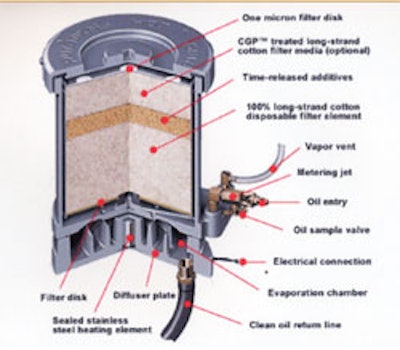
PuraDYN Filter Technologies Inc. offers a complete bypass system that filters the oil and replenishes the additives. Oil enters this system and passes through the replaceable filter element, where total base number (TBN) additives are replenished. Long--strand cotton fibers are compressed to resist channeling and remove contaminants down to less than 1 micron.
The filtered oil then enters a heat evaporation chamber where fuel and water vapors are evaporated and vented, removing components that contribute to generation of acid in the oil.
"We normally run about 6 gal. per hour," says Kevin Kroger, president, PuraDYN Filter Technologies Inc. "There is enough going through our bypass filter that it literally keeps the full--flow filter clean."
The size of the particles that are left typically will not harm the engine. "Because of the fine filtration, we are able to filter below the clearance gap on most engines," says Kroger. "Let's say the clearance gap is about 2 microns, which it is on most engines. We are filtering below 1 micron. Therefore, any solid contaminants passing through the system should be able to pass through the clearance tolerances on the engine. You reduce the amount of wear on these surfaces."
This system successfully removes soot particles from the oil before they can cause excessive wear. "When soot itself actually enters the oil, it is submicron," says Kroger. "But as time progresses, it coagulates with others. Then they start growing." Since soot is basically made up of carbon, a very hard substance, these particles can cause a lot of damage.
A full--flow filter will catch these soot particles once they grow to 5 to 10 microns. "Remember what I said about the clearance of our engine at 2 microns? Now I have a 5--micron particle going through there," says Kroger. "Our system is able to remove that particle before it gets to that size."
Richard Ford, co--founder, PuraDYN Filter Technologies Inc., reports that this system has been installed on many Caterpillar ACERT engines with success. "We are keeping the soot under 1%. They were changing oil before at 350 hours and now we are taking them out to 1,050," he states. "They are just changing both the synthetic full--flow filter and our filter."
For engines in the 250-- to 500--hp size range, Kroger estimates the installed cost to be between $500 and $600. "It would run you somewhere in the neighborhood of about $20 to $25 for the replacement filter," he says. "In the off--highway side of the business, payback is real quick. We have seen return as short as six weeks and as long as a couple of months."
Road Machinery, a distributor in Arizona and New Mexico, set up a mining customer, BHP Billeton, with the PuraDYN system to solve a contamination issue. This was a severe application, and based on oil analysis the oil had to be changed every 300 hours. "The oil samples they were getting were just so ugly, it was time to change the oil," recalls Eric Hirengren, Road Machinery.
After Road Machinery installed the PuraDYN system, BH Billeton was able to extend its oil drain intervals out to 900 hours. "I am comfortable that they can go 1,500 hours, but they are happy with what they have done," says Hirengren. "They are now doing one oil change where they would have done three oil changes."
The maintenance procedure is pretty straightforward. "At the 300--hour interval, when they were normally doing the oil change, they change just the PuraDYN filter and add makeup oil," says Hirengren. Full--flow filters get changed when the oil gets changed.
The amount of wear particles in the oil has been dramatically reduced. "I get oil sample reports every time they do a sample," says Hirengren. "This will take the wear metals down to 1, 2 or even 3 ppm."
Payback was rather quick. "On these units out here at the mine, they paid for themselves by the time the second oil change was due," says Hirengren. "You have to figure the cost of the oil, the cost of your filters, your person's time that is doing the service and then getting rid of the waste oil."
Waste oil disposal can be a challenge. "You are generating far less waste oil," says Hirengren. "The EPA is noticing that they are not generating as much waste oil."
The potential oil savings are substantial. The U.S. Department of Energy (DOE) conducted an ongoing study with the PuraDYN system on eight diesel engine buses. As of June 2004, the buses had travelled 473,192 miles without an oil change. This avoided 39 oil changes, which would have consumed 343 gal. of new oil and generated the same amount of waste oil. The report estimates that if all federal vehicles used this bypass filtration system, 1.7 million gal. of oil would be saved annually.
In the test, regular oil sampling was performed to ensure the oil met critical parameters and to determine the proper drain interval. The buses each averaged 69,946 miles on the unchanged oil. Since the regular service interval is 12,000 miles, the interval was extended 5.3 times.
If the oil drain interval was extended to four times, 80% of the regular oil changes could be avoided. The preliminary data suggests an 80% oil savings rate in heavy vehicles with the bypass filtration system.
Numbers like these are hard to ignore. You may be able to generate a lot less waste oil, increase uptime, save labor and save a lot on the purchase of new oil all at the same time with a minimal investment.