
Cracks are going to happen in asphalt pavement, and when they do it's your job to stop them from deteriorating the surface and creating potholes. Debris and moisture are the two biggest enemies facing the success of a crackfilling or cracksealing job. Proper preparation of a crack will extend the life of the crack repair.
To seal or fill
Crackfilling and cracksealing are two different techniques. Many people in the industry use the terms interchangeably, but there are important differences to keep in mind when considering these two methods.
In short, crackfilling is performed on cracks with little movement, meaning they don't open up in winter and close in the summer. These cracks are generally longitudinal (cracks that run up and down a road), block cracks, and some closely spaced transverse cracks.
Cracksealing is often performed on "working cracks," or cracks that get wider in the winter and smaller in the summer. These are often transverse cracks, or cracks that run across a road.
"Basically what we're trying to accomplish with cracksealing is a 5- to 7-year lifespan sealing job with a very flexible, elastomeric sealant. With crackfilling we're trying to get a 2- to 5-year lifespan, basically waterproofing and gluing that usually narrow crack," explains Mark Manning, vice president with Crafco Inc. "Crackfilling is more of a maintenance issue; cracksealing is more of a preservation function."
Manning says cracksealing should be done on pavements with fairly minimal cracking, less than 20%. When the concentration of cracks exceeds 20%, the damage is more likely due to pavement deterioration, such as oxidation or fatigue cracking.
"All pavements will crack sometime or another, and if you catch the cracks when they're less than 20%, then you're more likely to be able to seal them and have the procedure last 5 to 7 years," he says.
Brad Dunn, vice president of sales at Cimline, says cracksealing is best done early in the life of a pavement, in the first 1 to 3 years.
"You'd probably want to follow up every other year because you probably will have some secondary cracks that form off the primaries. The real key thing is the earlier the better," he says.
Cracksealing involves routing out a crack, which will give you intact asphalt sides for the sealant to adhere to. Crack routers are walk-behind machines that use carbide cutters to form a reservoir for the crack sealant. The configuration of the reservoir depends on how much your crack moves.
"You have two routing configurations — one is wider and narrower, and that's to accommodate 50% or more movement. And then you have a traditional 1 to 1 configuration which would be about a half-inch deep and a half-inch wide, for 50% or less movement," Manning explains. "That wide narrower one can go out to 2 inches wide to 3/8ths of an inch deep. That would be used in the very cold climates where the cracks are moving tremendously, like 100% or better."
Other common routing configurations are ½ inch by ½ inch, ¾ inch wide by ½ inch deep, and ¾ inch by ¾ inch.
Cleaning
Cleaning for a crackfill is very basic. Since the routing step is skipped, you need to find another way to remove dirt and debris from the crack.
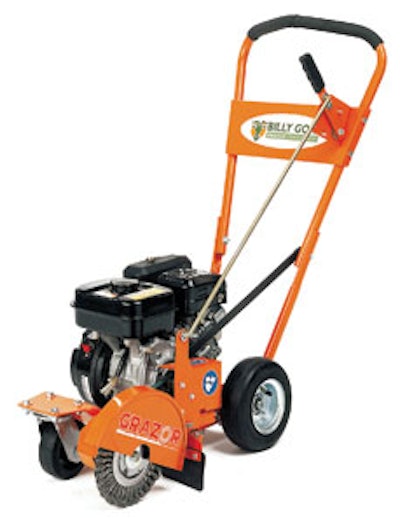
Some contractors prefer to employ the help of a wire brush in their crack preparation routine. These machines utilize a small motor that powers an upturning wire brush to rip vegetation and debris out of a crack. It also burnishes the sidewalls of the crack to help improve sealant adhesion.
"Billy Goat constructed the Grazor with heavy-duty caster wheels that swivel a full 360 degrees, so you can maneuver the Grazor with ease as it rips through ragged cracks at the rate of 5 feet every 15 seconds," says Melinda Thurston at Billy Goat Industries, Inc.
Whether you've routed or wire brushed a crack, you will need to use air to further clean. Backpack blowers and pavement blowers are common tools that contractors use for crackfilling and sealing, but Manning suggests higher-powered air.
"We like to see at least 100 psi of air to get the dust out of the little voids in the asphalt," he suggests.
Portable and stand-alone air compressors are available, as are air compressors integrated with the melter-applicator unit. In some cases, you may want to take a step further than air.
"Most cracks fail because of debris or moisture, so the next thing you might want to consider is a heat lance or a hot air lance," Dunn says. "Now you're not just running air but heated air, so you can actually heat the crack surfaces so the sealant adheres better and you're drawing any moisture out of the crack. This is especially effective in the mornings with dew, to get that moisture off the roadway before the sun comes up and dries it."
In areas where PM10 requirements restrict contractors from using blowers, Crafco offers the Crack-Vac as an alternative option. Manning says he sees this machine commonly used in crackfilling applications since cracksealing is most often performed on highways where these air restrictions wouldn't apply.
The care you put into crack preparation and the tools or combination of tools you use will affect the success of your crack treatment. Use your best judgment to decide what's best for your job.
The tested benefits of cracksealing
Of unsealed cracks, 75-80% developed additional cracks and potholes. Of sealed cracks, 1% developed additional cracks and potholes.
—Utah DOT
Unsealed cracks developed multiple cracks and spalling. Sealed, transverse crack condition remained stable with no spalling or secondary cracking. The conclusion: cracksealing retards deterioration and extends pavement by at least 4 years.
—Ontario Ministry of Transportation
For every $1 spend on pavement preservation maintenance programs, $4 to $10 was saved in rehabilitation. The earlier the preventative maintenance was applied, the lower the loss and higher the benefits.
—Montana DOT
Rehabilitation or reconstruction costs about 14 times as much as pavement preservation projects per lane mile over the life of the project.
—Michigan DOT