Since water covers nearly 80% of the earth's surface, chances are good that at some point you'll run into enough of it on a jobsite that you'll need to get rid of it.
"Sometimes we find water in places where we'd rather not have it," says Radu Murgescu, construction and mining market manager at ITT Flygt Corp. Basements are one place; excavation sites are another. At times, water can be your worst nightmare. "This is where pumps come in."
A selection of pump types
Contractors have a variety of pumps from which to choose. Some of the most common types used on construction sites include trash pumps, diaphragm pumps and submersible pumps.
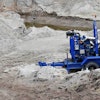
One of the most versatile of the group is the trash pump, especially one that is trailer-mounted, says Jeff Cooper, district manager, Pump & Power, United Rentals, Inc. "This type of pump is easy for contractors to move around and relocate where needed," he says. "Plus, most models will allow some degree of solids to pass through the pump. So these pumps also allow contractors to pump a variety of densities ranging from clean water to sludge."
These types of pumps typically have high suction lifts and relatively high discharge heads, as well as a simple design with few parts. However, they are not a good choice for pumping thick mud. And when there is only a small quantity of water to pump, priming will be lost.
Trash pumps are available in either wet priming or dry priming versions, explains Joe Belli, product marketing specialist with Thompson Pump & Mfg. Wet priming pumps require that the casing be filled with water before operation. Dry priming pumps utilize an external priming system, usually a compressor or a vacuum pump, to assist in purging air from the suction line of the pump system.
This allows the pump to achieve prime without filling the casing with water before operation. This maintains prime by assuring that an unknown influx of air will not reach the pump casing, causing cavitation and affecting the pump performance.
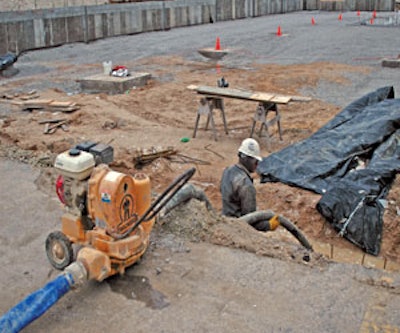
When water begins to thicken with dirt and debris, you may want to consider a diaphragm pump, which is designed to handle muddy water, sludge or any liquid with a high percentage of solids.
"One of the best features of the diaphragm pump is that it can run dry indefinitely without damage," says Belli. "These pumps are ideally suited for the construction industry, as well as for municipal and industrial applications where dry priming pumps are required."
Diaphragm pumps handle slow seepage or full capacity with each stroke. These pumps also keep jobsites dry when there is a small inflow. Another plus is that the diaphragm and valves are typically easily replaced.
Drawbacks include less capacity than a self-priming centrifugal pump for the same investment, and limited to low discharge pressure.
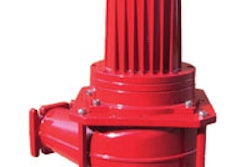
Submersible pumps provide instant priming and are capable of moving large amounts of water with high discharge heads. They're a good choice when you need to pump fluids that are a considerable vertical distance from the discharge area, such as in sewers, pits and mines.
They're also relatively low-maintenance machines that can even run dry. They do not require constant attention and you don't need to worry about flooding or freezing conditions. However, they are not designed to pump thick mud.
Another type of pump that is gaining in popularity is the well point pump. Initially developed for areas with high ground water tables, such as Florida, these pumps are now being used in states as far away as Rhode Island and Michigan. "Regionally speaking, the well point pump is the most commonly used pump for ground water dewatering tasks in Florida," says Belli. "These are typically used before excavation begins to remove any underground water. This makes the jobsite dry to allow for excavation or any other underground work to begin."
Evaluate the jobsite
To determine which pump is best for your situation, evaluate the jobsite conditions carefully. "By knowing the application completely, a contractor can choose a pump from a particular family, which has many different sizes and capacities," says Belli. "Focus on application first, size of pump second."
"Many of today's pumps are designed to be as effective as possible in wide-ranging jobsite conditions," notes Cooper. But there are factors that can influence your choice of pump, including the availability, or lack of, power; the condition of the intended discharge area; and whether or not the pump can be safely placed near the water or material being removed. "Obstructions are another concern," he continues. "Ask yourself what obstructions exist along the pathway of the discharge hose or pipe."
Belli cites a few additional factors, including the location of the pump, type of fluid being pumped, noise concerns and desired output/expected results.
The height of the pump in relationship to the liquid being pumped can affect suction lift -the vertical distance from the top of the free state of water to the eye of the impeller. Be especially mindful of this at higher elevations, where physics and atmospheric pressure limit the maximum amount of suction lift. If the liquid being pumped is located a long way from the pump and you can't move the pump any closer, you may want to consider using a submersible pump. It can be inserted directly into the water to eliminate any suction lift limitations.
Different types of fluid being pumped also affect which type of pump is the best choice. "Handling clear water vs. solids and fibrous and stringy materials may mean the difference between a solids-handling trash pump or a non-solids-handling pump," says Belli. "Acidic or salty fluids may require the use of a pump made from a material other than that which is standard." Fluids with higher temperatures can also be a concern because they can cause cavitation due to the vapor pressure of the fluid's high temperature.
While noise concerns relate more to heavily populated residential areas, business districts, hospitals and school zones, the Contractor's Pump Bureau has instituted an unofficial standard for acceptable noise levels for pumps and pumping equipment. "Studies have shown that prolonged exposure to high decibel levels of noise can damage your hearing," says Belli. "More and more cities across the United States are demanding additional sound attenuation on construction equipment to reduce the noise levels when they are in operation. The same goes with pumps."
If time is of the essence, you will want to evaluate the desired output/expected results to ensure you have a large enough pump to move fluid in a timely fashion. Belli relates that a 3-in. diaphragm pump moves about 90 gpm (129,600 gal./day), while a 6-in. wet prime trash pump moves about 1,500 gpm (2,160,000 gal./day). "The diaphragm pump will take longer to dewater than the wet prime trash pump and may not be suitable to meet the deadline," he points out. "It also raises the question of budgetary monies secured for a job. Using a pump that produces less capacity and takes longer to dewater may overdraw the fuel budget."
To help in sizing the pump to the job, each pump manufacturer publishes detailed performance data on its equipment models. Cooper encourages evaluating these specifications against your requirements. Factors you will need to know include viscosity of the material and the desired flow rate. You will also want to know how much distance exists between the pump and the discharge point, and the change in elevation between the material being pumped and the discharge point. Other factors include the amount of water that needs to be removed (expressed as gpm), the static head in feet (i.e., the difference between the current water level and the desired water level) and the type and amount of power available.
When selecting an electric submersible pump, check the power available from the source -either grid or generator. It must be powerful enough to start and run the pump(s) motor. Also make sure that the pump motor voltage rating matches the power source voltage.
Is it better to rent or buy?
Cooper relates that pumps 4 in. and larger are most often rented for short-term projects. "Pumps of all sizes can be high-maintenance items that require frequent cleaning and maintenance," he says. "Required pumping accessories such as suction hose, discharge hose or pipe, elbows and valves will vary by jobsite. For this reason, many contractors prefer to rent pumps rather than cover the costs of owning them, even if they use pumps regularly."
"The advantages of renting are plentiful, as long as the rental doesn't last longer than planned," adds Belli. "For one, construction crews are not responsible for repairs and maintenance on a rented pump. Contractors also don't have the costs of regular maintenance and repairs plus storage."
But there are benefits to buying as well. "If a contractor purchases a pump, he then has something in his arsenal of equipment that is capable of pumping wherever and whenever he needs it," says Belli. "If a contractor chose to purchase a versatile, multi-application pump, he would be even more capable of dewatering jobsites."
Match the pump to the job
To determine the best pump for the application, Joe Belli, Thompson Pumps, identifies these factors as required information: