During the past 26 years Carl Covington has worked for Dunn Construction, he's been part of the asphalt production transformation this 125-year-old leading Southern road contractor has undergone to maintain its competitive edge in a market that continues to put new and improved asphalt mix designs to the test.
And like the transformation Dunn Construction made from railroad construction to road construction in the early 1900s, improvements in asphalt production have helped the company meet customer demands for quality bituminous products.
Dunn bids and serves as general contractor on projects including industrial roads, storage yards, parking lots, subdivision, municipal streets, airport taxiways and runways, and interstate and other highway construction.
Dunn's road construction is supported by six asphalt production facilities in the northern part of Alabama. The company has expanded its operation through Dunn Roadbuilders, a sister company serving the east central and southeast sections of Mississippi.
The company's quality initiatives reflect the ever evolving technology Dunn addresses to meet the increasing demands of its customers. While "hot, black and sticky" were used to define quality bituminous concrete of the past, "Superpave, smoothness, polymer additives, restricted zones, fine aggregates, angularity, pay factors, warranty work and certification" are some of the terms used to describe today's quality bituminous concrete. In the past 10 years, a national research effort has been underway to determine and implement methods of designing, producing, placing and testing bituminous concrete. The objective of the research is to produce longer lasting, better performing bituminous concrete pavement. Dunn has responded, by not only investing in state-of-the-art equipment and plants, but also by expanding its Quality Control/Quality Assurance Division. Dunn's goal is to produce quality bituminous concrete pavements that exceed the requirements and expectations of its clients.
From the opening of its first asphalt plant in 1915, Dunn recognized the vital role it would play in the construction of quality asphalt roads throughout the Southeast.
From batch to drum
When Covington began his career with Dunn in the late '70s, drum plants characterized the company's asphalt production capabilities. But as Covington worked his way up from laborer, to plant foreman, to plant manager and now Southern Division manager, he helped the company integrate new drum production technology that improved productivity levels and also allowed Dunn to successfully produce the emerging mix designs that characterize the quality bituminous products of today.
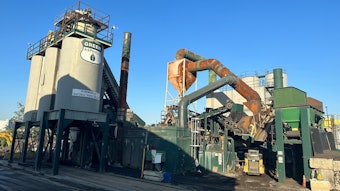
One particular Dunn asphalt production facility typifies the continuous improvement business philosophy of the company is the East Thomas, AL 300-tph Gencor UD300 Ultradrum plant, which was brought on-line in 1999. The Ultradrum counterflow design incorporates an isolated mixing section located behind the burner, so there is no chance of liquid asphalt coming in contact with the burner flame. The plant is equipped with an Ultra II burner, which is extended well inside the dryer for maximum efficiency and contact with the wet aggregates. The East Thomas plant is equipped with two 200-ton storage silos and replaced an old batch plant located at the facility since 1978. The upgrade not only allowed the facility to increase production from 160-170 tph (batch plant capacity) to 300 tph, it also provided improved technology required to produce some of the new mix designs, like open graded friction course and Superpave, which the Alabama Department of Transportation was starting to specify on many of its road projects.
Some modifications made
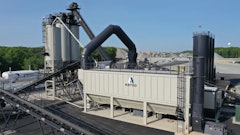
Knowing the direction DOT and other agency customers were headed in specifying new, more challenging mix designs in order to achieve more durable and better performing pavements, Dunn made some modifications to its new East Thomas plant. Heavier motors were installed on the mixing drum to accommodate mix designs with a higher aggregate content. Also, the plant was equipped with a larger baghouse, the CFS-151, to accommodate the additional dust created by producing the new mix designs, and to improve airflow to reduce excess moisture content in the aggregate in the spring and allow for increased production during the summer.
"If you want to maintain the temperature required to produce some of these new, challenging mix designs, you have to have a system that maintains adequate airflow through the drum," Covington says.
"The system is designed to handle the additional moisture content they have in their aggregate during the spring and also allows them to increase production up to 350 tph during their summer peak paving season," says Charlie Bartell, Gencor regional sales manager who helped set up the plant.
The modifications have proved essential in maintaining the output and quality of mix the East Thomas plant turns out. The plant produces approximately 300,000 tons per year, with 85 percent of its production used to support two Dunn paving crews working on major interstate and state highway projects in and around the Birmingham area. With a typical OGFC mix, the plant efficiently operates at 275 tph, and Covington attributes the plant's efficiency to a larger baghouse that maintains good airflow through the drum, which maintains the mixing temperature required to produce mixes like OGFC. Since the OGFC mix is a primary mix design required by many Alabama DOT projects, maintaining the right temperature during mixing and not allowing the temperature to get too hot is crucial in producing a mix that's acceptable for DOT projects.
"With OGFC mixes there tends to be more heat generated during the mixing process, and the baghouse we have at this plant does a good job of moving air through the drum and preventing the burner from overheating the mix," Covington says. "At other plants where too much air can be a problem with the mix being produced, we just damper back the airflow through the drum. But at this plant, we want the extra airflow produced by a larger baghouse to prevent the mixes from overheating.
"We've been running this plant 48 weeks a year since we put it into service and I don't think we've ever had to change the bags in the baghouse," he adds. "It's such an efficient airflow system, that with the exception of our scheduled two-week shutdown over the Christmas holiday, we're generally producing asphalt at that plant unless the temperature drops below 35 degrees F. When the temperature drops that low, it's hard to get mix out to a project at the temperature required for compaction, even if you can still achieve the desired temperature at the plant."
Day-to-day reliability
Max Taylor, plant foreman at the East Thomas facility, says maintaining the plant's reliability has required little in the way of major overhauls or upgrades. Typically, Taylor will schedule maintenance work during the winter (usually at the end of January) to take care of major repairs and upgrades. This year, he installed a new set of scales and made repairs to the slat conveyor system, as well as replaced some flights in the drum.
"It's been a very reliable plant," Taylor notes. "We run about 3,000 tons a day out of the plant and that's with two storage silos and five cold feed bins. With the different mix designs we handle on a daily basis, an extra silo and a few more cold feed bins would be nice, but we're still able to maintain good productivity with what we have."
The biggest challenge Taylor faces on a day-to-day basis is maintaining a proper temperature when mixing some of the designs being specified.
"You have to keep and eye on each job you're producing, especially the tonnage your producing, because the temperature can fluctuate quite a bit," Taylor says. "It's not easy to control the heat with some of these mixes because they consist primarily of tar and rock, and not a lot fines. If the heat drops too much from time a load leaves the plant and arrives at the project, the state will reject the load. And if the temperature is too high during production, then you run the risk of segregation. So you have to constantly monitor the temperature. Our goal is to send the mix out at about 325 degrees in order to achieve the compaction desired on the project."
Taylor relies on samples taken from the trucks before they leave the plant, as well as samples taken by technicians out on the project to make adjustments to asphalt content and temperature when producing mixes that must meet tight agency specifications.
"It's a lot different producing asphalt today than what it was years ago," Taylor says. "You have to stay on top of it all day long, and you have to make sure your equipment is in good working order. Fortunately for us (at the East Thomas plant), the company invests in good equipment and takes care of what needs to be fixed."