It was just 11 years ago that a couple of entrepreneurs in central Florida took a deep breath and jumped into the road construction market with just one dozer and a single employee. Today, P & S Paving Inc. of Daytona Beach, FL has 240 full-time employees who operate millions of dollars worth of state-of-the-art hot-mix-asphalt (HMA) production equipment, as well as sophisticated milling and paving equipment.
"We might have started out small," says Tim Phillips, president of P & S Paving, "but today our annual sales are more than $65 million. We're proud of that record."
P & S Paving operates within a 60-mile radius north, west and south of its Daytona Beach asphalt production facility.
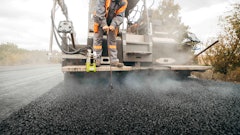
"When we started, we were just doing site work," Phillips recalls. "All of our paving work was sub-contracted to other companies. But in about our fourth year, we realized that we needed to make our own hot mix and lay it. That's when we went out and bought an old 1956 Cedarapids batch plant."
Over the next four years, the firm continued to grow. Phillips says his company was producing approximately 100,000 tons of hot-mix per year with the old batch plant when he and his brother, Todd, began to consider a more modern, more productive plant.
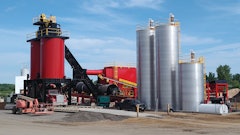
"We wanted to continue to grow in this market area," says Phillips. "So we looked around at the market until we found what we thought was the very best asphalt plant we could buy — an Astec Turbo 400 Double Barrel drum-mixer plant."
About the only decision left to make after purchasing the new plant was where to locate it without disrupting the company's entire HMA operation. After some discussion, the owners decided to put it right where the old batch plant was located.
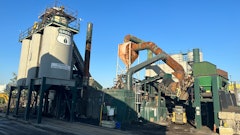
"We took that old batch plant down and installed the new Astec plant right in its place," Phillips says. "The control house was only three years old, so it stayed in place. But we removed everything else — down to the original dirt — and built a new plant from the ground up. Astec's engineers helped us with the basic planning. And we handled the installation ourselves."
P & S Paving personnel and Astec personnel stayed in close touch during the installation. And the timing of the installation was truly remarkable: They started taking down the old plant in the middle of November 2001 and started making mix in the new plant by mid-January of 2002.
"It was really kind of neat," says Phillips. "We took down a 1950s plant and put up a totally modern 21st Century plant in its place!"
Plant performance
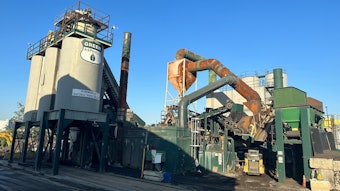
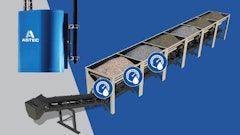
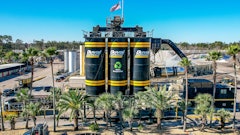
The centerpiece of the new plant is a relocatable Astec Turbo 400 Double Barrel plant that Astec has rated at 400 tph. There is also a relocatable cold-feed system with five 10 x 14 foot compartments, plus a one-compartment recycle feed system. Particulate control is provided by an Astec baghouse with a horizontal cyclone. The initial installation also included one 200-ton Astec New Generation storage silo. Another identical storage silo was installed a few months after the new plant was brought on-line.
The new plant's asphalt-storage needs are handled by a 30,000-gallon Heatec liquid asphalt-cement (AC) tank that is split in half to accommodate two different blends. The tank has a full 6 inches of insulation. Heat for the liquid AC is supplied by a Heatec helical coil hot-oil heater. The installation also has a stationary 15,000-gallon above-ground storage tank for fuel oil, as well as a 1,000 gph preheater for heavy fuel.
Phillips says P & S Paving has been successful in obtaining quite a few paving contracts for Florida DOT work in recent years. He says much of their work has involved HMA production calling for high percentages of reclaimed asphalt pavement (RAP).
"On the average, we're running 30 to 40 percent RAP in our mixes," says Phillips. "But we have the ability to go up to 50 percent in some of our base courses."
Phillips says the new plant is working out well. "We're very pleased," he says. "We know we can far exceed our old daily production rate with this new plant. So far, we have logged a rate of 1,600 tons per day — and we're looking forward to being able to hit more than 2,500 tons per day on an upcoming project. Frankly, we think that will be phenomenal productivity."
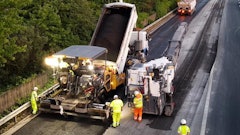
An extensive lighting system was also installed to allow P & S Paving to extend its workday to meet market demands. "We have various DOT jobs that require night work," says Phillips. "The DOT is moving more and more toward mandatory nighttime work. That's the reason why we went ahead and set up the new plant so everything is visible to us during nighttime hours."
Phillips says that during startup, there were a few minor glitches that had to be taken care of. They all wondered if Astec's service and support were going to be as good as other producers had said they were. But their questions about that subject were quickly answered.
"When the new plant was being started up, we had a few pieces or parts that didn't perform the way they should. Whenever that would happen, we'd call Astec and let them know about it. And the next morning, the part we needed was sitting here, ready to be installed. It might have been driven here all they way from Tennessee in the back of a pickup truck. Or it might have been flown in overnight."
The new plant quickly proved to be the right decision for P & S Paving.
"We think this plant gives us an edge on the competition in our market area," says Phillips. "We're more competitive as far as being able to use higher percentages of RAP. We use less burner fuel. We use less electricity; and increased storage capabilities. In today's market, whatever edge we can get is valuable.
"There are so many producers around the United States who have older asphalt plants and they are ready to upgrade or renovate their operations," he continues. "They can take a look at us and learn a lesson: Here's what somebody has done in just a few short years. We've gone from an old, rundown batch plant to a new, high-production plant."
P & S Paving produced 400,000 tons at the plant in 2004. Recent upgrades to the facility included a larger baghouse and the addition of a state-of-the-art closed-loop RAP-processing facility.
"All of this gives us a slight edge on our competition," Phillips adds. "We like to stay on the cutting edge with technology and we're convinced that approach has helped us achieve the continued growth we've experienced over the years."
Performance backed by service, training and customer support
Before buying the Astec Turbo 400 Double Barrel plant, P & S Paving Inc. considered other possibilities, but Astec's service, education and training were all big factors in the buying decision.
"The training facility they have in Chattanooga is very impressive," says Tim Phillips, company president. "I was there for one of their three-day executive seminars. It was very informative. I learned a lot of things — and we've implemented some of what I learned into our current operation.
"One of the things they stressed during the first day of the seminar was a thing they called 'processing RAP' and the cost savings you could rack up with this procedure."
Phillips was referring to a special procedure for crushing and sizing the RAP so that it will be of a constant consistency — which in turn should improve the quality of the final HMA mix.
"I was so impressed with that part of the seminar," says Phillips, "that I called back to the plant before the first day was even over, and told them to start doing it immediately. Some of the people at the seminar were shaking their heads like it wouldn't make much difference, but we're running higher percentages of RAP now, and the quality of the asphalt is far superior to what it was under our old procedure.
"That tip about processing RAP will save us a lot of money in the future," Phillips notes. "I know it will save us more than $100,000 a year, and it might even save us twice that much."