
All contractors have encountered the client who was unhappy with the finished job because he and the contractor weren't on the same page when discussing the actual work. This happens less often in pavement marking or sealcoating, but it can easily happen when contractors begin bidding pothole repair work. That's because repairing a pothole is somewhat of an inexact science. Factors to be considered include not only the client's budget but the size of the defect, the need to get the pothole repaired quickly, the quality of the surrounding pavement, and the expectation of how long the repair is going to last.
But make no mistake about it: Pothole repair is a staple of many pavement maintenance contractors' services. Pothole repair is a great way to introduce your firm to new customers, gives you an opportunity to showcase yourself by performing well on a small job, gives you an "in" to return, and in many cases enables you to sell future pavement restoration work right on the spot. Plus, pothole repair can help you keep your crew busy and keep some cash flowing throughout the slow winter months and give you early season work to do in the spring when weather is not conducive to other types of projects.
In fact, research conducted for the Federal Highway Administration (FHWA) has determined that even though potholes need to be repaired during the winter, "better climatic conditions increase the life expectancy for patches placed in the spring."
"The goal of spring patching operations should be to place patches that last as long as the surrounding pavement," according to FHWA's Materials and Procedures for Repair of Potholes in Asphalt Surfaced Pavements. "Patches surviving as long as the surrounding pavement reduce the cost of the overall operation by reducing the amount of labor, equipment, and material needed."
Anatomy of a pothole
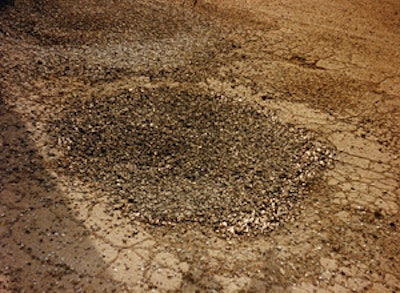
Potholes result when the pavement or the base or subbase beneath it cannot support the weight of the traffic. This is true whether the pavement is a parking lot or a roadway. And while traffic always has an impact on a weakened pavement, the main culprit in creating potholes is moisture. Any time there are cracks in the surface, moisture has access to the subbase.
As the material beneath the pavement becomes moist, it loses its strength and can shift when traffic drives over the surface. This weakening of wet material beneath the surface has a greater impact as temperatures drop because the wet material expands when it freezes, pushing the pavement surface up, then thawing and contracting when the temperature rises.
After enough of these freeze-thaw cycles occur a gap is created between the asphalt pavement and the base, and traffic driving over the surface breaks the pavement into the depression, creating the beginnings of a pothole. The longer this pothole is left untreated, the more extensive is damage to the surrounding pavement and the faster the overall pavement deteriorates. So it is cost-effective to repair potholes as soon as they occur.
While potholes are probably unavoidable it's important to realize that potholes can be minimized through proper pavement design and proper pavement construction. A regular maintenance program that involves crack repair and repair of other defects, sealcoating, and timely overlays, can help hold the number of potholes to a minimum.
Select appropriate repair
Over the years the paving and pavement maintenance industry has developed a number of methods to repair potholes, and matching the method to the client's expectations is essential, whether the client is a property manager or a municipality.
"It's important to recognize the difference between a pothole patch and restoration. The important thing is to make a distinction between pothole repair, which is temporary, and restoration, which is permanent," says Michael Groh, president of Pavement Consulting Inc. "Frequently the client just needs to get it fixed and the quickest way is to throw some mix in the hole."
Groh tells his property manager clients that they need to keep two things in mind when considering pothole repair.
"The site conditions need to be examined and taken into consideration, and the expectations of repair should be reflective of the site conditions," Groh says. "The client needs to have a reasonable expectation for pothole repair, so he needs to understand how that repair fits into the surrounding pavement and how long the options he's considering can be expected to last."
The reasoning behind Groh's recommendation to his commercial clients is simple. To get the most bang from their pavement maintenance dollar property managers don't need a pothole patch that is in better shape than the surrounding pavement. So while they certainly need to repair a pothole, they might not want to repair it to the best degree possible.
"A lot depends on the condition of the site," Groh says. "A repeated temporary patch is often the best approach if the surrounding pavement isn't worth a greater repair investment. If that is the situation the contractor should point out to the owner that more extensive repairs are necessary when weather conditions allow."
Safety often dictates
In most repair instances the most important considerations for a property manager or city is the safety of the public, whether drivers or pedestrians, and the safety of the crew. Whether the pothole is on a parking lot or roadway, unrepaired potholes can lead to liability concerns from people swerving to avoid them, losing control of a vehicle after hitting them, or pedestrians stumbling into them. The more extensive the repair, the longer it takes to complete, the more the property or road is disrupted, and the longer the crew is exposed to the dangers of traffic. So most often the goal of the customer is simple: Get it fixed as soon and as quickly as possible.
The most common quick-fix pothole repair technique is generally considered the least effective, with the lowest up-front cost, and perhaps the highest long-term cost: the "throw-and-go" method. This approach uses a local cold mix asphalt thrown into a pothole, piled slightly above the surface.
Because it only involves dumping cold mix into a pothole, leaving the traffic to provide any compaction, this method is still used frequently because it's the most productive approach. Contractors and city crews can fill a large number of potholes in a day. But the mix doesn't last long in the hole. In fact, traffic often pulls the uncompacted mix out. The advantage of this process is the hole is filled quickly and the problem is solved, if only for a brief time, and crews are exposed only briefly to traffic dangers.
A slight improvement over the "throw-and-go" approach is "throw-and-roll," in which the cold patch is compacted and which FHWA studies say "should be considered a superior alternative to the throw-and-go method."
The high-performance option
A significant step above both those methods is use of specially designed high-performance proprietary pothole repair materials. These high-tech mixes, available in bags or in bulk from companies such as The EZ Street Company, Logan County Asphalt, QPR, and Unique Paving Materials Corp., combine aggregate and emulsion specially formulated to adhere to itself and to the pavement and also to resist the effects of moisture.
There are a variety of these types of products on the market, many of them specially formulated for the climate and aggregate available in a particular region, and they work much better than standard cold mix. Producers of the materials market them as "permanent" repairs, and tests have proved that when properly placed and compacted the materials often perform as advertised. However, they are more expensive than traditional cold mix, but the fact that they last longer means the life-cycle cost is lower.
Groh says he often recommends using these high-performance materials to his commercial clients.
"When using a high-performance cold patch you will have a greater investment in time and dollars but a greater expectation of longevity as well," Groh says.
One of the more recent entries into this high-performance repair market is New Life Surface Solutions, which markets a two-component, cold-pour product that is water based and is mixed on site. Steve Arnold, New Life Surface Solutions manager, says the New Life product is sold in 5-gallon buckets which contain a bag of aggregate with a set-up catalyst and a bladder containing the emulsion. Each bucket can fill a 950-cubic-inch pothole.
After the pothole is swept clean, remove any ice, snow, or water using a heat lance or torch. The contractor then pours the liquid into the bucket, adds the aggregate/catalyst mix, stirs it up, and pours it into the pothole. Any large potholes need to be backfilled first with pieces of broken pavement, stone, or p-gravel. Arnold says the product sets up in five minutes and can be driven on in 10 minutes. A winter mix with an extra catalyst is also available.
"If the pothole requires more then one pail, you just pour in the entire pail, then pour another pail right over it even though the first pail has set up or is setting up," Arnold says. "It will bond to itself great. Even if it took 10 pails you could pull it out after it had set up and it would come out as one piece."
Arnold says that contractors can even pour the mix in a pothole that contains some water and the mix will displace the water and still set up. That's a claim made by most if not all high-performance cold mix producers, but Groh and Loyed Woodland, founder of The Pothole Medic, recommend cleaning and drying the pothole first.
"The average pothole is never properly prepared, which is why most fail," Woodland says. "These new pothole patching materials are a helluva material and they do a great job if given half the chance. But they're usually not given the chance."
Groh agrees. "High-performance temporary patching materials will outperform a standard cold mix material, but that doesn't negate the need for proper preparation of the pothole," Groh says.
Infrared is effective
Among the most popular recent advances in pothole repair is use of infrared technology, which heats the pavement to the point where it is workable. New asphalt and a rejuvenator are added by the contractor and the heated pavement is raked to grade and compacted, resulting in a sealed surface.
"Use of infrared in pothole repair is outstanding because infrared gives you a nice dry area," Groh says. "It gets rid of any excess moisture, and any failure of pothole repair is because moisture is present. Using infrared technology according to manufacturer's recommendations is an excellent way to approach pothole repair."
Bob Kieswetter, owner of Heat Design Equipment, Kitchener, Ontario, says the infrared process can be used for pothole repair but that the infrared process is best used to repair pavement before potholes are formed.
"Infrared repair is primarily a maintenance process," Kieswetter says. "It's ideal for repairing cracks before the pothole stage."
But he says the advantage of using infrared to repair potholes is the process does create a bond and softens the areas around the pothole, allowing the contractor to create a good bond between the stable pavement and the repaired pavement. He says infrared repair also provides a sealed joint to prevent water penetration.
"It helps make the repair strong and helps make it last," Kieswetter says.
Groh says the size of the infrared equipment controls the area of repair, and that needs to be kept in mind when deciding to use infrared repair.
"Often you don't extend the repair to a stable area because the infrared unit isn't big enough or due to cost considerations of multiple applications," Groh says.
But most infrared equipment manufacturers now offer not only a variety of different-sized equipment but also units that can be configured to fit a variety of different size and different shaped repairs.
Heat Design Equipment, for example, markets a 6 foot x 12 foot production machine that can repair between 1,000 square feet and 1,500 square feet of pavement a day utilizing between 2 and 3 tons of new hot mix. The company also offers a 4 foot x 3 foot unit that can be reconfigured in a variety of configurations including one measuring 8 feet x 18 inches.
Groh stresses that infrared repair is effective for a variety of pavement repairs but is not a substitute for restoration patching because the infrared process doesn't address deficiencies in the aggregate base and or the subgrade.
But how do you determine whether infrared is a viable option? Kieswetter says make sure the pavement surface is relatively flat.
"As long as there's not a significant change in grade elevation we try to repair with infrared first to reseal the surface. It's a cheaper way to maintain it," Kieswetter says. "As soon as you get the surface rolling up and down where you can see the subgrade has been affected by water then you probably want to try a different approach. But as long as the pavement is not severely changed in grade we'd try to reheat it and repair the surface with infrared."
Kieswetter says a number of industrial and commercial clients are requesting an infrared repair be tried first because it's a better maintenance process, it's quicker, and less costly than a remove-and-replace effort.
"In the correct circumstances infrared repair is a great option for pothole patching," Groh says. "It's one of the best applications for infrared technology."
"Remove and replace" improves pavement
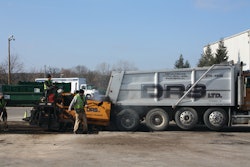
Sometimes the tried-and-true remove-and-replace approach is still the best option. While more time consuming, more labor and equipment intensive, and more expensive, this approach will yield some of the best results and actually improve the overall quality of the overall pavement.
The following steps will result in a successful pavement restoration repair.
- First, because the remove-and-replace approach involves a crew and takes longer, it's important to set up traffic control around the worksite. Contractors working on-road can consult the American Traffic Safety Services Association for appropriate traffic control setups. Contractors working on parking lots and low-volume streets can establish their own traffic control by paying close attention to traffic flow and pedestrian traffic and redirecting people and vehicles away from the worksite. Workers also should wear appropriate high-visibility clothing.
- Mark out the area to be removed, either with spray paint or chalk. Marked out edges should be straight sided and most research indicates a rectangular or polygon shape works best.
"It's important to exceed the limit of damage so the cuts and repairs extend go into stable pavement," Groh says. "One of the most common causes of failure of a restoration repair is not extending the cut into pavement that is stable. When you cut out too small an area you are leaving damaged pavement to surround your patch, and that damage will work its way into the repair you've just made." - Remove the existing damaged pavement. Groh recommends milling, sawcutting, or using an air hammer (in that order) as ways to remove the pavement and create clean edges. Using an air hammer is the least preferable option because the action of the hammer itself can create cracks in what had been stable pavement.
- Excavate to a stable grade, making sure to remove all damaged or wet material of the base and subbase. "A lot of restoration patches fail because not a lot of attention is paid to the subbase material," Groh says. "It's essential that any wet or otherwise damaged material be removed from the hole before going on."
- Replace base aggregate as necessary.
- Tack vertical edges of the repair to improve adhesion.
- Install asphalt in two lifts. Groh recommends no less than 4 inches total of hot mix asphalt.
"Two lifts is essential because sometimes you think you are working in a stable area but after you place the mix and begin compacting it settles and you realize the area was not as stable as you thought," Groh says.
In those cases you are left with a very thin lift to place on top just to level the pavement surface or you are creating a depression if you don't add mix. To avoid the problem place a first lift and then compact that.
"Even if there is a small amount of settlement you have a 2 inch or so second lift to bring the repair back up to grade," Groh says.
Spray patching for contractors
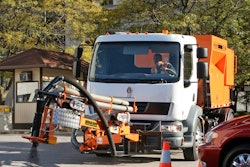
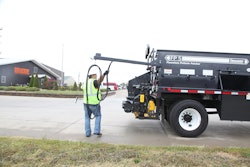
Still another pothole and pavement repair alternative is spray injection patching, sometimes referred to as velocity feed patching. Loyed Woodland, The Pothole Medic, Brockton, MA, is a contractor who generates virtually 100% of sales through pothole and pavement repair. He says half his repair work is on commercial and industrial properties while the other half is on roads for municipalities. And he does it all from the cab of a Wildcat spray-injection patching machine he has tweaked over the years to better perform some of the things his clients demand.
"The industry has been repairing potholes the same way for 70 years," Woodland says. "Why would anyone continue to do that knowing how ineffective it is? Velocity speed patching (also known as spray-injection patching) is the wave of the future. There's no question about it in my mind. But there needs to be more education of how this equipment works for that to happen. That understanding, plus some of the tweaking we've done over the years, makes this approach the way to go when repairing potholes."
While spray-injection patching machines differ, they are available in tow-behind, truck-mounted, and stand alone vehicles. The process is similar on all equipment and involves air pressure blowing water and debris from a pothole, spraying a tack coat of binder on the insides and bottom of the hole, blowing asphalt and aggregate into the hole at 50 to 90 mph, velocity compacting from the bottom up, and then covering the patched area with a layer of aggregate. Pavement can be opened to traffic immediately.
Woodland owns one Wildcat spray patcher, which he bought in 1996. It requires only one person to operate on the road and two in commercial areas to sweep back in any material blown out "and to watch for pedestrians who are notorious for walking where they don't belong despite safety restrictions put up."
While he doesn't know how many repairs the machine made last year it did put down 550 tons of stone and more than 21,000 gallons of emulsion.
"That's a lot of work for one machine," he says.
He says the spray-injection technique was intended primarily for municipalities because it's the least invasive repair method, its cost-effectiveness, and most important the safest for the operator who is now seated in a climate controlled cab for more productivity. Woodland says he has accomplished nine consecutive months of patching on high- and low-speed roadways and commercial parking areas with zero failures. He says spray-injection machines also address the pre-mentioned perimeter settlement and create a true plane with a seamless patch creating a permanent repair.
"What most people don't do when they repair potholes is they don't address the perimeter problem and as it continues to be a pothole the perimeter problems prevent any pothole repair from being successful," Woodland says. "You repair the pothole but the traffic has a tremendous amount of impact on that repair and the pavement surrounding it.
Traffic puts pressure on the areas and produces a depression, which gives water a place to collect and the problem just continues. The spray injection method addresses the problem by repairing not only the pothole but the perimeter as well, leaving behind a new plane, a new surface and no depression."
He says he often conducts demonstrations for property managers and city officials and often ends up with contracts on the spot.
"Property managers like it because it's less inconvenient for them," he says. "Parking lot areas are closed for shorter times, traffic is disrupted less on roads, and there's a longer patch life. All these things combine to sell the process. The process also sells itself because people are really impressed when they see it work."
Woodland says spray-injection machines are the future of pothole and pavement repair largely because the machine, though it is expensive, can reduce the manpower needed on the job, repair more pavement quicker, expose workers to traffic less time, and disrupt traffic and the public less time. He says cities (and contractors) will be able to reduce their overhead by hiring fewer people to get the work done or can reallocate that labor to other jobs, improving productivity.
He says that while the spray-patching process has been around almost 40 years it hasn't taken hold because it needs to be tweaked (as he has done) and its operators need more training than is generally provided.
Woodland says operators need to better understand both the chemistry of emulsions and the electrical charges of the stone to use this process as effectively as possible.
"It's not that difficult but you do need to understand these things to make this process work best," he says. "Once people understand the process better spray patching will become the dominant way to repair potholes and other pavement defects."
But regardless of which approach you choose — and many contractors offer more than one of these methods — pothole repair can be a mainstay of most pavement maintenance businesses.
"Contractors can use pothole repairs to gain an 'in' with prospective clients," Groh says. "Perform the work at the best level possible based on conditions so you can have a chance to come back to do restoration work later.
"Getting in and establishing the relationship with the property owner and gaining trust on a small project can lead to opportunities to generate more work in the future."