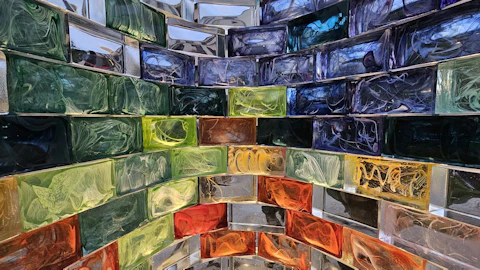
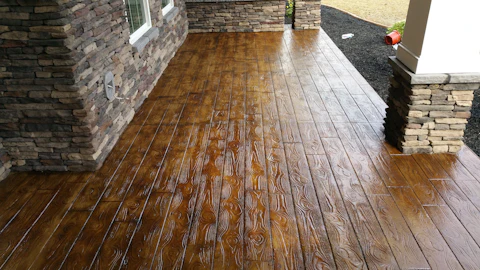
For decorative contractors who use concrete as a canvas for color, the combination of chemical stains and concrete dyes is a perfect synergy.
Although stains have received much applause for their amazing color transformations, dyes deserve equal kudos. These underrated coloring agents can achieve vibrant tones simply not possible with stains alone.
“Dyes can get the applicator into more vibrant colors such as yellow, blue, and purple to name a few,” says Bob Harris, president of The Decorative Concrete Institute and author of Bob Harris’ Guide to Stained Concrete Interior Floors.
“The nice thing about working with dyes is that you can mix them at the jobsite to obtain your desired color,” he says. “Dyes are often used in conjunction with acid stains to produce a variegated look and, in most cases, complement the already stained floor.”
Gary Jones of Colormaker Floors Ltd. agrees about the versatility of dyes. His company offers a proprietary line of water- and solvent-based dyes in a vast array of colors, including subtle earth tones, vibrant hues, and pastels.
“We use a lot of dyes, which for us go hand in hand with the patina stains,” he says. “The dyes back up the stain and give you a wider range and vibrancy of color. They also allow you to do more layering of color.”
Another proponent of dyes is artist Dana Boyer, owner of ConcretiZen. She makes her own dyes to enhance and customize her stained concrete work. Applying a dye is “like putting blush on your cheeks, over a foundation. It bumps up the color a notch,” she says. Boyer notes that acid stains generally come in only about eight or so neutral colors. With dyes, almost any color is achievable. “It’s an enhancement for the stain,” she says. “You start with a base of color and build up from there.”
How dyes work
Essentially, concrete dyes are translucent, penetrating color solutions. Unlike acid-based stains, they do not react chemically with concrete. Instead, they contain very fine coloring agents that penetrate into the concrete surface.
Both water- and solvent-based dyes are available, with each type having unique qualities. Water-based dyes, such as Colormaker’s Someru, generally produce soft pastel tones. Bolder hues, including red, blue, yellow, green, purple and orange, are possible with solvent-based products. DecoTone from Decosup and SuperStone Concrete Dye are examples.
Most dyes are packaged in concentrated form, allowing flexibility in the end color. They can be used full strength to attain greater depth of color or diluted with water or solvents to produce paler shades or simply a light wash of color. You can also intermix different colors of dye to produce your own custom hues.
When to use dyes
Concrete dyes can further enhance your chemical staining projects and open up a whole new set of design options. Harris says that the primary reason for using dyes is flexibility — to obtain colors not possible with chemical stains.
“When concrete dyes are combined with chemical staining, there are no limitations from a predetermined color palette,” he explains.
But dyes have a multitude of other applications as companions on chemical staining projects. Artisans have used them to:
Application techniques
Dyes can be applied in a variety of ways, depending on the results you want to achieve and the size of the job. Harris typically uses a high-volume, low-pressure (HVLP) sprayer on his projects.
Boyer’s techniques vary. “Every job is different. I may spray it, roll it, or brush it. There are many different ways to apply dyes,” she says.
Regardless of the technique used, it is important to test the concrete surface for acceptance of the dye before application. The degree of penetration and intensity of color will vary depending on the application method used, age and porosity of the concrete, cleanliness of the surface, and other general conditions. Some surfaces may not even accept the dye, particularly if they are dense and nonporous.
When applying dyes to an already stained surface, Harris recommends waiting until the stain achieves the desired look and intensity. The surface also should be clean and dry before dye application.
Limitations of dyes
Dyes, like chemical stains, are intended to enhance rather than disguise the surface. They will not hide cracks, blemishes or other flaws. Nor will they mask an underlying color. “Dyes are transparent, so you really can’t do any color correction with them,” says Boyer.
You should also expect variations and inconsistent color with dyes, even when applying them to the same surface. But most people find these variations desirable because they result in a more natural, mottled appearance.
Harris says that when working with dyes, jobsite color blending is often necessary to obtain the hue you’re after, since most dyes come in a limited range of standard colors.
This may require an understanding of the basics of color theory. “Knowing that mixing blue and yellow produces green or that red and blue make purple allows greater flexibility with dyes,” he says.
Protecting and maintaining dyed surfaces
Although dyes are formulated to penetrate into the concrete, it is still necessary to protect dyed and stained surfaces from wear and contaminants by applying a sealer.
Harris also recommends applying several coats of floor finish, or wax, to protect the sealer from wear. The sacrificial wax coating acts as a shock absorber to scuffs, scratches and grime. Plus, it is easy to buff out a coat of floor finish and then reapply more if necessary. As long as the owner is diligent about ongoing maintenance and doesn’t allow the floor finish to wear down to the sealer, dyed and stained concrete surfaces should last indefinitely.
Anne Balogh is a writer for ConcreteNetwork.com (www.concretenetwork.com), a website serving more than 400,000 visitors per month seeking information on concrete industry products and concrete contractor service providers.