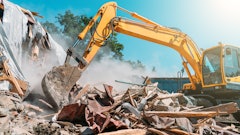
Concrete is a long--lasting material, but roads, buildings and other concrete structures can exhaust their usefulness. When these structures are demolished, the debris can get a new life through concrete recycling.
Meet the crusher
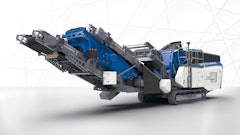
Concrete recycling begins by transforming large pieces of concrete into useable rock. The tool for this job is a crusher. Both portable and stationary models are available. The main difference between them is that stationary crushers use an impacter that is mounted in a fixed location, Eagle Crusher Company, Inc., marketing manager Jeff Hillis explains. Portable crushing systems can be towed between locations behind truck tractors, though it may take several loads to move all the parts. In addition to an impacter, each crusher system has a chassis with separating screens, a hopper, a feeder and conveyor belts to move the crushed material out.
Concrete waste is put into the hopper using a front--end loader or excavator. A vibrating feeder moves the material into a transition point where fine material is separated out to reduce wear on the crusher. The concrete then goes into the impacter. To make aggregate, a horizontal shaft impacter is required.
“This type is state--of--the--art for recycling concrete because it makes a cubicle product,” Hillis says. “If you’re going to use aggregate in concrete, asphalt or most approved applications, it has to be cubicle.” Many other crushers are cone and jaw type, creating elongated pieces that don’t lock together as cubicle product does.
“Our crushers feed the concrete in whole, rebar and everything,” Hillis says. “As the material is crushed, it goes up the belt and under an electromagnet which removes the metals off to one side. This is a significant part of the business, because if you had to remove the rebar first, it would not be economically feasible to crush concrete. The machine does it quite efficiently.” The metal is sold as scrap, adding another product to the recycler’s bottom line.
The resulting concrete product depends largely on the screening process. Triple deck screens make three products plus the fines while double deck screens yield two products plus fines. Hillis said most people make either 1 1/2--in. down to 1--in. material for use as road base.
While recycled aggregate can be used in new ready--mix, the resulting product is normally limited to curbing, pavement or barriers in the United States rather than for structural concrete because of quality concerns, notes Dr. Abdul Chini, professor and director of the Rinker School of Building Construction at the University of Florida.
Eagle’s smallest crusher can crush 60 tons of material per hour, while its largest can process more than 600 tons per hour. When the crushing process is completed, the recycled rock is put in conical product piles about 100 ft. high.
A portable crusher can go to a site where a building is being demolished and replaced, and the resulting crushed concrete can be used right there for fill. “This reduces costs because you don’t have to truck the material,” Hillis points out. “People who live in the area like it because there aren’t concrete trucks going up and down the street everyday.”
Little impact on operators
Although those working close to a crusher may need ear protection, the machines are surprisingly quiet. “The highest decibel sound on a crushing site is the backup alarm on a loader,” Hillis says. The second noisiest thing is the crusher’s vibrating screen.
“Generally dust is controlled by a water spray bar,” he notes. “That meets most requirements.” Foam and mist systems are also available, but most people use water at all of the transition points.
Economics of concrete recycling
Concrete recycling has expanded dramatically in the United States in the past 10 years, though its use is still much less than in Europe and Japan where there are shortages of both virgin aggregate and landfill space. Only about 10 percent of concrete is recycled here, compared to 90 percent in the Netherlands and 40 to 50 percent in the United Kingdom and Japan, Chini says. Before concrete recycling becomes more prevalent, he says it will need to become economically feasible. “We have to reach a point that disposal of concrete is not as cheap as it is right now,” he says. “This is a place where governments can play a role by making landfill usage more expensive and by providing additional incentives to people who recycle.”
Some increased recycling is already happening due to normal economic forces. Landfill tipping fees in some areas are quite high. A distant landfill also favors recycling when the high cost of diesel fuel, trucks and drivers to haul debris is considered. To get around these expenses, some general contractors stockpile their leftover concrete and are visited by a portable crusher owned by a concrete recycler once a year. Other contractors have a portable crusher visit a specific site for a few days to handle small demolition jobs.
Increased demand for crushed aggregate in areas like the Northeast where much construction is underway is another factor promoting recycling. “Some of our customers crush everyday and cannot produce enough material to keep up with demand,” Hillis says.
Brossart Materials and Recycling, a subsidiary of Spartan Construction, recycles concrete for that company and about 50 other contractors. These contractors bring mostly demolition materials to Brossart’s yard in Burlington, Ky., and pay $10 to $20 per load depending on the truck size for the privilege, a fair price because landfills are far away. It also accepts washout and leftover concrete from ready--mix companies. Brossart only crushes at its yard twice a year and sells the resulting rock, which includes 1 1/2--, 2-- and 4--in. sizes, for commercial work and sub--base at $5.50 to $6 per ton.
Contractors and government agencies in north and central Florida save a $32 per ton landfill tipping fee by taking their old concrete to Chip’s Dozer Service, which accepts these materials for free. The company crushes 60,000 to 80,000 tons of concrete per month. Much of the resulting aggregate is purchased by those same government agencies for use in sub--base, underground bedding and new concrete.
Gettin into recycling
Although the entry level price for a portable crushing plant is $200,000, the payback period for this investment is short. Crushers can be used with any material, including natural limestone, and the plants have a high resale value.
Crushing system operators are required to comply with the federal Clean Air Act. “It’s time--consuming but it’s not difficult to meet the standards,” Brossart says. Each location must be qualified separately. After setting up, an inspector comes and does an analysis while the crusher is operating and gives approval that is good for one year.
A producer’s perspective
Concrete producer Rinker Materials is currently studying whether to use recycled aggregate in its ready--mix and anticipates knowing whether the company will enter this market in about a year. The performance, handling costs and transportation costs of recycled aggregate compared to virgin aggregate are the issues of concern.
However, Rinker is already active in recycling concrete in other ways. For several years it recycled unused concrete returned from jobsites into tetrahedrons used to create artificial reefs. These 3-- to 6--ft. triangular units were purchased by government agencies for placement underwater off the Florida coast. Marine animals find the crevices the randomly placed tetrahedrons create to be appropriate habitats. Reduced market interest led to the end of their production by Rinker.
“We do recycle concrete now by making large mac blocks,” Don Beers of Rinker says. “This is a solid chunk of concrete that is 6 ft. long and 3-- by 3--ft. We stack them up and use them for 9--ft.--tall aggregate storage walls.” These blocks are made from unused concrete returned on ready--mix trucks.
Some concrete recycling could become unnecessary if concrete contractors did a better job of calculating how much ready--mix they need, Beers noted. “We are flabbergasted at the amount of concrete that comes back to us from the contractors,” he says. “If you order the correct amount of concrete, you pay less and we don’t have to worry about what to do with it when it comes back in.”
Jean Feingold is a Jacksonville, Fla.--based writer who frequently covers concrete and other construction--related topics.