The hot mix asphalt (HMA) industry in the United States is undergoing major, positive, and long lasting changes. There are new mix designs, new installation methods, new density and compaction requirements, and more stringent smoothness and "rideability" requirements. No longer is it enough to simply, "make it black and don't look back."
To cope with this progress there is a new breed of paving contractor, using a new generation of technologically advanced hot mix asphalt paving machines coming onboard. Today, even the small to mid-sized asphalt paving company, with one to three full-time laydown crews, must have the management, personnel, technical expertise, field experience, and equipment previously demanded of only the larger paving contractors.
Typical of this new breed is R.W. Colby Paving Inc. of Dracut, MA. Four years ago, 39-year-old Warren Colby, a well-educated man with 20 years' experience in the asphalt industry, felt that the time had come to strike out on his own. Having started out as a laborer on an HMA crew, Colby worked his way up to roller and paver operator, followed by a seven-year stint as a foreman, which led to a superintendent's position. When the company Colby was with was acquired in a buyout, he became part of the new firm's asphalt operations team, helping oversee the day-to-day operations of 12 asphalt crews.
By then Colby had a successful track record, an impressive income, and a secure future. But he wanted more. So together with his wife Renay, they formed and incorporated their company in April 2000. With Warren Colby as the firm's hands-on president and Renay as chief operating officer, R.W. Colby Paving is involved principally in small to mid-sized hot mix asphalt paving projects for about 90% of the time. The remainder includes prep work, dig outs, and fine grading. The firm covers a territory that includes all of Massachusetts and the southern portion of New Hampshire.
The right mix of pavers
One of his first equipment acquisitions, after defining his target market, was a LeeBoy 8000 paver. This was followed by LeeBoy's 8500 paver, and the recent acquisition of LeeBoy's new 8816 machine.
R.W. Colby recently purchased the larger 8816 because of the opportunity to expand into new markets. A thorough, realistic investigation indicated that there was a definite need for a competent contractor in R.W. Colby's service area to pave medium-sized parking lots.
"The 8816 has enabled us to enter a new market where there is a need and still be competitive," Warren Colby says. "I can put down more tons per hour with it and it has more power to push large, fully loaded, tri-axle trucks easier. Because it has more hopper capacity I can put more tonnage through the machine even in tight quarters where a truck can't fit."
He says that in tight areas the crews use skid steer loaders to charge the 10-ton hopper. "At the end of the day my total production figures are significantly higher," he says. "We can do the critically precise paving projects, the tennis courts and other recreational facilities where precision is mandated. Yet we can also do a 20-ton driveway, a 1,500-ton chopped-up industrial development site, and a small highway project."
This mix of equipment enables R.W. Colby to operate just under the radar screen of its competition. Instead of being a threat to large asphalt contractors the company is viewed as a reliable asset that can be utilized in a subcontractor role — even to Colby's former employer.
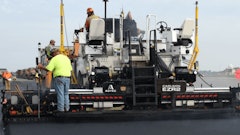
A typical example is the surfacing access paving of a large new industrial structure in the Miles Standish Industrial Park in Taunton, MA. As a subcontractor R.W. Colby executed a 4,000-square-yard project from a larger paving contractor. The project was a perfect fit for R.W. Colby's LeeBoy 8816 laydown machine, which was maneuverable enough to cope with the diverse shape of the job. Colby planned the job to be done in a series of passes which allowed the operator to complete the job utilizing the paver's screed at widths that were most conducive to maintaining the maximum head of material without possible segregation.
The contract called for 350 tons of asphalt, including a 1½-inch compacted binder course, 1,500 linear feet of asphalt berm, and a compacted 1-inch surface course that required about 240 tons of a dense mix.
"Proper compaction is at the core of every successful asphalt paving project," Colby says. "But rollers are not the total answer to a good job. Nor is the fact of the paver's maximum width paving capability."
Colby says that even though the company's pavers utilize an 8-foot screed that extends to 16 feet when necessary, the Colby crew often prefers not utilizing the full width.
"We have found we can put down a more uniform mat if you don't try to utilize its maximum capability," Colby says. "But don't misunderstand me. When you need that 16 feet it's very nice to know that you have that capability. But our crews do just as well by pulling 10- to 12-foot-wide passes and maintaining a full head of material at the proper angle of attack at the screed. This is no big problem. You layout the project ahead of time, use a paint stick to mark it on the ground and, perhaps most important of all, go over the plan with the operator in advance. In the long run we come out with the same time and productivity figures."
Rules of engagement
Warren Colby has learned several things from working with the "big boys" over the years and follows "Rules of Engagement" he developed:
- It is most important that you do not deceive yourself. Understand thoroughly the total cost of doing a project. Include all the incidentals. Don't mislead yourself into thinking that you can get by with fewer people and/or machines than you know it will require.
- Understand fully what each person and machine can do. Then realistically schedule your crews for most of the situations that are usually encountered … from weather to job priorities.
- Accept that most customers want quality workmanship, done at a fair price, that will meet realistic expectations of longevity. In other words, no short cuts. Don't cut your bid just to get a job to "keep your people busy." You will always lose money.
- Purchase the best machine you can afford. Good equipment costs good money. Reputation is the best selling point you have going for you. Protect it!
- Customers rightfully expect their project to be done in a professional manner, done when the contractor says he will do it, and done the way he says he will do it; no excuses for lack of people, machines, or materials. The only exception to this rule is weather and then the clients want it done as soon thereafter as good weather returns.
Dan and Gini McKain are freelance writers/photographers specializing in the construction industry.