For the past year and half, Tom Ritschel, president of Micro-Surfacing Inc. (MSI) of Peoria, IL, and other members of the Illinois Pavement Preservation and Maintenance Association have been encouraging state DOT leaders and legislators to initiate a preservation program.
Like many road agencies across the country, IDOT traditionally operated in a reactive mode in approving funds for the worst roads first, before allocating dollars to maintain other projects. While some of IDOT's county and municipal counterparts have used microsurfacing preservation techniques, the state agency used funds for major rehab projects, and any preservation work that was done was usually done too late on a badly deteriorated roads, which offered little if any value in maintaining the structure or extending the life cycle of the roads.
The preservation association made informational presentations at IDOT's nine district in the early spring of 2004. Finally in May 2004, IDOT earmarked over $3 million for preservation work on state roads, with bids for 16 projects due on July 30. After Labor Day, the contracts were let and Ritschel and Bob Byrne, co-owner of MSI, St. Louis, were awarded 10 of the projects (nine microsurfacing and one slurry seal).
Ritschel and Byrne operate two microsurfacing paving crews — one in Peoria and one in St. Louis, generating approximately $4 million in annual revenue on preservation work primarily in Illinois and Missouri.
The projects MSI was awarded were two-lane state roads, two to eight miles long, with moderate traffic volume (5,000 vehicles per day) and in relatively good condition. Illinois DOT has a condition rating survey (CRS) for grading road quality, from 1 (very poor) to 9 (best), and MSI worked on roads with a 4.4 to 6 rating.
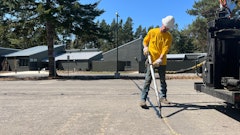
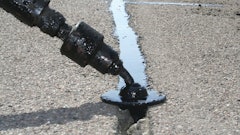
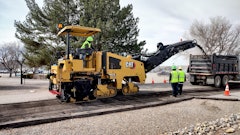
"Some of the roads were good candidates for a microsurfacing preservation treatment, and some required some crack repair and bump grinding (on raised reflective cracks) before we could apply the surface treatment," Ritschel says.
Knox County project
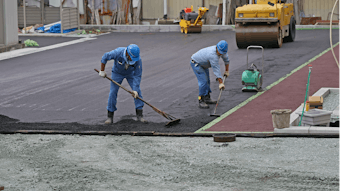
One particular project let by IDOT District 4 in Knox County, a 5.2-mile two-lane stretch of Hwy 150 from the Spoon River to the Knox/Peoria County line, was a CRS-rated 4.4, 7-year-old road structure that required bump grinding and crack sealing of reflective cracks before MSI's paving crew could apply two layers of the microsurfacing treatment. The total project contract was $217,464.
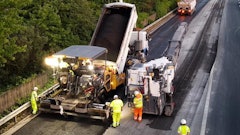
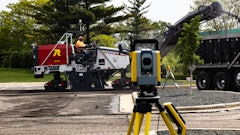
With a nearby staging area to store the 1,500 tons of quarter-inch minus aggregate required for the project, MSI's crew calibrated its Bergkamp M1 paver to proportionately mix the aggregate, emulsion, water and Portland Cement filler (which chemically activates the curing process) to meet IDOT's mix design requirement for the project.
"On a project like this, we submit a mix design provided by our emulsion supplier (Tri-State Asphalt of Morris, IL in this case), the state specifies the aggregate gradation, and then our emulsion supplier determines how much emulsion is required based on the aggregate specified," Ritschel says.
Type II project specifications also called for 30 pounds of dry aggregate per square yard of road surface be applied in a two-layer application. The microsurfacing mix design blended in the paver's pugmill chamber consisted of the aggregate, cement filler, along with the liquid asphalt emulsion, which has 3 percent latex rubber and a chemical additive that allows the asphalt emulsion and water to mix. After being blended by the paver, the mixer is delivered to the spreader box for application to the road surface.
"Two thin applications cure better than one thicker application, and you also get a much better finish if the road surface has any variations (reflective cracks, rutting, etc.)," Ritschel says. "We originally estimated the job would take four days to complete the microsurfacing application, with our paving crew completing a single lane each day, but we ran into a slight delay on our aggregate supply, so it took us an additional day to complete."
At about the same time, MSI completed a 2.2-mile stretch of Hwy. 150 in Henry County using a Type III mix design requiring a 36-pound dry aggregate content. On this particular 10-year-old pavement, which had a CRS rating of 6.6 (good condition), IDOT requested additional aggregate to compare how the two different projects would perform. The project contract was $119,115.
Time will tell
On the Knox County Hwy. 150 project, Ritschel estimates the microsurfacing will extend the road's life cycle five to seven years. During application, IDOT officials monitored application rates and will conduct their own evaluation of how the treatment performs over time. The agency is particularly interested in how the surface treatment holds up to a typical harsh Midwest winter.
If the preservation approach proves successful for IDOT, Ritschel estimates significant savings in maintaining road quality for the state. According to Ritschel, micosurfacing a road that's in fairly good condition costs approximately $18,000 per mile, while a typical mill and fill (milling off the surface mat and applying a new hot mix asphalt mat) can cost approximately $36,000 per mile, and a full-depth rehabilitation can cost upward to $200,000 per mile.
"Most states are in that 'worst first' mode of maintaining existing roads. They are reluctant to invest in roads that are in good condition, with the understanding that the investment will eventually reduce the overall costs of major rehabilitation, because the roads will last longer," Ritschel says. "The biggest dilemma with a product like microsurfacing is that it has to be applied in a preservation mode in order to extend the life cycle of the road. If the road is in bad condition, a preservation approach is not going to help. And agencies find it difficult to invest in roads that are in good shape, when taxpayers want the worst roads fixed first."
While Illinois and Missouri are in their infancy with preservation pavement projects, Ritschel says both are optimistic on how the approach can help maintain quality roads, stretch budgets and free up available funds for new and major rehabilitation projects.
"The state (IDOT and legislators) has taken the initiative to endorse a preservation approach even though it does not provide immediate savings, but rather long-term savings by extending a road's life cycle," Ritschel says. "They (IDOT) understand how an investment in preserving good roads can pay dividends in the future. IDOT is incorporating familiar preservation techniques (like crack sealing) with unfamiliar preservation techniques (like microsufacing) into their 'mix of fixes.' We're (preservation proponents) trying to provide maintenance activities in ways that lower life cycle costs, thereby saving the agencies money and making taxpayers happier."