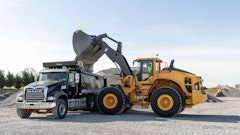
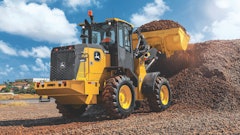
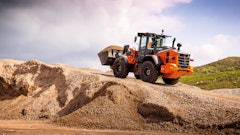
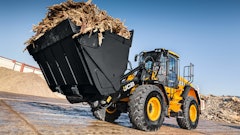
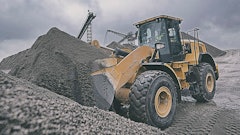
Construction places unique demands on wheel loaders compared to their larger cousins used in quarries and plants. Many construction loaders are used in multiple applications with a variety of attachments, such as forks, specialty buckets and brooms.
We asked several contractors experienced with using wheel loaders to share their advice on features that make these machines more productive in their operations.
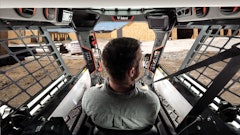
Operator environment emphasized
Phend and Brown Inc. is a northern Indiana-based highway and heavy contractor that owns a couple of asphalt plants and also performs some sewer work. Its fleet includes several larger Kawasaki plant loaders, plus a pair of Volvo L110 and two older Volvo L120 loaders working in the field.
This contractor looks at all loader makes when making a purchasing decision. “You go for your best price and your best all-around machine,” says Tim Baker. It also looks at several major criteria. “Visibility is number one,” says Baker.
Some models they have encountered provided limited visibility to the work area. “That’s one thing we really like about the Volvo units. We can see what is going on around us, especially when we are trenching.”
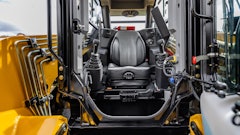
It is also important to note that comfort is directly linked to operator productivity. “The more comfortable he is in the unit, the more productive hours we will get out of him,” says Baker.
Features like the comfort of the seat can have a major impact on operator performance. “We like the air seats,” says Baker. “That really took the burden off of a heavier-set fellow. The mechanical seats are only good for so much. But you go to the air-ride seat and it just makes a world of difference.”
Richards Corp., a family owned and operated Connecticut-based site development contractor, has six wheel loaders. “We have two John Deere 644s, a Komatsu 320 and a 380 and two Dresser loaders,” says Dennis Doyle. “They are used year-round for loading material, side dumping if we are doing sewer work and all winter long we have a contract for snow plowing.” All but one of the loaders have side dump buckets and forks. One has a 12-ft. snowplow for winter operations.
The company’s loaders are equipped with air-suspension seats. Prior to becoming a partner and the equipment manager for the company, Doyle was an equipment operator. “Operator comfort is very important,” he states. “The loaders are geared for a man to get in there and be productive for eight to 10 hours a day, then get out and go home to his family and still be able to play with his kids.”
Ritschard Brothers Inc., an Indiana-based site development contractor that also performs demolition work, has found that noise is another factor that impacts operator comfort. The company has nine loaders, including Michigan and Volvo units ranging from an L70 up to L120s. “Volvo has such a wonderfully quiet running engine,” says Dave Reinhold.
Reinhold believes all new wheel loaders are becoming more operator friendly. “When I look into a new wheel loader now, basically they are all pretty much thinking about conditions for the operator,” he states.
Make it perform
Loader performance can be measured by several criteria, including handling, fuel economy and tractive effort. One feature that can increase performance is ride control boom suspension systems.
Ride control not only impacts comfort, it allows an operator to traverse a jobsite at greater speeds without spilling material from the bucket.
Phend and Brown Inc. has found this feature particularly helpful. The company does a lot of paving and uses the loaders to backfill. “A lot of times there will be a 1 to 1 1/2-in. drop from the new pavement,” says Baker. Keeping backfill material off the new pavement is important. “With the boom suspension system, you can almost run full speed off the edge of the paving. The wheel loader will rock up and down, but [the material] doesn’t dribble out all over the place.”
On a recent job, the loaders were traveling almost 70 miles a day. “We were running them down the road part of the way, then running right out into the dirt,” says Baker. “With that suspension, you are up and down the road at 25 mph.
From the operator’s standpoint, you have taken all of the shock out of it.”
The suspension system can also be turned off for better productivity in specific applications. “We do a lot of back dragging to smooth out the work site,” says Baker. “When you are back dragging, you have to kick it out of that mode.”
Ritschard Brothers Inc. is also interested in how the machines handle both on the jobsite and on the road. “We work in close proximity, so we normally have our operators run our loaders around and move from job to job,” says Reinhold.
Fuel efficiency is a critical factor for many contractors in wheel loader selection, including Hard Rock Excavating. This excavating contractor does site development, utility and demolition work for Arlington County, VA. The company has three loaders for truck loading, including a Liebherr 538 and a JCB 426.
“Fuel economy and power are important on the jobsite,” says Charles Sweeny, owner. He says the Liebherr unit has proven very fuel efficient while still providing impressive power. He also appreciates the way it transfers power to the ground. “It has a limited-slip [differential], which doesn’t spin the wheels.”
Performance also tops the list for Indianapolis, IN-based Milestone Contractors Inc., a heavy highway firm with four Volvo L70 and two Caterpillar IT 28 tool carriers in its fleet. These loaders are generally used to backfill for the pipe utility crews. “We look at the versatility, the power and the quickness of how they handle material and the traction,” says Ron Rapp, equipment manager.
Built for longevity
Longevity is the most important selection factor for Richards Corp. “Last winter, I just went through a 530 Dresser that was bought new in 1987,” says Doyle. “It is still a very productive loader.” Ten years is the normal life expectancy for a loader in the company’s operations.
Articulation pins can be an Achilles’ heel for a wheel loader. “The center hinge wears out fast,” says Doyle. “With the new machines, the manufacturers are finding better parts to put in them. They are lasting longer and longer.”
Baker adds that it is important that the articulation and bucket pins be well sealed. If grease can escape, the pins will constantly wear out.
It’s about support
Even with the productivity features mentioned, all of these contractors say selection really boils down to support from the local dealer.
“You have to know that if you have a problem there will be someone to help you right away,” says Doyle. “Know who you are buying from. W.I. Clark [the local John Deere dealer] is a great company for parts and service. Any problems that we have had, they have jumped on the problem and solved it. Komatsu has done the same thing.”
Sweeny agrees that dealer support is critical, noting, “We have a great Liebherr dealer that is out there right away to fix the problem.”
Ritschard Brothers Inc. has tried other brands, but according to Reinhold, they have not had the quality of service provided by Rudd, the local Volvo dealer. “We get great parts support from Rudd,” he states. “It has just worked out real well.”