Savvy business people realize that markets constantly change. The needs and wants of customers transform over time and so must the products targeted at meeting those needs. Eight-track tapes gave way to cassette tapes which were eventually replaced by CDs. Today's trend is now for music on the go with miniature digital players.
A similar evolution has led to a recent production trend within the asphalt road building industry — the need for plant portability, partially due to market changes and permitting issues — has made asphalt plant equipment manufacturers take notice of producers' needs to make a quality mix in a portable plant design.
The need for speed
Although "portable" plants have been on the market for decades, there are varying degrees of portability. "Years ago, portable plants took up to three weeks to dismantle, move, erect and make all the necessary electrical connections for making mix," says Mark Spicer, vice president of Terex Roadbuilding plant sales. Today, most portable drum mix plants can be moved and ready for production within a week.
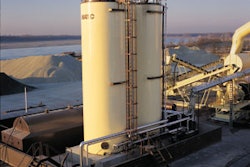
Some of today's portable plants have all the capabilities of their stationary drum mix counterparts. They can produce state approved spec mix designs, have the capability of running RAP, capture dust and return it back to the drum mixer, include storage silos and employ a full-capability controls program.
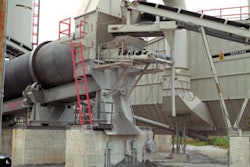
These traditional plant designs — like the CMI Triple-Drum portable plant series from Terex Roadbuilding — are capable of producing from 250 to 500 tons per hour (tph), giving producers the benefit of mid-range production on top of the advantage of moving from site-to-site. While the plants can be moved and set up in about a week, they still require multiple loads for transport. Some plant designs will require up to 15 loads for relocation, making the move more complex.
Recent market conditions have forced plant manufacturers to look beyond the more traditional definitions of portability, ushering in an era of portable plant designs with faster, easier and less costly relocations. According to Spicer, tight state and federal dollars are calling for less tonnage on today's road contracts. The 200,000-ton contracts of a few years ago are being broken into smaller, multiple stages.
Therefore, the 500-plus-tph relocatable and stationary plants are too large and too costly for some of today's contractors. In addition, increasingly difficult permitting processes for new stationary or relocatable plants are moving production facilities further away from jobsites. Trucking times of over an hour are now commonplace for some of today's paving contractors.
"With portable plants, contractors want to get closer to the job to avoid longer, more costly trucking cycles," says David Emerson, vice president of engineering for Terex Roadbuilding. A problem with many traditional portable plant designs is the cost to move them outweighs the economic benefit gain on some of today's smaller contracts. In addition to the multiple loads required for moving, many traditional portable plants still require costly equipment, like cranes, for setup.
Super portables
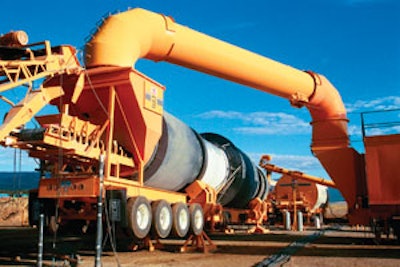
The producer's need for increased portability has paved the way for a new genre of portable plants, kind of a "super portable" design. Many of these scaled-down portable plants can be moved in fewer than six loads, including ancillary equipment and components. Some designs incorporate the controls, mixing drum, cold-feed bin and emissions control on a single chassis.
These newer portable designs have further reduced moving time to within a few days and lessened the logistical complexity of the move. This increase in portability, however, has come at a price. "The simplicity of these super portable plant designs significantly reduce the types of mixes they can efficiently produce," explains Emerson.
The newer portables include parallel flow drum mix technology and less environmentally friendly wet-wash systems, which can make permitting more challenging. The scaled-back controls programs operating these plants and limited capacities to run RAP make it more difficult to produce state spec mixes. And if wanting to run more complex mix designs, contractors must add cold feed bins and storage silos to the base plant design, increasing the number of loads and time required to move the plant.
Although these portables meet the producer's need for speed, the types of projects in which they can be used are limited because they cannot easily produce a wide variety of mix designs.
The quest for quality
Previously in order to run the full gamut of state mix designs, producers had to rely on traditional cournterflow portable plant designs. However, as previously mentioned, these plants can take up to a week or more to move and are costlier to move than super portables.
Terex Roadbuilding, known to the industry for its high production counterflow plants encompassing more than a century of asphalt technology through its Cedarapids/Standard Havens brand of Magnum relocatable and stationary designs and CMI brand of Triple-Drum portable and stationary plants, has been thoroughly investigating the need for portable asphalt plants. "Producers want a portable plant that is easy to move and affordable to run all state spec mixes," states Spicer.
The manufacturer is taking a different approach to the super portable concept; introducing a low-load, full counterflow technology portable plant. "Picture a full size, full capability counterflow drum mix plant and shrink it down into an extremely portable design. That is our vision of the new plant," describes Emerson.
The new portable counterflow plant from Terex Roadbuilding, slated for unveiling at next year's ConExpo-Con/Agg exposition, will combine a Magnum-based counterflow drum mixer design, with a baghouse, self-erect silo and multiple cold feed bins. The new base plant will feature four- to seven-load portability, depending on the producer's need.
According to Spicer, "Our goal is to allow the producer to make short moves within a day." More importantly, the new plant will use a field-proven PLC control package. "The plant incorporates a scaled-back version of the same Impulse controls program that runs our stationary plants," comments Emerson. This base controls package will allow producers to run all state mix designs.
Since the plant includes counterflow drum technology, it will produce fewer emissions than parallel flow drum models, and it will enable contractors to include higher percentages of RAP in the mix, up to 25 percent. The introduction of a baghouse to the super portable design concept offers a more environmentally friendly way of capturing emissions, and it will allow captured fines to be run back into the drum mixer.
Terex Roadbuilding is also looking to take advantage of portable plant permitting opportunities with regards to electrical connections. "The electrical rules are much tighter with stationary plants versus temporary installations. A producer can save as much as $100,000 in wiring charges alone with a portable plant," says Spicer. The new design will include plug-in, quick-connect electrical connections and limit the number of cables.
Finally, the new plant will reduce the number of specialized pieces of equipment needed for dismantling and setup. The entire plant will be set up without the need of a crane, using only the types of equipment producers typically have on site, front end loaders and skid steer loaders.
There's a reason why next March's ConExpo-Con/Agg trade show in Las Vegas will be the largest international gathering place in 2005 for the construction and construction materials processing industries. More than 2,300 exhibitors will use this venue to display the latest equipment advances available to the market. Now, Terex Roadbuilding's incarnation of the latest thinking in portable asphalt plant design is giving producers another important reason to attend the show.