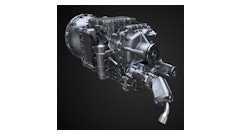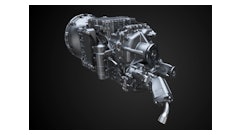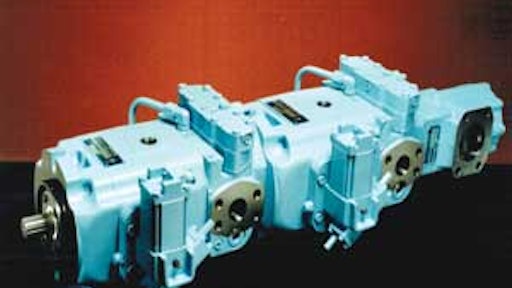
Many variables impact the life of hydrostatic transmissions. At the top of the list is oil cleanliness. “The most common failures are due to fluid cleanliness and improper maintenance,” says Michael Kanitz, marketing product manager for heavy--duty hydrostatics, Eaton Hydraulics.
“Life expectancy is also heavily dependent on the duty cycle of the machine,” says Brad Nicol, Applications Engineering, Parker Denison. “High operating speeds, high pressures, high cam angles and high shock levels will all shorten the life of a hydrostatic transmission.”
Keep It Clean
Ensuring the proper level of oil cleanliness goes a long way toward achieving maximum life. “If viscosities and cleanliness levels are maintained in the proper range, you could expect more than 5,000 hours out of a hydrostatic transmission,” says Nicol. “Even operating at the max conditions, our transmissions should last longer than 5,000 hours.”
But tight tolerances demand clean fluids. “One of the main advantages of piston pumps and motors is their high volumetric efficiency,” says Nicol. “In order to obtain these efficiencies, clearances must be very tight, so very small particles can do large amounts of damage. Remember that most damage in high--pressure hydraulic systems is done by particles too small to see, so visually inspecting the oil is not good enough.”
It doesn’t take a lot of contamination to wreak havoc. “A small number of particles can do a lot of damage in a transmission,” notes Nicol. “For example, if the flow rate through a transmission is 100 gpm, and there is 5 gal. of trapped volume in the loop, the contaminant goes through the pump and motor 20 times a minute.”
Oil sampling provides a method to ensure the system conforms to manufacturer cleanliness specs.
The cleanliness standard varies by manufacturer. “For hydrostatic transmissions used in mobile applications, our typical recommendation is an ISO 20/18/13,” says Eaton’s Kanitz.
“We recommend an ISO cleanliness of 17/15/13 or better for our piston products,” says Nicol at Denison.
But everyone agrees the cleaner you can keep your oil, the better. “Cleaner oil typically leads to longer service life for a component,” explains Nicol.
Rick Sporrer, manager for technical services, Sauer--Danfoss, reports that, according to a recent study, 19% of all incident reports received by a particular large original equipment manufacturer were caused by degradation of the oil being used in the hydraulic system. “It had to do with cleanliness of the oil,” he states.
Fluid quality also plays an important role in transmission life. “There are certain fluids that Eaton does not recommend for hydrostatic transmissions,” says Kanitz. “With some universal tractor fluids, without proper additive packages and under the wrong set of operating conditions, we have found instances where the fluid can attack the yellow metals in the pumps and motors — specifically the bronze, which is contained in the shoes, cylinder bores and bearing faces of the cylinder block.”
A good quality hydraulic fluid is a better choice. “Petroleum--based hydraulic fluids with rust and oxidation inhibitors typically work the best,” says Nicol.
You also need to be aware of the risk of cross contamination. Sporrer reports one company was experiencing failures due to contamination from attachments sent to a repair shop. “The repair shop used a low--quality grade of oil,” he explains. “This low--quality oil would then go throughout the hydraulic system and ultimately it would react with some of the yellow metals in the hydrostatic system.”
Owners Play Important Role
Sporrer cites three factors that every fleet owner can control to maximize hydrostatic transmission life: fluid maintenance, hydraulic circuit preventive maintenance and service procedures.
Fluid maintenance includes making sure the hydraulic reservoir is filled using quality refill fluids that meet cleanliness standards. Prior to adding fluid to the reservoir, always clean the cap with a lint--free rag to minimize contamination entering the system.
Dirt ingression when adding fluid is one of the most common problems. If containers are used to transfer fluids, they should be clean and resealable so you can close them up immediately. “But most importantly, the fluid you are adding to the system should be pre--filtered,” says Kanitz. Bulk oil tanks should be equipped with filters. “That is probably the most common mistake because new oil is not necessarily clean oil.”
Nicol adds, “Operating a system with a low fluid level increases the chances for entraining more air in the fluid. Aerated fluid will damage the transmission and it will accelerate the oxidation of the fluid.”
Hydraulic circuit maintenance includes making sure the oil filters are changed according to service guidelines; hoses are in good condition; oil coolers are working properly; and any venting device is operating correctly, according to Sporrer.
Finally, service procedures require strict adherence to published guidelines. For example, know the torque on fittings and do not over torque these items, Sporrer advises.
Technicians also need to be careful they do not damage sensitive electronics on today’s sophisticated hydraulic systems when servicing the transmission. Sporrer notes that many failures can be traced to wiring damage. “As they are servicing a product, they damage the sheaving on the wire,” he points out.
Maintaining cleanliness when servicing the transmission is a must. “Many hydraulics shops have a clean room where they do all of the assembly and disassembly of hydraulic components,” says Nicol. “This protects internal parts from exposure to contaminants that are normally present in the shop.”
Make sure the entire area of a machine is clean prior to removing any part of the system. Any opening should be sealed to keep contaminants out. This includes all hydraulic hoses and tube assemblies. “All fluid conveyance lines affected by failed hydraulic components or new replacement lines should be properly flushed and visually inspected to make sure there isn’t rubber dust, steel braid or other contaminants present prior to installation,” says Kanitz. “During installation, have the hose assemblies and components capped. Do not remove the caps until you are ready to install the fittings and complete the plumbing.”
Any dust or debris which enters the system will eventually result in another failure. If possible, perform all repairs in a dust--free environment.
Measure Hydrostatic Transmission Health
One gauge of hydrostatic transmission health is the charge pressure. “In our service literature, we include a step--by--step procedure for checking the charge pressure at low idle, at high idle and with some load,” says Sporrer. “Different manufacturers prefer different settings. They range from 200 to 500 psi.”
Low pressure indicates a potential problem. “If one of the components begins to wear out and the system is leaking more than the charge pump can make up, replenishing (boost) pressure will begin to drop,” says Nicol. “Catching this early can prevent a catastrophic failure that would be more expensive and time consuming than fixing the worn--out component.”
Oil analysis also plays a key role in monitoring transmission health. It provides a picture of what types of contaminants are in the oil and in what quantities. “[Oil analysis providers] will give you a judgment on whether or not you need to service the machine right now or whether the contaminant level is normal,” says Sporrer. This can head off larger problems.
“Eaton can provide a complete report that not only indicates the fluid cleanliness, but it will show the condition of the system itself and if there is a component that might be nearing failure,” says Kanitz. “In many piston pumps there is a bronze material that contains copper. If there are a lot of copper particles in the fluid, we can tell that there might be evidence of either cavitation--type damage or contamination--related damage.”
You can also gauge health through the actual performance. “If the system’s performance starts to degrade, it could be due to a number of different factors,” says Kanitz. “It could be due to the filtration going into bypass and the filter being plugged up. Most hydrostatic transmissions, if they are designed correctly, will become sluggish when the charge filtration starts to plug.” Also check to make sure case drain lines are not pinched or restricted as this can cause system overheating.
“Poor performance may also indicate excessive wear to one or more internal components in either the charge pump or high--pressure system components,” says Kanitz. “This may signal impending catastrophic failure and it should be investigated and corrected immediately to minimize costly repairs.”
Startup After Repair
Any time a hydraulic system is repaired, contaminants are introduced. Monitoring oil cleanliness after a repair is paramount to prevent problems down the road. “There are standards that every hydrostatic manufacturer has related to the cleanliness level needed at startup,” says Sporrer. “We recommend an ISO grade 23/21/15 right after startup. That is cleaned up to a 22/18/13 over a short period of time.”
Oil lines and pumps are often drained of oil during repair. If these components are not primed with oil prior to startup, they could be damaged.
“Every hydrostatic manufacturer has a startup procedure that involves making sure the cases of the hydraulic units are pre--filled with oil, and there is a clean shot of oil coming through the inlet lines into the units themselves,” says Sporrer.
“Then, as you start up the machine, you may crank it for 30 seconds before actually starting the engine. That primes everything.” The engine is then run at low idle for a short period of time.
This type of procedure helps ensure components have an adequate oil supply and will not be damaged from oil starvation during initial startup.