Compact excavators are tough little machines. Despite their smaller size, they can perform many of the same types of jobs as their larger counterparts, plus they are designed to withstand some of the most challenging operating conditions.
Yet, compact excavator performance can suffer and damage can occur if these machines are not used properly. While failures are often the result of an inexperienced operator, even someone with years of experience can cause damage by pushing the machine beyond its design limits.
Following are five important reminders to pass onto your customers so they will get maximum performance from the compact excavators in your fleet.
1. Read the operator’s manual
The amount of instruction you give a customer is going to depend on their level of experience. “An experienced compact excavator rental customer probably knows the basics, such as general operation, lifting capacities and safety guidelines,” says Tom Connor, excavator product representative with Bobcat Co.
“However, if the rental business is dealing with a new or inexperienced operator, they should consult with the customer about the safe operating procedures and lifting capabilities.”
There are several ways to instruct customers, ranging from verbal instruction to safety brochures and videos. Reminding your customers to review the operator’s manual, however, is one of the fastest and easiest ways to have them familiarize themselves with the machine they’re renting. The operator’s manual can also provide guidance on proper operating techniques for the work conditions.
For example, “if your customer is working on a slope and he puts 500 pounds of dirt in the bucket, then swings down below, obviously it’s a dangerous situation. If he swings up and puts the dirt on the uphill side, then he’s minimizing the danger that could occur,” says Mike Smith, owner/president, IHI Compact Excavator Sales.
“This is basic operator training, and our operator’s manual spells all that out. Unfortunately, people don’t read them.”
Bad operating practices are not only unsafe -- they can also affect productivity. For example, some operators will try to work with the excavator in the high--speed mode. High--speed, note sources, should be used to only travel across the jobsite. Operators will not have a lot of torque when the machine is in high--speed mode, so they assume the machine is not performing.
Another tip one can learn in the operator’s manual, according to Kenny Sato, product manager for compact hydraulic excavators for Komatsu America Corp., is when using rubber shoes, don’t travel and steer on crushed rock, rough hard rock, or edges of steel plate and scrap iron. “In our operator’s manual, we show prohibited practices for operation and maintenance,” he says. “It should be a ‘must’ for operator’s to read the manual before operation begins.”
2. Stay within the limits
As with full--size models, compact excavators have established operating capacity ratings. Pushing the machine to exceed these ratings is asking for trouble.
“All machines perform (periodically) at above their rated capacities,” notes Pat Bright, product manager, Mustang Mfg. “But to operate a machine repeatedly above its rated capacity will cause increased wear on pins and bushings, possible structural problems and increased undercarriage wear.”
Each manufacturer provides specifications for carrying a load in the front, the back and on the side of the machine. Yet these charts are not always followed, and the machine can tip over, damaging it and putting the operator at risk. Always point these charts out to your customers before they leave the yard.
According to Smith, operating capacities are established based on both stability and the hydraulic capabilities of the machine.
“In a lifting situation, for example, our rated loads are rated at 87 percent of the hydraulic capacity or 75 percent stability,” he explains. “The operator needs to keep that in mind. If he’s sitting at a severe angle, he’s going to have less lifting capacity than if he was in a stable position.”
Following capacity limits also applies when using attachments. If you have the wrong size attachment -- a bucket that is rated at a larger width than the excavator is capable of handling, for example -- that could throw the machine off balance and possibly tip the machine over.
3. Be aware
While it might seem a basic principle of equipment operation, remind your customers about the importance of knowing their operating environment. Operators should always make sure they’re operating in an area that is safe.
Special attention must be paid to underfoot conditions. Operators should be aware of the ground conditions the excavator is sitting on. These machines don’t react well to unstable ground, and they can slide sideways if the ground sinks underneath them.
Stability becomes an even bigger issue when working on uneven ground. “Operators need to position the machine properly,” says Smith. “The backfill blade on the excavator is designed for backfilling and to work as a stabilizer. They should use the blade to level the machine and get a stable platform.”
Because of their size, compact excavators are frequently used in very tight work areas. This makes it even more important for operators to check for potential obstacles that could affect performance. Neglecting to check the surrounding area could produce unwelcome results, such as getting the boom stuck in a tree branch or running into an object on the jobsite.
4. Keep it maintained
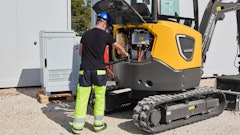
Daily preventive maintenance, including checking the fluids (coolant, engine oil and hydraulic fluid) is a must to keep compact excavators running optimally, says Connor with Bobcat. “If any of these levels are low, the rental customer should add the manufacturer’s recommended type of fluid,” he says. “It’s also important to keep these areas clear of dirt, so remind your customers to use a clean rag to check the levels.”
Regular greasing is another important, yet neglected, step to keeping compact excavators maintained. Daily greasing will keep the machine working properly for a lifetime, say sources.
Following recommended maintenance schedules is also a must. Follow recommended greasing, oil and filter change intervals, as well as ask customers to perform a daily walk--around inspection. During the walkaround, customers should check for leaks and loose nuts and bolts, as well as inspect the track tension. If the tracks are too loose or tight, they should be adjusted after greasing.
Proper preventive maintenance becomes even more critical when the machine frequently powers hydraulic attachments, such as hammers.
“Whenever the machine is using attachments, whether it be a demolition hammer or an auger, we recommend that you change the hydraulic oil and filter on a shorter interval than normal,” says Smith. Vibration from hammer operation can also accelerate wear. “You need to pay attention to connectors to make sure everything’s tight to minimize the potential leaks. You might also need to shorten up the grease intervals.”
5. Think safety
Safe operation of compact excavators lies primarily in the hands of the operator, which could make you think that it’s out of your hands. However, you need to stress to customers before they leave the yard the importance of keeping safety in the forefront of their minds. One important tip to pass onto customers is to resist the temptation to “go around” the safety restraints of the equipment. “There are built--in safety features on the machine for a reason,” says Smith. “To get under parking garages or in certain places, we’ve seen operators take the rollover protection system off, which is obviously not a good thing.”
Ultimately, safe operation of compact excavators comes down to common sense. Remind customers of this -- if something looks dangerous, they probably shouldn’t do it.
Match the machine to the job
When renting compact excavators, the most important thing is matching the unit to the application, say sources.
“Operators should check whether the machine’s size, working range, digging force and lifting capacity are enough for the job,” says Kenny Sato with Komatsu America Corp. “The availability of pattern change function (for the controls) will be important, because the operator can operate the machine with his/her preferred control.”
Tom Connor with Bobcat Co. agrees. “Matching the right machine to the application is very important,” he says. “It’s also important to make the customer feel comfortable. You need to put the customer in a machine that gives them the right amount of performance (dig depth, cycle times, etc.). You also have to match the attachments to the excavator.”