Technology in Class-6 to Class-8 vocational trucks tends to evolve at a moderate pace. But exhaust emissions and fuel-efficiency regulations have accelerated the rate of technology adoption that is expected to transform truck offerings in the medium- and heavy-duty market in a relatively short ten years.
"We will see an increase in alternative fuels with no revolutionary technology in the next five to ten years" says Len Deluca, director, Ford Commercial Trucks. The company's strategy is to offer choices. "One technology may work for one customer, but doesn't work for another. There is no silver bullet. Ford believes alternative fuel selection is the future. It will all depend on the application and what the customer needs. Diesel engines will continue to be the predominant engine."
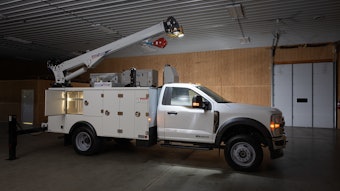
In addition, gasoline engines may start making headway in the medium-duty market. "We foresee an opportunity with our upcoming 2012 F-650 truck with a 6.8-liter V10 gas engine," says Deluca. "There are many advantages that a gas engine has over a diesel engine, in particular, acquisition price. It will give customers who don't need the full capability of a diesel powertrain a more economical purchase option."
Focus on fuel
Fuel economy is always top of mind for commercial truck owners. "It is the biggest operational expense for many customers," says Deluca. "Ford expects the cost of diesel will continue to increase in the future."
The upcoming heavy truck fuel economy standards will impact vocational truck offerings."The new fuel economy standards will mean a higher acquisition price, but it should be offset by reduced fuel costs over the life of the truck," says Deluca. "Customers should also expect more alternative fuel choices offered by manufacturers to help offset rising diesel costs."
"The 2014 Greenhouse Gas (GHC) regulations will make both OEMs and customers look at fuel economy from a broader perspective than in years past," agrees Brad Williamson, manager, engine and component marketing, Daimler Trucks North America (DTNA). "But this will not change our direction to always provide innovative products that are both good for the environment and our customers' bottom line. Many changes (for both engine and truck technology) will be moderate in pace with a constant focus to improve on what we can offer today, yet still keeping our eyes open for potential developments that could accelerate the pace of change."
It all centers around fuel efficiency. "We will continue to work to get more fuel economy," says Bob Mann, Navistar. "Fuel economy is tremendously important for every application."
Vocational trucks will need to take a much different approach than over-the-road tractors. "In the vocational world, there are not a lot of things we can do with aerodynamics," says Mann. Instead, much of the focus will revolve around certain truck accessories. "Today, a lot of those are basically driven off the engine. We are going to be looking at other ways to [drive them]."
Engines have limitations on how much economy you can extract. "If you want to get a certain amount of horsepower out, you are still going to have to put a certain amount of fuel in," notes Mann. "We are already running two turbochargers. We already have high-cylinder injection pressure. It is going to have to come in some other ways than just the engine." Some of the possibilities include reduced driveline friction, different gear ratios and methods to power accessories on the truck without the engine running.
Recent changes in the vocational truck market have really been driven by government regulation and aren't directly tied to customers' bottom lines. That said, OEMs are working to ensure a return on investment.
"The changes that DTNA is working on benefit the customer, and this means an acceptable payback period for any equipment price increases," says Williamson. Many of the demands for off-highway trucks are the same as on highway: fuel economy, weight, durability and uptime. "DTNA is working closely with our partners (internal and external) to evaluate all options for new components to ensure the finished products we produce meet the customers' needs, promote the cleanest technologies available and position us for long-term success."
The company's Shaping Future Transportation Initiative has resulted in a wide technology offering, including SCR, hybrid, natural gas, electric and biodiesel alternatives. "This allows the customer to test various products to make their own decisions as to what technology works best for their business," says Williamson. "In the long run, it will be customer demand that decides the technology the industry will accept and make successful."
Alternate fuels march
"When you 'go green' you are basically giving up payload in some shape or form," says Mann. "If it is a hybrid, you are going to be adding a tremendous amount of weight for the drive motor and the bunk that holds all of the extra batteries. If you buy liquefied or compressed natural gas, you are going to be adding some incremental weight with the tanks, and bigger tanks require bigger straps and bigger brackets." But the benefits in terms of lower operating costs make the tradeoff worth the price for some customers.
Ford offers everything from compressed natural gas (CNG) and liquefied natural gas (LNG) to hybrids, plug-in hybrids and battery-only electric vehicles. "The Ford full line of trucks (Transit Connect, F-Series and E-Series) all offer some type of an alternative fuel option. By the second quarter of next year, all of the trucks will offer the CNG/LPG option," says Deluca.
Rousch CleanTech is working with Ford to develop the propane-powered trucks. The first to hit the market will be the F-450/550, available in second quarter of next year. They will be followed by the F-650, which will be the company's heaviest propane truck to date. Ford has already re-introduced a 6.0-liter gas engine, and the propane version will be available later in 2012.
Propane has several attractive charateristics. "It favorably compares with a diesel from a performance standpoint," says Todd Mouw, Rousch CleanTech. "Obviously, the low-end torque of a diesel is hard to match with propane, gas or CNG." But propane's characteristics are better than CNG. "With CNG, typically you are going to see some kind of power loss."
Like gasoline and diesel, propane is stored as a liquid. "You need less capacity and tanks to go your desired distance of range," says Mouw. "The tanks we put in the vehicle typically use the same package space as gas or diesel. Propane is a 104-octane fuel. It is cost effective and much cleaner than diesel. It will package and perform much like diesel."
Propane burns cleaner than gasoline or diesel. "Typical vehicles that are fueled by propane autogas emit 12% less carbon dioxide, about 20% less oxides of nitrogen and 60% less carbon monoxide when compared to gasoline vehicles," says Steve Wayne, Propane Education and Research Council (PERC). Currently, PERC has partnerships with companies such as Rousch CleanTech, Freightliner and General Motors.
According to Mouw, propane is actually safer than gas or diesel. "It has a narrower flammability range and a higher flashpoint. The flashpoint is much hotter than gas or diesel and the air mixture/fuel ratio has to be just perfect for it to ignite," he explains. In addition, there is no risk of ground contamination. "In fact, when propane is not under pressure, it doesn't pool up as a liquid. It just vaporizes and dissipates."
Propane tanks are made of 1/4-in. steel. "They are 20 times more puncture resistant than conventional fuel tanks," says Wayne.
There is a good business case for propane, as well. "Historically, propane has been 40% less than gasoline," says Mouw. "We see that decoupling even further. " With a Ford F-550, he estimates you could save as much as $20,000 over the course of 150,000 miles.
Of course, availability is always a concern with alternative fuels. "We are really well aligned to support the construction market infrastructure," asserts Wayne. "We have partnerships in place that really support the fleet operator when they do make a decision to move to alternative fuels. The ease of refueling has led to accelerated growth of using these vehicles. There are thousands of these propane autogas refueling stations already in the U.S."
"Ninety-seven percent of the propane that we use in this country is domestically produced fuel," Mouw points out. "We are exporting 2 billion gallons of propane today out of this country."
"We also have quite a bit of additional propane coming on line," adds Wayne. "We will have an abundance of propane fuel in North America."
Navistar is moving in a different direction, choosing to develop LNG and CNG vehicles. "The beauty of LNG or CNG is they have a completely different flashpoint than propane," says Mann. "They are lighter than air. If you were to run into a CNG truck and the tank got punctured, [the fuel] would just basically evaporate into the atmosphere."
The performance of LNG or CNG is basically the same, says Mann. The difference comes in how it is fueled. Users of CNG tend to have dedicated fueling stations, while LNG doesn't require a dedicated fueling source. "In addition, it is much quicker to fill the LNG than it is the CNG," he states.
Navistar is working with Clean Air Power to transform its MaxxForce 13 into a dedicated gas engine. "They basically put six injectors on the front of the air intake," says Mann. "It runs on a mixture of 15% diesel and 85% LNG. The packaging of LNG is a little more friendly that CNG. It has the advantage of using off-the-shelf components."
Hybrids ahead
Navistar was one of the leaders in the move to hybrid technology with the introduction of hybrid utility trucks, where the engine can be turned off and the body operated with stored electrical energy. This makes a lot of sense in applications where trucks do a lot of starting and stopping, generating electricity that can then be used to run equipment with the engine off.
BAE Systems has vast experience with heavy-duty hybrid drive systems. "We have 3,500 of these systems on buses today," says Mike Mekhiche. "About 3 1/2 years ago, we started looking at the truck market. We spent over a year analyzing the best architecture, particularly the heavy-duty vocational truck market."
The result is the HybriDrive Parallel Hybrid drive system, which has an electric motor/generator located between the engine and transmission. "The automatic transmission is controlled entirely by the hybrid system," says Mekhiche. "The software and shift maps are actually tailored for the application."
There is a lithium-ion storage system. "It is liquid cooled and completely sealed from the environment," says Mekhiche. "A system controller manages energy flow between the wheels and battery... It is a very simple, common architecture."
Unlike many other hybrids, it is designed to withstand the demands of the on/off-road environment. "We have designed this system to be a true heavy-duty propulsion system. The differentiator is we do have a clutch between the engine and electric machine itself," Mekhiche explains. "That clutch allows us to basically separate the powertrain from the engine. Doing that allows us to launch the vehicle electrically without support from the engine. The engine is then revved up to the appropriate speed where it is most efficient. At that point, you re-clutch and connect to the engine." The result is less fuel consumption and lower emissions.
While on the jobsite, you can declutch from the engine and operate equipment on the truck electrically. If you need to inch forward, you can do that without turning on the engine. "It saves a lot of fuel and a lot of noise," says Mekhiche.
Two electric variants are available with a choice of transmissions. "There is a 70-kW (94 hp) with 400 Nm (295 lbs.ft.) of torque and a 110-kW (148 hp) with 800 Nm (590 lbs.ft.) of torque," notes Mekhiche. "Depending upon the size of the vehicle, the vocation and duty cycle, we can marry one of the two electric machines with four different transmissions to get the maximum torque." For a Class 8 construction vehicle, you would use a CX 31 transmission and the 148-hp, 590 lbs.ft. variant. "With that kind of power and torque, you can propel the vehicle electrically without support from the engine.
"We designed it so that it interfaces with engines anywhere between 300 and 650 hp, whether it is CNG, diesel, or gas," Mekhiche continues. "The HybriDrive provides the best performance in duty cycles where you have some level of stop and go. With all types of duty cycles, we are showing an average 30% fuel savings." In addition, the system recaptures energy when you take your foot off the throttle, saving wear and tear on the brakes.
"We are going to ramp up production by Q4 of 2012," says Mekhiche. "At this stage, we are working with a number of OEMs."
Challenges on the horizon
The biggest challenge for the future remains federal oversight. "There always seems to be some surprise that comes up in the form of government legislation," says Mann. "As regulations come into effect, most of it is going to add equipment on the truck."
Regulations come with a price, which ultimately has to be passed on to the consumer.
"The cost of the truck will be the biggest challenge facing the Class 6 to 8 vocational market," says Ford's Deluca.