Southeast South Dakota Union County Public Works Administrator, Raymond Roggow, has applied fog seal to all of his county's chip-sealed roads for most of the past five years and is very pleased with the results. This practice has allowed highway officials to extend the life of chip-sealed road surfaces for at least one year, he says, which significantly reduces highway maintenance costs.
"We have no more windshield calls since we started fog sealing," Roggow says. "That's been a very positive outcome of the practice. Before we used the fog seal, we were striping our roads every year. Now the striping is lasting two years or more before it has to be redone. That's significantly reducing our maintenance budget."
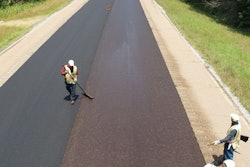
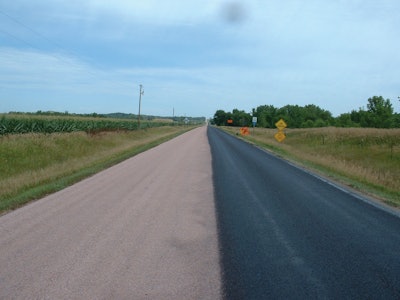
Roggow also appreciates the contrast between the dark surface of a fog sealed road and the striping. He says the benefits of fog sealing haven't gone unnoticed by drivers in the county.
"When you apply fog seal, the road looks like it's been overlaid with asphalt," Roggow says. "People like the finished appearance of the road. They also appreciate the visibility of the striping at night. It makes nighttime travel much safer. With the dark road surface, you also have an advantage in winter. Ice and snow will melt somewhat faster because the road surface heats up more quickly on a sunny day."
Fog sealing is an application of asphalt emulsion sprayed onto a pavement surface with or without a sand cover. The emulsion is diluted to the proper consistency to obtain complete coverage of the roadway. Because fog seal works better on a coarse aggregate surface where asphalt emulsion has room to pond between aggregate particles, fog sealing is a highly satisfactory complement to a chip seal surface.
If fog seal is applied to a smooth aggregate surface, a dry choke cover is applied to prevent a slippery road surface. The choke is generally sand or aggregate less than 0.25 inches in diameter.
Fog seals are used to delay weathering of pavement, to waterproof pavement surface, to improve the pavement/s ability to keep water from penetrating the base course or subgrade and to reduce raveling.
The necessities
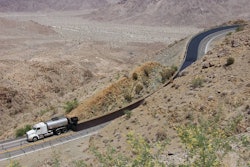
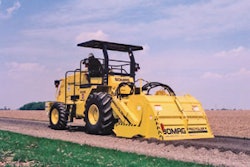
Equipment required to apply fog seal is a distributor truck used to dispense the asphalt emulsion. If sand is applied, a sand spreader is also required. Fog sealing a chip sealed road requires brooming excess chips with a power broom prior to application.
Roggow notes that Union County didn't need to purchase any additional equipment to implement the fog seal.
"We use a Roscoe 2,500-gallon unit that sits on the bed of an older Ford truck," Roggow says. "When we started using fog seal in 2005, we did some test sections. We were pleased with those first results and started using fog seal to follow up all our chip seal work."
Jebro, Inc. in Sioux City, IA, provides the non-polymer emulsion for Union County. The product is a CSS-1 and CSS-1H type and grade with application temperatures between 100 and 170 degrees.
Recommended application rate is 0.10 to 0.15 gal/sy; a 1:1 dilution. Jebro, Inc. Account Manager Mike Spohr says fog sealing has gained popularity in recent years primarily because it helps reduce costs.
"Everyone likes the fact that it helps hold aggregate in place once a road is chip sealed," Spohr says. "It's easy to apply. One of the challenges to using it is making sure weather conditions are just right so it sets within a couple of hours."
The challenges
Sunny, warm and dry are the conditions best suited to fog sealing. A breeze will help set the emulsion that much faster. Roggow says his crew generally selects a 10- to 15-mile stretch of road that was recently chip sealed and contacts residents along the road so they can plan to restrict travel while the emulsion is being applied.
"We post someone at every intersection so we can keep them off the road till the emulsion sets," Roggow says. "We bring in a tanker of the product and apply it at whatever rate will utilize that tanker load. Typically we apply 1,500 gallons of 1:1 dilute to 15,250 square yards of road, which normally equals both lanes for one mile of road. If we have a little less road, we apply at a slightly higher rate. We don't apply it at less than 0.10 gallons per square yard."
John Hazen in South Dakota's Hutchinson County has also started using fog sealing. He has had success in applying as much as .23 gallons per square yard and says he doesn't apply the emulsion at less than .20 gallons per square yard.
"We get a longer lasting surface at the higher application rate," Hazen says. "We've used fog sealing on 100 miles of Hutchinson County roads. We're waiting to see how the road surfaces compare to other roads without the fog seal and ensure we can justify the cost. We do expect to realize some cost savings with the fog seal process."
Hazen also uses a Roscoe distributor. Both Hazen and Roggow strive to apply fog seal as soon as possible after completing a chip seal. Hazen also works on a 10-mile stretch of chip sealed road, blocking intersections along the route.
"Wind and sunshine are really key to getting the emulsion to set up," Hazen says.
In the five years that Roggow has used fog sealing, he's only had one incidence when the weather didn't cooperate and the emulsion took nearly 24 hours to set.
"The forecasted weather conditions didn't materialize," Roggow says. "We just got done shooting the emulsion when a fog rolled in. We babysat that road into the night and thought by sundown we should be okay. We had a couple instances of people driving on the road during the night and having emulsion on their vehicle. By morning the emulsion finally was set. Now we watch the weather like a hawk and do all we can to ensure we'll have the warm, dry conditions we need. The warmer the better."
Adopting the fog sealing process
The State of South Dakota conducted some fog seal tests on a number of roads before adopting the process. South Dakota Department of Transportation Area Engineer Ron Peterson at Yankton says the State of Minnesota offered a presentation on fog sealing after using it for a number of years. The information spurred the SDDOT to explore the benefits of the process.
"Fog sealing is now a standard process for the SDDOT," Peterson says. "The primary aggregate used for chip sealing in southeast South Dakota is pink quartzite rock. It's extremely hard and durable. The drawback of the aggregate is the sharp, angular shape of small particles which can damage a windshield if it's picked up and thrown by a tire."
SDDOT applies fog seal emulsion at a rate of 0.05 gallons per square yard, mixing it with an equal amount of water. Their cost, using a contractor, is approximately $800 per lane mile.
When chip sealing is followed by fog sealing, the life of the chip sealed road is expected to be at least six years and as much as seven years.
"It depends on the volume of traffic," Roggow says. "If we possibly can, we do the fog seal two or three days after the chip seal. If the chip seal sits too long and the weather's real hot, the quarterlanes will start turning black and the fog seal doesn't adhere to the chip seal rock as well. We calculate that we're saving about 17 percent of the maintenance cost on each road we fog seal, just because that road surface lasts longer.
"We were probably one of the first South Dakota counties to start using fog sealing," Roggow adds. "I know the highway superintendent in Pennington County, on the western side of South Dakota, is fog sealing his chip sealed roads in lower traffic areas that last up to seven or more years instead of five. We'll keep using it. We've been impressed with the results."