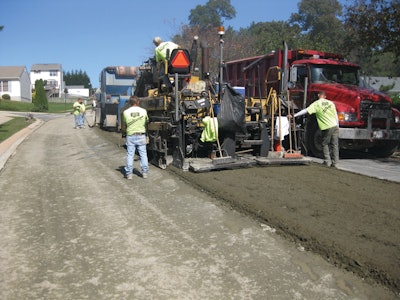
The City of Havre De Grace, MD sits at the intersection of the Susquehanna River and the start of the Chesapeake Bay. This is one of the East Coast's most naturally beautiful and sensitive locations, so it's only fitting that a very green technology was used to reconstruct one of its roadways.
The City Public Works Director Larry Parks and the consulting engineer, Kercher Engineering of Newark, DE, had a major issue with one of the roadways within the city. Canvasback Road services a very large residential population as a feeder road and also serves as a short-cut to Maryland SR 40 and SR 155.
SR 155 has a direct exit onto I-95 North and South just west of the city. A very large number of school buses also used Canvasback Road to pick up and drop off school children in the city and other locations within Havre De Grace and Harford County.
Total reconstruction needed
The cross section of Canvasback Road was four inches of old asphalt, zero to 2 inches of aggregate and a subbase of clay and other unsuitable materials. The old oxidized asphalt was inundated with potholes, alligator or corrugated cracking, and longitudinal cracks.
In some areas, there were subbase issues with the underlying base pushing through the asphalt causing occasional “soft & yielding." Storm water penetrated the cracked pavement making these already deteriorated pavements even more susceptible to continued damage. Canvasback Road needed to be totally reconstructed.
With total reconstruction, the city would need to mill and remove the existing asphalt pavement. The reclaimed asphalt pavement (RAP) would then go to an asphalt plant for crushing and be introduced back into a new hot mix asphalt (HMA) base or a HMA wearing layer.
One of the issues with the removal of the asphalt on Canvasback Road was the inconsistent depth of the asphalt. In some areas there were four inches of asphalt, in other areas, there was as little as two inches. The added unsuitable soils pushing up through the asphalt would cause these materials to not be accepted by asphalt plants because of contaminated RAP.
"If the roadway asphalt depth is varying, it's hard to control the depth of cut on a mill machine and contaminated RAP is produced," says Mike Polak, a partner with E. J. Breneman. "This type of material is likely not to be recycled back into a new HMA, as separating the aggregates and soils from the RAP is time consuming and difficult."
After the asphalt pavement is removed, the underlying aggregate would be removed. On Canvasback Road, the aggregate was very limited. "What do we do with the unstable soils?" says Polak. "At what depth should they be removed? How should the remaining material be stabilized?"
With the issues of total reconstruction mounting and realizing that the excavated waste material would have to be placed into a landfill or disposed of environmentally, the city had to look for another option.
Kercher Engineering had the task of finding a solution to the reconstruction of Canvasback Road. Alan Kercher contacted E.J. Breneman L.P. and consulted with Polak.
Choosing the process
A survey was conducted on Canvasback Road that started with a walk through the project from SR 155 to Chapel Road. It became very clear that the roadway needed to be stabilized using full depth reclamation (FDR).
The FDR process rebuilds a worn out asphalt pavement by recycling the existing pavement. The old asphalt and base materials are pulverized, mixed with cement and water, and compacted to produce a strong, durable base for an asphalt surface.
"Unfortunately, on new development roads, subgrade issues are a problem," says Polak. "Specifications and inspections are not adhered to, then after several years, the problems start to surface. Asphalt pavements start to crack or just totally fail; mud pushes up through the aggregate and the cost to repair is a heavy one. Canvasback Road had been one of these unfortunate roadways."
Cold in-place asphalt recycling train
There are some instances where another FDR technique is being used. E.J. Breneman has been using its cold in-place asphalt recycling (CIR) trains to reclaim thinner lifts of deteriorated roadways.
In 2002, an CIR experiment at a depth of 8 inches was conducted on a roadway in Limerick Township, Montgomery County, PA using Portland cement as the additive.
The Cold In-Place Asphalt Recycling Train is normally used with emulsified asphalt to re-build recycled asphalt roadways.
On the Limerick road, too much soil contaminated the asphalt. The developer contracted Breneman to CIR the roadway. The 3 inches of asphalt binder was in very bad condition (open graded) and resulted in a soft subbase with little to no underlying aggregate. "This was not a CIR project," says Polak.
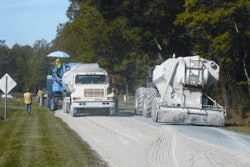
The logistics of sending one of the reclaimers to the project site was out of the question it was decided to use the CIR equipment as this equipment was already on site. Portland cement was spread. The cement and 8 inches of material including asphalt, aggregate and soils blended together to make an homogeneous blend of material.
Because the down-cut milling head mixes the materials continuously until it expels them onto the conveyers in the center of the machine, the material is completely hydrated.
"Because of the limited depth of reclamation on this project, the CIR train was best suited. But, it will not cure issues that exist below 8 inches, “says Polak. "The reason the depth is limited is due to several equipment features and the existing roadway material conditions."
One concern is the down cutting drum and the available space in the cutting chamber of the mill, says Polak. Unlike reclaimers that basically cut the proposed depth and send the reclaimed material over or under the cutting mandrel and place the sized material under the mole boards and out onto the surface of the roadway, the CIR mill keeps the material in its chamber longer. The cut material needs to travel along the built in augers to the center of the mill-head where it is expelled onto the first stage conveyor. With the material in the head longer, it does mix all the cut materials, additives and, any extra water needed, thoroughly as the material is continuously rotated over the head.
"This is an advantage for mixing, but it then limits the depth of cut and becomes a disadvantage," he explains. "The deeper you cut, the more material is generated and the more additives needed. At some point the head would become overwhelmed and the processing box overloaded with excess material."
Another reason the process is limited is the material is paver-laid. "In all instances, a traditional bituminous paver has been used to place the new cement-treated base to the desired depth and scope, the paver can only handle a certain amount of processed material and this is also a limiting factor," he says.
Challenges of Canvasback
Canvasback Road had curb and gutter pans on both sides of the roadway. In every intersection there are a minimum of three and sometimes four water valves.
Accompanying the water valves, there were manholes in each intersection and many others throughout the lineal sections of the roadway.
Traffic was a major issue, and it was determined that the roadway must remain open at all times to vehicular traffic. There were a total of 12 intersecting roadways. None of the intersecting roadways had access to other roadways, so no diversion plan could go into effect. All traffic would need to be controlled and dealt with on Canvasback Road.
There was approximate 17,000 square yards of roadway on Canvasback Road. "Of the 12 intersecting streets, some are cul-de-sacs while others intersect with each other, but all streets are connected to Canvasback Road," says Polak. "As already stated, traffic control was a major part of this project. A detailed traffic control plan would need to be developed."
Overcoming the challenges
On Canvasback Road, the concrete gutter pans posed a special challenge. The old asphalt was in some areas an inch or more above the gutter pan. The new HMA was to be placed at a depth of 2.5 inches and above the 8 inches of in-place Portland cement base, which meant the removal of some existing material prior to the in-place cement treatment.
The disadvantage was that the removal needed to be done in conjunction with the in-place Portland cement base. "One of the project requirements was no open cuts or drop-offs would be tolerated during construction, overnight and weekends," says Polak.
The other consideration was the 48 water valve covers and 28 manholes. "The utilities needed to be removed before construction," says Polak. "The mill could traverse the utilities, but the low profile of the paver and height of the screed would not be able to go over or around them."
All of the utilities where removed before the major construction took place. Steel plates had been placed over the area of the utilities so no debris would enter storm or sanitary sewers and water valves would not get clogged with fines from the operation.
Another challenge was the areas that showed deeper lying issues that needed to be repaired prior to operation. These areas where cut to a depth where the base became solid. Stone was placed to grade and compacted, and then two inches of hot mix binder course was placed and compacted to keep the aggregates in the patches stable.
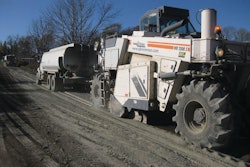
E.J. Breneman used a Wirtgen milling machine with a 2-foot cutting head to excavate along the concrete gutter pans to a depth of 10 inches immediately in front of the in-place Portland cement train. This material was exported from the project site and placed in a recycling center for future use.
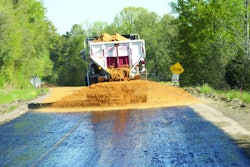
As the gutter pans where exposed the next part of the construction practice was applying the additive. E.J. Breneman used a Stoltz spreader to place its additives.
Determining the additive
Before the project started, a Geo-technical Engineer was hired by E.J. Breneman. Materials at the depth of re-construction in several areas had been taken from Canvasback Road.
"When taking samples for FDR, it's important that the section of sampling represents the total depth of the operation that will follow," says Polak. "If it's deemed the depth of reclamation is 10 inches, then the sample taken should also be at that depth. The sample should include a representation of all the materials from the asphalt down through the aggregate to the soils in the subbase.
The entire section was tested and, once analyzed, the geo-technical engineer tested for a compatible additive or combination of additives to add to the combined material at different percentages. Different additives can offer differing strengths, dry and lower moisture contents, or modify soils.
It was determined Portland cement was the correct additive for Canvasback Road. Different percentages of Portland cement were mixed with the additive, broken after curing at different intervals of time such as 7, 14 and 28 days. "This will give different strengths of the materials and guide Kercher Engineering to establish what strengths Canvasback Road would need," says Polak.
Kercher would take into consideration the ADT (average daily traffic), what type of traffic, ESALs and loading. They may also take into account any future development that might impact the roadway in years to come.
Applying the additive
Once the Geo-tech report was given to the engineer, he then established a mix formula for the project, normally what PSI (pounds per square inch) is required on the entire roadway. Based on the report, the contractor then calibrated its dry bulk spreaders to spread the required Portland cement evenly to mix and produce a compacted base material that will in the prescribed time yield the correct PSI.
"The Geo-tech was represented on the project at all times there is mixing and placement underway," says Polak. "One of his duties is to check moisture in the mixed materials, take mixed samples and produce cores in the laboratory for testing. The Geo-tech had a nuclear gauge with him during the period of time mixing was taking place."
Once the material was placed by the paver, it was compacted. As the process progressed along both gutter pans, the paver left the new mixed material flush with the top of the gutter pan.
Then under compaction, the material compacted down and left a 2.5 inch reveal below the top of the gutter pan. This allowed for the 2.5-inch HMA, which would need to fit flush with the top of the gutter pan.
A 12-ton steel dual drum vibratory roller was used for compaction of the new cold in-place Portland cement base. The base material produced was very dense graded and compacted well. A 25-ton pneumatic-tired roller was also used to aid in the compaction effort.
Advantages of in-place method
"One of the most significant effects of this in-place method is there is no grading of the material by a motor grader," says Polak. "Once the base is laid, it's basically finished. There is no segregation of fines from larger particles. The final grade is set by the paver, similar to that of paver laid concrete."
At the end, the in-place Portland cement base receives a prime coat - usually emulsified asphalt that has been cut with water at around 50 percent. The prime coat is sprayed on the entire surface and will protect the air from dust. It will also slow the curing of the base, holding moisture in the mat longer. If the product cures too fast it could prematurely crack.
Once the Canvasback Road in-place Portland cement was completed, crews from Goettner, a sub-contractor to E.J. Breneman, raised all the utilities to a height of 2.5 inches above the cement base. In October 2011, Goettner also applied the final HMA application. Traffic control devices where added along the entire roadway and the project was finished.
"This type of process needs careful consideration because of the depth of cut," says Polak. "At 8 inches deep, the base will support the hot mix overlay and the traffic above.
"In no way does in-place Portland cement base take the place of FDR," he concludes. "The process is just another idea that works and is suitable for certain instances. This process is value for money. It is green, saves time, saves natural resources, saves commuting time and saves funding."
E.J. Breneman L.P. was established in 1942 and has been using new green technologies since 1983. The company has been a member of the Asphalt Recycling & Reclaiming Association (ARRA) since 1986; Mike Polak is a past president of ARRA.