Information from this article was first published in Demolition Magazine and is being reused with permission from the National Demolition Association.
The seven-story brick Savoy Apartments Hotel is notable as the first public building in Houston to have electricity. However, the roof had caved in and the structure had begun to pull apart vertically due to a crack from the top to bottom of one wall. In the weeks before the demolition, pedestrians had reported bricks were falling from the decaying structure.
Cherry Demolition, Houston, Texas, doesn't often get to demolish structures as old as the Savoy, particularly ones that are built almost entirely of brick. The 103-year-old brick structure had no concrete or steel columns but instead was held together by bricks.
"It's rare that we come across a building constructed like this in the Houston market," says Mike Dokell, Division Manager for Cherry's Commercial, Residential and Interior Division. "The building was not a good candidate for implosion for several reasons, and it needed to be taken down by an excavator."
Dokell says implosion was never an option because the original hotel structure was attached to a 17-story addition and to a low-rise structure, both of which needed to remain intact.
"The hotel's exterior brick walls had huge cracks, and this made the building very unsound. What's more, the back third of the building was in bad condition, and that portion of the hotel roof had collapsed in 2001. The collapsed roof section also had caused the top five floors in that area to fall in," he says.
Because the building faced Main Street, Dokell was concerned that imploding the unstable building could damage Metro's light rail lines. Metro suspended a portion of its light rail operations in front of the building at about 6:00 p.m. one Friday night with plans to restart early the following Monday.
"We had a brief window of opportunity in which to do this job," Dokell explained. "So, we had to be ready to start right away."
Cherry had several goals for the Savoy demolition project:
- Take the building down safely
- Ensure that there was no damage to:
- Main Street
- several large oak trees near the building
- adjacent 17-story addition
- attached low-rise structure
Demolishing the 103-Year-Old Brick Building
Preparations included installing protection on top of the adjacent low-rise structure to prevent damage from falling building debris. The company coordinated with the Houston Police Department to maintain a 400-foot barrier surrounding the structure.
"Because of a city order that had declared the building a safety hazard, Houston Police were already on site before we began and remained on patrol until after we were finished," Dokell says. "The Houston Fire Department assisted by keeping a constant stream of water on the building to ensure there was zero dust throughout the demolition."
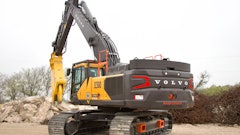
Cherry's six-man crew began the demolition at about 10:30 p.m. immediately after Metro disabled the power source for the light rail operation. Cherry used its PC600 Komatsu excavator equipped with a modified boom with a 90-foot reach.
"Because the back one-third of the building was so unstable, we began removing some of the more damaged sections there before moving to the front side of the building," Dokell says. "When we got on the Main Street side, we placed crane mats in the street for protection and began the tedious job of dismantling the rest of the structure from the front."
Dokell says demolishing a brick structure is quite different from taking down other, more conventional structures. Every brick is essentially a joint, so it is difficult to predict exactly how the building will fall while the demolition process is underway.
"Our key in taking down this building was to take a 'nibble' and 'peck' approach - we didn't want to get too aggressive. That is, we took the building down slowly and methodically. We took out small chunks of the building before moving on to other sections. That way, we could better control how the structure came down and contain the resulting debris," he explained. "We also were very pleased to see that our high reach excavator did what it was supposed to do," he added.
Dokell says his crew worked around the clock from 10:30 p.m. Friday until about 4:00 p.m. on Sunday and brought down the most critical portions of the building without incidents and only minimal impact to nearby structures. The building was finally at a stage where it was no longer a safety hazard.
"We cleaned up the debris from the Main Street side so Metro could restart its light rail line operation the next morning. We only had a small amount of glass to replace in the adjoining 17-story structure. There was no damage to the low-rise building," Dokell says.
"From an operational standpoint, we considered the job a big success. We were extremely pleased with the efforts by our people. They worked together well as a team, and lots of folks from all our other divisions were very supportive and volunteered to help do whatever we needed. We really had all the tools, equipment and people we needed to get this job done right and on time,” he says.
Cherry's crews returned to the site Monday morning to begin removing the middle third of the building. This task was accomplished by the end of the week, and the site was cleared of all debris by the end of the following week.
Unable to Recycle
Because the building had been so unstable, Cherry was only able to access the structure's basement, first and second floors before the demolition. Because of this, the company was unable to remove any salvageable or recyclable items from the old hotel or perform asbestos abatement work. Because the building debris contained asbestos, all materials from the demolition were taken to an approved landfill site for disposal.
"For us, as a major recycling company, it was terribly disappointing not to be able to salvage or recycle any materials from the Savoy building," says Leonard Cherry, owner and principal of Cherry. "In the majority of our demolition jobs, we are able to go in and remove salvageable items and then recycle about 88 percent of all building materials, including concrete, steel and other building components."