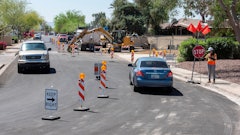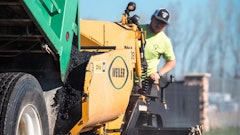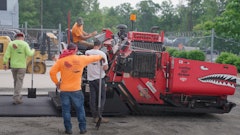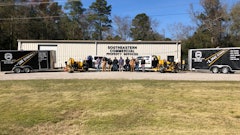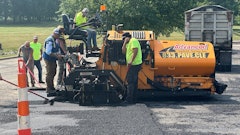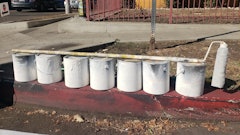
Striping equipment comes in all shapes and sizes from large dedicated truck-mounted units and more portable palletized and tow-behind stripers to walk-behind stripers. Each has its place. When deciding between truck-mounted and more portable stripers, however, the application and how much money you’re willing to spend take top priority. But they’re not the only determining factors when selecting the right equipment for the job, say manufacturers. Striping units have a variety of features all designed to enhance productivity, no matter how big or small the job is.
Start with project scope
The key factors that best dictate what type of striping equipment you will need are based on your target job size, the specifications of governmental agencies, and the budget you have to work with, relates Steve Shinners, vice president of sales and marketing for MRL Equipment Co. “Our truck-mounted paint striping units start at about $170,000 and up as compared to half that price for a pickup truck and a palletized unit. But larger stripers have their advantages. In addition to capacity, they offer a more stable platform than smaller units, and a cab-over truck provides better visibility and can offer higher production than palletized units. They can also accommodate larger air compressors for loading paint, glass beads and applying the paint.”
MRL Equipment Co. manufacturers a full line truck-mounted stripers, with compact models starting with capacities of 120 gallons that have all of the same features found on much larger stripers, says Shinners, who emphasizes that production is extremely important today. “Contractors need to be on target when it comes to matching a machine to application. In other words, you don’t want to put a small palletized unit on a highway job or employ an expensive, large capacity truck-mounted unit to stripe small municipal roads and apply temporary markings.”
The first step before making any purchase is to match the machine to the scope of the projects, says M-B Companies Eastern Regional Manager Rob Bowman. “Ask yourself, how many miles you’re going to put down every day. Obviously, if you’re looking to apply 50 lane miles a day, then a pretty large truck will be required to accommodate large paint tanks. Or is the equipment going to be used primarily in an urban area? A smaller truck with a shorter wheelbase is a better choice for areas where it can be difficult to maneuver. “
M-B Companies manufacturers both palletized and truck-mounted stripers, including the Model 155 Airless and Model 320 air spray pallet units and the Advantage 500 truck-mounted paint striper. Adds Bowman, “Some contractors would like to use their trucks for other applications during winter months. In that case, a palletized unit or tow-behind striper would be the better fit.”
Graco’s Global Product Marketing Manager for Pavement Tim Wehner agrees. The company’s two road striping units, the RoadLazer RoadPak System, to be used in the back of a pickup, with a trailer, or on a utility vehicle, and its RoadLazer Tow-Behind striping system, are ideal for striping airports, construction zones, highway ramps, and large parking lots. “These units fit best on jobs that are more confined,” he explains, “and they are the perfect solution for municipalities, airports and larger parking lots.”
One doesn’t have to sacrifice features with size either, he adds. “Big truck-mounted units, for example, sport camera systems that allow drivers to restripe by themselves. Now, smaller units like RoadLazer offer the same system, along with double-acting guns providing extremely accurate starts and stops to ensure a perfect restripe match.”
When deciding between the two smaller units, tow-behind or modular, time and material become important considerations, says Wehner. “The modular in-truck unit is best when the operator needs to have a lot of flexibility for a variety of striping jobs; a tow-behind unit gives the user the ability to quickly detach the unit and use the truck for other jobs. The tow-behind also leaves the truck bed empty to allow more paint and beads to be carried.”
Equipment considerations
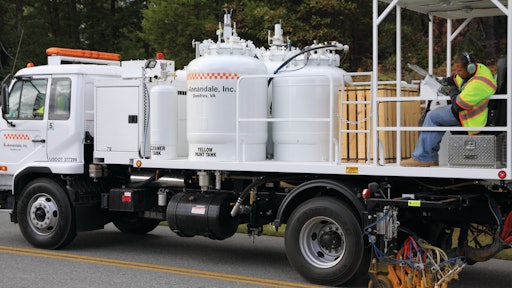
As mentioned, truck-mounted and palletized stripers comes with a variety of features. Bowman, for example, says that M-B Companies builds many trucks with rear shelters that enable the rear operator to remain more comfortable in less-than-ideal weather conditions. “Some states also require a data logger to be installed that records and saves the amount of paint, beads, paint thickness, GPS locations, and so forth. Even if not required, contractors may want to employ data loggers to facilitate budgeting.”
Then, there is the all-important crew to consider. “What type of equipment has the crew used previously?” Bowman asks. “I have customers who prefer air spray paint trucks and others who prefer airless trucks. The difference in technologies is less important than the operator’s comfort level with it.”
“I would guess that a small percentage of our contractor customers opt for air spray units,” points out Kelly-Creswell company sales manager Don Hollon. “Airless lines are a bit sharper, but the units also are more expensive up front and replacement parts are more costly. Still, it’s an operator’s preference more than anything else.”
He continues, “You have to decide how many guns you will need. A typical configuration for our truck-mounted units would include three paint and bead guns in the center and one of each on the edge. The big concerns here revolve around both productivity and safety, being able to stay in your own lane of traffic.”
The company offers both pallet- and truck-mounted models. Hollon estimates that 75 percent of its sales go to contractors who want their machines customized for their application. Units can be outfitted with eight or ten guns for airport striping or mounted with a lazer pointer to replace a long out-front pointer. For small jobs, Hollon directs customers to the company’s model WV-50, a single-operator, self-propelled unit that carries 50 gallons of paint.
Hug Manufacturing also offers a full line of stripers, including two-truck mounted models and a palletized unit, all available with either airless or air spray paint systems. Company president John Hug notes that for contractors thinking about a pallet striper, a ¾-ton pickup with 8,800 GVW is required to accommodate the weight of the machine, along with the paint and beads. “One of the nice features about our pallet-mounted machines is that it weighs only 1,280 pounds, which leaves more capacity for paint and beads. As he points out, a 55-gallon drum of paint weighs 750 pounds and the beads another 350 pounds.
Among other features, the company’s pallet unit can be fitted with either a hydraulic steerable or fixed paint gun carriage. Other options include a paint meter, a hand gun for stencil work, an intercom for two-person operation, hydraulic paint agitator and a storage cart for the striper when it’s not in use. Two 60-gallon stainless steel paint tanks and a 500-pound capacity bead tank are also optional.
Hug notes that an enclosed paint gun solenoid and stainless steel hose ends add to a striper’s durability, while Shinners emphasizes that protection of key components such as electrical and air lines, is important, as well. Hollon, too, reminds first-time users that stripers need to be maintained just like any other piece of equipment. They have to be cleaned out at the end of the day, and at the end of season. Airless units also need to be winterized.
Special concerns
Shinners points to potential requisites when working with sub contractors as well as with city, county, and state government agencies. Among them, he cites certification of equipment, workers, and paint as three likely ones. “New paint high-build formulas,” for example, “are being specified that may require a double drop bead or element application requirements that can dramatically change the design of the truck you are considering.”
Bowman emphasizes that contractors need to be aware of the Federal Excise Tax (FET) applied to any chassis with a GVWR greater than 33,000 pounds. “I had a customer who was looking to purchase a paint truck with two 300-gallon paint tanks,” he recalls. “The setup required a chassis that exceeded 33,000 pounds. By recommending a Nissan UD with a GVWR of 32,900 pounds, which accommodated two 250-gallon paint tanks, we saved him $70,000 between the increase in price for the heavier chassis and the addition federal tax.”
Be aware of state laws that limit per-axle weight, along with federal laws that pertain to the relationship between axle ratings and wheelbase length, he adds. Look for the manufacturer to provide assistance in these and other areas and make the appropriate suggestions.
Indeed, as the above manufacturers explain, the first step in buying a striper is matching it to your application, and the key work there is productivity. A less costly palletized striper is better suited for smaller jobs whereas a larger, truck-mounted unit will have the required capacity, speed, and appropriate bells and whistles to accommodate large highway projects.
There are other considerations, as well. Do you want an airless or air spray unit? The above manufactures offer both, with the price tag for airless being a little steeper since the technology requires 800 to 1,200 psi to atomize the paint. If the job calls for thermoplastic striping, then melters and kettles become part of the equation to heat powdered material so it can be spayed onto the surface.
Don’t anguish too much over your buying decision, though. Contact the above manufacturers for more information and help in determining the right machine for your application.
Photo captions:
Hug: Hug Manufacturing’s pallet-mounted stripers weigh only 1,280 pounds, which leaves more capacity for paint and beads.
KC -1 Kelly-Creswell’s single-operator, self-propelled WV-50 is ideal for small jobs.
M-B – 2 M-B Companies builds many trucks with rear shelters that enable the rear operator to remain more comfortable in less-than-ideal weather conditions.