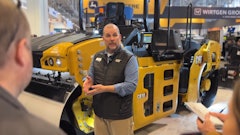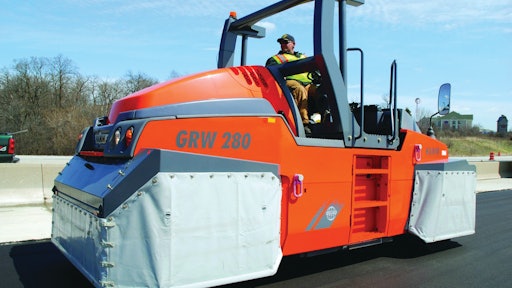
While most contractors may use a steel drum roller to complete their paving jobs, a time can come when rubber-tired rollers might be a consideration. Rubber-tired, or pneumatic, rollers used with steel drum rollers in certain applications provide contractors with a better base before paving, achieve a better density or compaction and improve the look of the finished product.
Before purchasing a pneumatic roller, however, you should understand the role it plays in a paving operation. Compared to using only a steel drum roller, pneumatic rollers have many benefits for contractors.
"The tires provide better static penetration into the materials," says Steve Cole, vice president of the Western Region, Dynapac USA. "We are looking for static penetration to relocate the particles and increase the density."
Pneumatic rollers have become more popular with stiffer mixes, such as those used in SuperPave, since it can help you achieve compaction density.
"Traditional steel drum rollers may tend to push this material as opposed to compacting it. The pnuematic-tire machines confine the material between the tires and with the kneading effect have a better opportunity to improve density in a tender zone," says Cole. "The kneading effect brings the oil up to the surface. It gives it that really nice, rich, black finish, which is what some contractors like to see."
For this reason, many contractors choose to use a pneumatic roller in the intermediate position in a paving train when laying stiff mixes, following behind the breakdown roller about 50 to 100 ft. "Contractors typically use a steel drum roller with vibration to get the breakdown right behind the paver," says Cole. "Then you have a pneumatic as an intermediate resealing the material and bringing the density up." This is followed by a steel drum roller to ensure the smoothness.
How pneumatics work
The manipulation of the asphalt comes from ballasting of the pneumatic roller to achieve a specific weight.
"The front four tires will rut the material, and along in the back, you have five back tires that will fit around the four tires," says Chris Connolly, product manager for asphalt, BOMAG "You've created a situation where not only have you vertically put pressure on the material by rutting the material, but you're coming along and counter-rutting." This manipulation effect brings density and stiffness to the material.
Unlike steel drum rollers, pneumatic rollers are able to conform to the surface being paved. "Rubber tires that are air inflated and have some give conform to the work surface whether it is rolling stone or asphalt," says Shannon Chastain, owner of Basic Equipment. "In comparison, a steel drum roller has no give to it, causing a bridging effect over parts of the work surface. In the design of a rubber-tire roller, every wheel on it can oscillate. In addition, you have the flex and give of the rubber tires, as well."
This is especially useful with patching utility cuts or potholes. By having all-wheel independent movement, the pneumatic roller is able to dip down into a pothole and compact it much more thoroughly, Chastain says. "No matter what the contour of terrain on the work surface, the pneumatic roller is going to be able to get a more consistent compaction density across the entire work surface."
The fact that it doesn't follow the deformations helps with the compaction of uneven surfaces. "A steel drum is just going to bridge over all of the deformations and not get compaction in the low areas," says Cole. "A pneumatictire machine is going to be getting all sections on the crossface of the material."
Bruce Monical, marketing manager at Hamm, says a pneumatic roller will eliminate the voids of air and space in the asphalt mix that would otherwise cause potholes to appear. "One thing that happens when rubber-tired rollers roll over the top is that it compresses the asphalt, making it more dense," he points out.
The roller kneads the asphalt gently at the surface, driving larger particles lower and bringing fine sands to the surfaces. With the fine sands at the top, the asphalt is sealed better, decreasing the chances of water getting into it when it rains.
Pneumatic rollers can be used on several different projects such as subdivision streets, large parking lots, and driveways. They are also used on chipseal projects.
"When you do chipseal, if the rocks, chips or small aggregate that you put in the oil are rolled with a steel drum roller, you will crush it and break the rock," ?? Wilkens says. "Rubber-tired rollers will set the rock into the oil a little bit more and the point or the edges of the rock won't be broken by the rubber tires."
According to Cole, 25-ton rollers are typically used on highways, while the 12.5-ton pneumatic rollers are used for chipseal applications and county or city roads.
The machines can also be used on other projects besides asphalt, Connolly says. "A lot of times, these machines will find themselves on different types of material," he says. "Anything that is tough to move particle-wise, you will find a pneumatic."
In fact, contractors in Texas often use the large pneumatic rollers as proof machines on dirt applications. "They just roll 50,000 lbs. back and forth over the jobsite and if it doesn't sink or deform the soil, then it is a high-quality, compacted material," says Cole. "It is a verification tool. It is relatively unique to Texas."
Points to consider
When determining whether to add a pneumatic roller to your fleet, there are several points to consider. "One consideration would be what asphalt mix you are using and the target density requirement," Monical says. "It's really a matter of what the job is and if it would require you to have a pneumatic tire roller."
Project owners are looking for longer lasting mix designs; as a result, the mix designs are getting stiffer. As a result, compaction is more challenging to achieve, and over-rolling with a steel drum will result in breaking the aggregate. "If I have a tougher mix design and I'm having problems getting density with the double-drum vibratory roller, or I'm over compacting to get density and I'm crushing the aggregate, my solution is the pneumatic tire roller," Connolly asserts.
While requirements of the job factor into the purchase decision, Chastain says you should also look at your competitors. "It's a situation many times of what is the competition doing, first off, and being able to compete with the competition on the quality of work," he comments. "[Contractors] are kind of forced into the situation to be competitive. Ideally, every asphalt paving contractor would be running a pneumatic roller." The benefits to using a pneumatic roller are there, but they aren't always seen immediately.
Pneumatic rollers offer versatility not available with a steel drum roller. The weight of the machines and air pressure of the tires can be adjusted to meet the specific pressure desired on a particular job.
"You are either going to adjust the tire pressure and/or you are going to increase or decrease the weight of the machine," says Cole. "Machines come standard roughly around 20,000 to 25,000 lbs. All manufacturers have the ability to add water, wet sand or steel to bring it up to that 25- to 27-ton capacity. You can adjust the weight of the machine, as well as the tire pressure."
Central tire inflation systems can keep tire pressure equalized and allow the operator to adjust pressure on the fly. "It is a nice feature as long as the operator knows how to use it effectively," says Cole.
Keeping tires in top condition
Once you've made the investment in a pneumatic roller, it is essential to maintain the unit in top condition. There are several areas of the unit that require regular maintenance.
Regularly check tire conditions and air pressure. "By adjusting the air in the tire, you're adjusting the ground contact pressure," Connolly says. Therefore, the air pressure must be checked each day to ensure proper wheel load.
According to Chastain, if you operate pneumatic rollers properly and use caution, tires can last up to five years. However, many variables go into determining tire life, including the kind of material the roller is on and the number of hours it is used.
A lot of contractors don't want to use pneumatic rollers because of the possibility of material pickup. Material pickup not only affects the smoothness of the mat, it can damage the integrity of the asphalt. Pickup of material can be caused by the tires not being hot enough; tire pressure being set too high; or a machine that is too heavy. Some types of aggregate are also stick more readily to tires and behave differently at certain temperatures.
Cole says you have two options to combat these issues: You can use heat skirts to keep the tires hot, or you can utilize a release agent in the water system.
It is important to maintain proper care of the coco mats. "Checking and/or replacing coco mats on the tires is one step to follow," Chastain says. "The coco mats pick up some of the material off of the surface. They act like a brush to brush that material off of the tire to prevent material from collecting."
Also pay close attention to the scraper system, whether it's steel, brushes or coco mats. "Make sure you have a good scraper system to knock any material off of the tires," says Cole. This, in turn, will help to extend tire life.