The world’s second busiest airport in terms of flight operations behind Atlanta’s Hartsfield-Jackson International is undergoing some major changes. The O’Hare Modernization Program (OMP) as the expansion and upgrading project is named, is one of the country’s largest current construction projects.
The project is under the management of the Chicago Department of Aviation (CDA) and involves constructing a new runway and taxiways, expanding and/or relocating some existing runways and taxiways, and constructing a new passenger terminal. The work is being done in phases with the new terminal to be built in the future as demand dictates.
The OMP is reconfiguring O’Hare’s airfield into a modern parallel runway configuration from the original system of intersecting runways. This new configuration will reduce flight delays and increase capacity.
Upon completion of the OMP there will be a total of eight runways, six will be east-west parallel and two will be crosswind. Two relocated runways will have been constructed to accommodate new larger Group VI aircraft. Several miles of new taxiways will have been built as well. Also included in the plan is the eventual construction of a new passenger terminal on the west side of the airport.
Incorporating sustainability
The CDA has continually emphasized the importance of incorporating and utilizing sustainability practices in the design and construction of all projects related to the OMP. Roughly two years ago members of the OMP team evaluated the use of more environmentally friendly warm mix asphalt (WMA) as opposed to hot mix asphalt (HMA).
The CDA had extensive consultations with the Civil Engineering Department of the University of Illinois and with representatives from the Federal Aviation Administration (FAA). Based on research, the CDA concluded that WMA was an appropriate substitute for HMA on O’Hare’s taxiway projects.
O’Hare International as a result of the above research and testing is the first airport in the Great Lakes Region and among the first in the United States to produce and place WMA as part of the construction of new taxiways for the OMP.
The specific names of the projects are OMP Taxiway Zulu Sierra (ZS) and Runway 9C-27C Northeast Projects at O’Hare International Airport. Plote Construction Inc. of Hoffman Estates, IL constructed the Taxiway ZS project. The Walsh/TJ Lambrecht Joint Venture is the contractor for the Runway 9C-27C Northeast project. K-Five Construction Corporation of Lemont, IL, is the asphalt paving subcontractor.
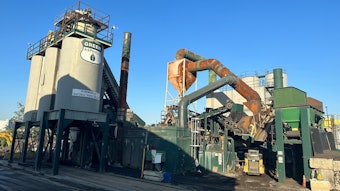
During 2011 OMP contractors placed more than 7,100 tons of WMA to construct the asphalt-treated permeable base (ATPB), binder course and shoulders for Taxiway ZS. This work was done from late July to early August 2011 and the overall Taxiway ZS project was completed in the fall of 2011.
This new taxiway is a component of the OMP Completion Phase 2A and was constructed as a Group V category taxiway. Group V status can accommodate Group VI aircraft (NLAs) with certain operating restrictions. Taxiway ZS is located on O’Hare’s south airfield near the Southwest Cargo area and runs in a north/south orientation between future Runways 10C-28C and 10R-28L.
Concurrently, in the fall of 2011 the OMP deposited approximately 37,000 tons of WMA for the ATPB, binder course, and shoulders of a group of taxiways included in the Runway 9C-27C Northeast project. Approximately 30,000 tons of WMA remain for construction in 2012.
This work is being conducted at the northeastern corner of the airfield and is part of future Runway 9C-27C. The WMA work is slated to be completed in the spring of 2012. The Runway 9C-27C Northeast project consists of new taxiways and the realignment of existing taxiways.
WMA new to aviation
WMA is a relatively new technology in relation to the aviation industry. Therefore, the CDA was required to seek approval from the FAA before using WMA for the OMP. The CDA prepared and submitted a Modification of Standards for FAA review to obtain approval and permission to utilize the more environmentally friendly WMA asphalt production and paving technique.
The CDA worked in conjunction with the FAA for approximately two years before receiving FAA concurrence to use WMA on the specified taxiway projects. This achievement was the result of the CDA’s extensive and vigorous testing program coupled with assurances to the FAA that WMA is a suitable substitute for the traditional HMA material.
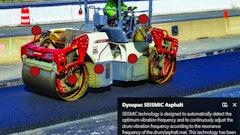
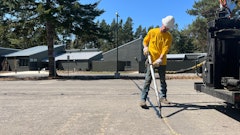
To ensure the WMA is properly mixed and installed the OMP conducts a very rigorous quality control and assurance program. This includes preparation and approval of a mix design, placement and diligent monitoring of a WMA test strip, and laboratory and additional field testing.
The weight of aircraft is a consideration in designing and constructing runways and taxiways much as various factors are taken into account in highway construction. Numerous factors are considered and evaluated when designing and engineering pavement sections for runways and taxiways.
These factors include the weights of the design aircraft, estimated repetition of arrivals and departures during the desired design life, underlying soil conditions, typical depth of frost, and cost. Highway designs consider the estimated volume of traffic, volume of truck usage and weights, existing soil conditions, depth of frost, expense, and additional factors and variables.
Larger aircraft factor in
Over the past several years there has been the introduction of the next generation of NLA such as the Airbus A-380 and the Boeing 747-8. The A-380 is currently the world’s largest passenger aircraft at 240 feet long and a wingspan of 262 feet. This behemoth in various cabin configurations can carry more than 850 passengers.
O’Hare sees a large volume of heavy cargo planes including various models of the 747. One of the considerations of the OMP was to design portions of the new infrastructure with the accommodation of large aircraft as a major consideration.
Available runway length for arrivals and departures is extremely important for the airlines, both passenger and cargo. An example at O’Hare is Runway 10L-28R which is 13,000 feet long and provides sufficient departure length for large aircraft departing nonstop to the Far East. Shorter runway lengths force airlines to absorb weight penalties. These include reducing the number of passengers on a flight, the amount of cargo carried, or the amount of fuel onboard which can affect range of the aircraft.
In addition to runway and taxiway widths, the separation distances between them dictate the type of aircraft allowed to use those pavements. Two of the OMP runways, 10C-28C and 9C-27C are designed to accommodate Group VI aircraft such as the 747-800s and the A-380. Building the infrastructure to accommodate large planes and/or to reduce the incidence of weight penalties is expensive. The cost savings of WMA is therefore significant in the process of the OMP.
Anatomy of the runway
The anatomy of the runway and taxiway components and materials will be discussed starting with the deepest layer which is the lime stabilized sub-grade. This establishes a solid and consistent foundation for the asphalt and concrete components of both the runway and taxiway cross sections. The top 12 inches of the soil sub-grade is stabilized in the OMP with a mix of lime and water.
The next component is the asphalt treated permeable base (ATPB) which is open graded asphaltic cement concrete. This section is typically placed in one or two lifts to build the 6-inch section. In addition this layer is constructed or compacted from 100 degrees F to 150 degrees F to maintain the voids between the aggregate. The ATPB allows for drainage of water through the pavement section. The Performance Grade (PG) for this layer is 58-22.
The next layer is the asphalt binder which consists of an asphaltic blended aggregate mix based on Illinois Department of Transportation (IDOT) specifications. The PG for this material was 64-22. An approved chemical additive is included in the mix which allows for the lower temperatures and creates WMA. This 6-inch section is also typically placed in two lifts similar to the ATPB. This asphalt binder has fewer air voids than the ATPB. Asphaltic cement is used in this layer in lieu of Portland cement concrete (PCC) to reduce the cost of the pavement section.
Lastly the top surface layer is reinforced PCC. The thickness of the reinforced PCC layer varies from 16 to 21 inches depending on the runway.
Runway designs
Airfield pavement designs are similar to the typical Interstate highway design. However, airfield cross sections are typically thicker due to the weight of aircraft and the stress of aircraft touchdowns upon landing on runways.
Taxiway ZS used approximately 7,100 tons of WMA and 7,000 square yards of PCC. Upon completion of the Runway 9C-27C Northeast project, the contractor will have used approximately 67,000 tons of WMA and 108,000 square yards of PCC.
The Chicago Department of Aviation has been and continues to be very committed to incorporating green best practices into all aspects of O’Hare International and to Chicago’s smaller but well utilized second airport, Midway International. This includes airport design, construction, operations, terminal maintenance, and day to day management.
The CDA developed a Sustainable Airport Manual (SAM) to establish guidelines and policy and procedure for airport operations including construction and is applying this to the OMP. The exploration and research that went into the decision of using WMA follows the sustainability practices. The incorporation of WMA as a component in O’Hare’s taxiway design and construction meets the “triple bottom line” so to speak.
WMA is proven to be a paving method that has less of an environmental impact than HMA for example. WMA also has the potential to save time and expenses. In relation to a project with the scope of the OMP the saving of time, labor and materials cost as well as the lesser environmental impact are significant.
The benefits of using WMA are related to sustainable development and improved working conditions. Included in this are environmental benefits from reduced fuel consumption, and reduced asphalt plant emissions. There are physical benefits that relate to the paving process such as increased workability for transporting and placing asphalt and potentially extending the length of the paving season. Using this innovative and more eco-friendly paving technology is one of the many industry leading sustainability initiatives that continue to be incorporated at Chicago’s airports.