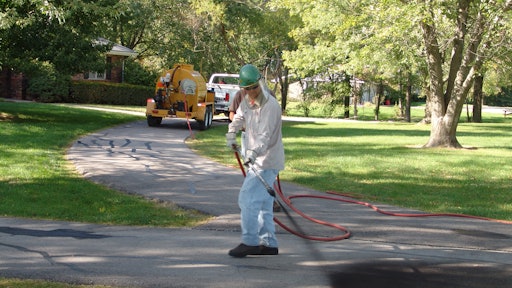
As most sealcoaters know, water is the major component of sealcoatings. The sealer supplied as a concentrate contains typically 60% water by volume. After adding 30% water to 100 gallons of the concentrated sealer the water proportion increases to nearly 70%, by volume. Sealcoatings, like other water-based coatings, dry and cure by releasing water to the atmosphere. The optimum cure and the full strength of the sealcoatings are reached after the release of all the water.
By understanding how water is released from the sealer film and how the pavement itself and ambient conditions influence that release, contractors will be better able to obtain optimum cure and improve the overall performance of their sealcoat. If not allowed to cure properly even the very best of sealer could experience poor performance and premature failure.
How Sealer Film is Formed
Sealcoatings, like most water-borne coatings, start releasing water into the ambient atmosphere as soon as applied. The surrounding air acts as a blotting paper to soak up the released water, its capacity depending upon the relative humidity of the atmosphere (more on this later). Sealcoatings attain full cure through the loss of all the water from the wet film. As the water leaves, the volume of the wet film shrinks, in direct proportion to its water content (by volume) in the mix. For example, if the mix design has 70% water by volume, the wet film will shrink by 70%, i.e. 30% of its original volume.
The evaporation of water from the wet film produces a steady turbulence in the film and forces the suspended particles to move closer to one another (figure 3). As this happen the film becomes progressively denser, eventually forcing the binder particles to touch each other and fuse into a continuous film, encapsulating the filler particles in the process. At the same time the excess binder in the matrix allows the film to effectively bond to the pavement surface.
Descriptions such as the full cure, final set or optimum strength mean that the sealcoating has reached its full strength and is capable of performing its task as a protective coating. A properly cured sealcoating forms a continuous film free of voids or imperfections that stops water, chemicals, salts, etc. from penetrating and damaging the asphalt pavement underneath. Understandably, any deficiency in the curing process will prevent the binder from fusing properly and leave voids in the film, thus resulting in inferior performance or failure.
During the curing process, sealcoating films transition through various stages (figure 4) of water evaporation from the applied film. First it attains initial drying when the film becomes “tack free” to the light touch, then it becomes firmer (about 80-90% cured) to take light pedestrian traffic, and finally, when all the water is lost through evaporation, full firmness to withstand light vehicular traffic.
To better understand the drying and cure process, visualize the wet film not as one solid entity but as a composite of numerous layers of molecularly thin films (imagine a sheet of plywood). Like most water-based coatings, sealcoating dries in successive layers, from top to bottom. As each layer dries, it shrinks in volume, becomes tight and relatively impervious, thereby impeding the evaporation of water from the bottom layers. It has been established that the cumulative water loss happens rapidly in the early stages of film drying—in other words the first 80-90% of the film dries relatively fast, but the release of the last 15-20% of water takes much longer, requiring the right set of ambient and pavement conditions. For optimum performance, all water must leave the film: 80-90% is not good enough. The uncured bottom layers of the sealcoat will be torn or dislodged if traffic is allowed on it too soon. The percentages noted above are strictly to explain the phenomenon of the cure stages. The final cure will depend on many factors: mix design, coverage rate, and ambient conditions of temperature, humidity and the wind velocity.
Ambient Cure Conditions
Ambient conditions play the decisive role in determining the thoroughness of the overall cure process, therefore, sealcoating performance. These conditions are the recommendations of the industry and its research association, Pavement Coatings Technology Council (PCTC).
Temperature (both ambient and pavement).
Sealer should not be applied unless the pavement temperature is at least 50°F and the air temperature is 50°F and rising. The fusion of the binder particles (in sealcoatings) to form a uniform and continuous film depends on their ability to soften under the ambient and pavement temperatures. The process of fusion is greatly enhanced at higher temperatures, say 75°F to 85°F. Conversely, the fusion process is significantly reduced at temperatures below 50°F. Let us review the extremes; cold and hot temperature applications.
* Cold Temperature Application. When sealcoating is applied below 50°F, refined tar (or asphalt) particles do not soften and form a continuous film – so they leave clay and filler particles uncoated. The color of the sealcoating cured under such conditions usually turns out grey and blotchy in appearance and never returns to its characteristic dark slate/black color, even when the pavement temperatures rise later. Simply, the temperature of the pavement normally does not reach high enough to re-melt the binder particles and force them to flow and form a continuous film. Even if the pavement temperatures reached high enough it still will not be sufficient to re-mobilize the binder particles to flow and envelope the clay and filler particles to form a continuous film. Needless to say sealcoating cured under cold weather conditions lacks the integrity and is liable to fail prematurely.
* Hot Temperature Application. Applications under hot temperatures can be equally problematic. Sealcoatings should not be applied under the summer sun (over 90°F,ambient) without first cooling the surface with a fine mist of water, also called “fogging.” Water should be used to dampen the pavement -- without leaving puddles.
If applied to a hot pavement without “fogging” it, the sealcoating film almost gets “baked” as soon as it hits the pavement. With the sudden loss of the film fluidity, the binder particles are immobilized and do not fuse properly. Devoid of the proper fusion process, binder particles do not effectively envelop the clay and filler particles in the sealer film to attain the proper hardness. They stay as thermoplastic entities in the film, which become sticky and soft under hot ambient and pavement temperature conditions, thus causing potential “tracking” problems.
Relative Humidity (R.H.) or Humidity
Relative Humidity (R.H.) also plays a significant role in the cure mechanism because it directly influences the rate of water loss from the sealcoating film. Relative humidity is the ratio of the actual moisture content of the air, at a specified temperature, to its total capacity. For example, 50% R.H. means that only half of the air’s total capacity to hold water has been used and it is capable of absorbing another 50% of moisture or vapor from the surroundings.
Conversely, 90% means that the ambient air is loaded with moisture and has very little (only 10%) capacity left to hold additional water. Sealcoating applied under highly humid conditions take a long time to cure because there is very little room for the ambient air to absorb the released water from the film. The sealer film will release only the amount of water that can be accommodated by the atmosphere. The atmosphere and the surrounding environment can be thought of as a sheet of paper towel: When dry it will soak up the spill but will not mop up if the towel is too wet. Sealcoatings, understandably, will cure faster at lower humidity than at higher humidity. Under highly humid conditions, sealcoatings shall be allowed longer drying time before the application of the subsequent coats and finally opening to traffic.
The interdependence of temperature and relative humidity on the water evaporation rate is depicted below in the following table and the graph, (figure 5). You will notice that the water evaporates more than 3 times faster at 40 % R.H. than 80%, at a given temperature.
Along the same lines, the capacity of the ambient environment (air) to hold water to the point of saturation increases with the increase in temperature, as depicted in the following table and the graph (figure 6).
The drying and cure times specifications do not take wind velocity or air movement under consideration, however, air movement, especially under highly humid conditions, helps sealer dry faster than without any air movement. A light breeze assists in the dissipation of the water and volatiles from the immediate vicinity. Conversely, under low humidity conditions (below 20-25%). the air movement may cause the sealcoat to dry a bit too fast.
Girish C. Dubey is president of STAR Inc., Columbus, OH, which has affiliate sealer producing operations throughout the U. S.
[sidebar]
For Optimum Sealer Performance
1. Mix sealer accurately according to the mix design as agreed for the project. Use the proper dilution with water, sand loading, additive content, etc.
2. Apply sealer at the proper coverage rate (expressed either in gallons/square yard or square feet/gallon) on a properly cleaned and repaired surface.
3. Allowed sealer to cure “thoroughly” under a set of pavement and ambient weather conditions which will allow the coating to attain its optimal firmness. These “ideal” conditions are simply the ambient and pavement conditions that are specified by the sealer producer and accepted by the industry under which the sealcoatings shall be applied and allowed to cure.
[sidebar]
How to Learn More about Sealer & Paint Curing
Most contractors know that their toughest job-related decision is how to interpret weather conditions. If it's raining the answer, unlike the sky, is clear - for the moment anyway. But are you missing a window of opportunity if you call off all work for the entire day? Making the wrong decision costs both time and money. Contractors looking for insights into the curing/drying process for both sealer and paint can learn more from “How to Know 'Weather' to Sealcoat or Stripe” presented by Greg Driskell, Professional Pavement Products, at National Pavement Expo, Jan. 23-26 2013 in Nashville. This session will discuss the four primary factors that affect whether you should be applying paint or sealer to pavement. By understanding these factors and how they affect one another, you can improve your "go or no go" decision making. This session will also cover some basic common sense surface testing and troubleshooting techniques all sealcoaters and stripers should know. Visit www.nationalpavementexpo.com for more information.