
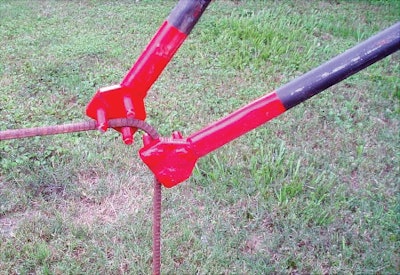
Consider the following case. Contract documents call for #6 reinforcing bars embedded in a concrete wall and with right angle bends that will be the top bars in a floor slab to be added later. But here’s the problem. The available wall forms are 8-ft tall and the concrete wall is 7-ft tall. Rather than cut up the forms, the contractor decides to embed straight bars in the wall, then field bend them after the forms are removed. Is that permissible?
Section 7.3.2 of ACI 318-11, “Building Code Requirements for Structural Concrete,” states that reinforcement partially embedded in concrete shall not be field bent, except as shown in the contract documents or permitted by the licensed design professional. When contract documents don’t show that field bending of embedded bars is planned, the problem is getting permission of the licensed design professional.
Using research cited in ACI 381-11
The Commentary for Section 7.3.2 provides more detail regarding cold and hot bending embedded bars by stating that construction conditions may make it necessary to bend bars that have been embedded in concrete. It further states that contract documents should
specify whether the bars will be permitted to be bent cold or if heating should be used. Results of two research studies are cited.
Both studies were done on reinforcing bar specimens only, not bars embedded in concrete. The researcher for the first study cited stated, based on limited data, that reinforcing bars can be successfully reworked in the field, both cold and with preheat. But the author warns that cold bending may break the bar, especially if ambient temperatures are low, and recommends preheating to 1,100 to 1,200 F before bending.1
In the other study, bending and straightening tests were performed on 254 Grade 60 reinforcing bars of three sizes — #5, #8 and #11 — with procedures that simulated field conditions. Test bars were encased in three oak blocks and bent by placing a steel pipe of slightly larger diameter over the bar and applying a force to the pipe using a hydraulic ram. Bend diameter was controlled by placing the pipe close to the blocks initially, then moving the pipe away from the oak blocks to maintain the desired bend diameter. This roughly simulates the procedure of using a hickey bar for field bending. Researchers reported that #5 and #8 bars were bent at room temperature to a diameter as small as three times the bar diameter and then straightened without breakage or cracking.2 For comparison, ACI 318-11 permits bending to six times the bar diameter.
The researchers concluded that field bending and straightening of reinforcing bars up to #11 in size should generally be permitted. They also noted that heating #11 bars to 1,500 F significantly improved the ability to bend these larger bars.

ACI 301-10 requirements
If ACI 301-10 is the project specification, the requirements for embedded bar bending are more conservative. Only bar sizes from #3 to #5 can be cold bent, and then only if the bar temperature is above 32 F. All other bar sizes must be preheated to 1,100 F to 1,200 F before bending, and the reheat length of reinforcing bar must be equal to at least five bar diameters in each direction from the center of the bend. Extending the preheating length below the concrete surface is not allowed, nor is allowing the reinforcing bar temperature at the concrete interface to exceed 500 F. Any damage to zinc- or epoxy-coated bars must be repaired.
CRSI recommendations
In their Engineering Data Report Number 54,3 The Concrete Reinforcing Steel Institute states that straight embedded bars may be planned to be field bent into place, such as an outside face wall where vertical bars will be bent horizontally to become the slab end top bars. As in the case mentioned earlier, the procedure is intended to facilitate slab formwork erection. But the data report states that the architect/engineer should review the bending procedure and notify the contractor’s reinforcing bar placing inspector who should discuss the bending procedure with the placing foreman to ensure that the bends conform to the ACI 315 requirements.4 It may also be necessary to notify the owner’s or local building department’s inspectors.
One suggestion for getting the engineer’s permission
Because some engineers are very conservative it may be difficult to get permission after the bars have already been bent without an inspector present. The best solution for this problem is obvious: Point out the documents mentioned here and get permission before bending the bars.
One option is to restraighten one or more of the bent bars cold, then have a testing lab test them to fracture while still embedded in the concrete. If the tensile strength meets specification requirements, the rest of the bars can be judged to be suitable, and replacement bars for those broken can be epoxied into the wall.
References
1. Black, William C., “Field Corrections to Partially Embedded Reinforcing Bars,” ACI Journal, Oct. 1973, 690-691.
2. Stecich, J.P., Hanson, John M., and Rice, Paul F., “Bending and Restraightening of Grade 60 Reinforcing Bars,” Concrete International, August 1984, 14-23.
3. “Field Inspection of Reinforcing Bars,” Engineering Data Report Number 54, Concrete Reinforcing Steel Institute, Schaumburg, IL 2004, 8.
4. “Details and Detailing of Concrete Reinforcement (ACI 315-99),” American Concrete Institute, Farmington Hills, MI, 1999, 44.






![Strux Macrofibers 58c9b97fd4aaf[1]](https://img.forconstructionpros.com/mindful/acbm/workspaces/default/uploads/2025/08/strux-macrofibers58c9b97fd4aaf1.cNEEIfY9kp.png?ar=16%3A9&auto=format%2Ccompress&dpr=2&fit=crop&h=135&q=70&w=240)


