The power to buy resides in the hands of the customer; that’s the way it is, that’s the way it’s always been and that’s the way it always will be.
The role of the contractor, then, is to work to influence that buying decision as much as possible in his (or her) favor. Some contractors do this by price. Some do it by service. Some do it by establishing relationships with customers.
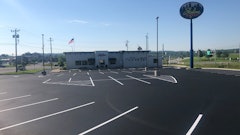
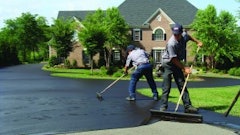
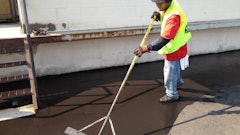
Miller Sealcoating & Striping influences the buying decision by empowering the customers – and last year that empowerment resulted not only in a huge increase in sales but in a shift by buyers from a conventional asphalt-based sealer to a polymer-modified refined coal tar sealer that is more expensive.
“It turned out to be a powerful thing for us because 90% of our 2011 sales went to the higher-quality material,” says Dan Miller, owner of Miller Sealcoating & Striping, Fairmont, WV. “Everybody who wanted to get greater value for their dollar opted for the higher-end material. We were pleasantly surprised at the response.”
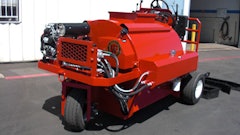
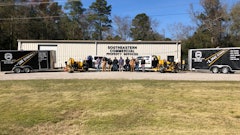
Started in 2001 with an old state highway department tar kettle that he converted into a gravity-fed tank, Miller Sealcoating & Striping has grown steadily over the years to today’s business which relies on six employees in peak season handling 120 clients, many of whom control multiple properties. The contractor, who also leases a 1-800-PAVEMENT vanity phone number, operates a 2000-gallon tank, a 1500-gallon spray application machine, a 1000-gallon spray machine, a 325-gallon squeegee buggy, an infrared repair machine, a 200-gallon cracksealing melter/applicator, two sealer storage tanks (6000 gallons and 5500 gallons), a 30-ton sand silo, a John Deere tractor fit with a power broom, and five Graco LineLazers.
Like many sealcoating contractors Miller started in the business doing driveways but today he generates virtually 100% of sales from commercial work. “Initially we were strictly driveways but every now and then we picked up a parking lot and I quickly saw the benefits of doing large parking lots vs. 10 small driveways,” he says. “Then at the end of the first year I helped out a big job that used a big spray rig and I quickly saw the benefits of that.”
At the end of his first year he’d totaled a whopping $8000 in sales. That was followed by $20,000 in year two and $70,000 in the third year. “Since then we have grown incrementally each year,
Miller says. “We haven’t had any real boom years, just steady growth.”
Offseason Planning Pays Off
Part of that steady growth is the result of Miller’s offseason efforts to improve the company – which is where the idea for offering a higher-quality sealer option came from.
“I have a bad habit of overanalyzing everything and in winter time I start thinking about where we need to go,” Miller says. “I’m not afraid to try new things and I look at the parking lots we’re going to do and try to figure out what equipment we need to maximize each job and be as productive as we can be.”
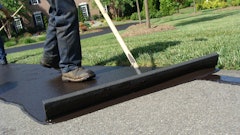
Over the years this offseason approach has led to the company’s expansion of its sealcoating fleet, the addition of a small squeegee machine (he says not many people in the Mountain States have a squeegee machine, which helps him especially in subdivisions that require two coats -- one squeegee and one spray), the acquisition of the infrared unit (because area pavers were too busy to take on small patching jobs) and additional striping equipment.
“But you really have to be careful because more equipment doesn’t necessarily mean more profitability,” he says, citing the company’s approach to striping as an example. “Just because we have the equipment and can do the work doesn’t mean that it’s a good use of our time. It’s better for us to run two sealcoating crews instead of one sealcoating crew and one striping crew, so now we subcontract 80% of our striping work.
“If you’re not careful you can end up trading one type of work for another type of work -- one piece of equipment for another piece of equipment -- and one ends up sitting there not being used,” he says. “If that happens you traded one job for another without increasing your bottom line.”
Will a Higher-quality Sealer Pay Off?
So last year, as Miller was reevaluating his 2010 season and planning for 2011, he wondered what would happen if he gave his clients another option of sealer material. He already offered a variety of application options (one coat or two, squeegee or spray, one coat squeegee and one coat spray) but those options applied only to the standard asphalt-based sealer he has been using for years.
Miller had used coal tar sealer for years but during the coal tar shortage, like many contractors, he was forced to switch to an asphalt-based sealer and he likes working with it. “But it doesn’t last as long as coal tar and I’m always trying to figure out how to make something last longer for my customers.”
Last winter Miller focused on trying to figure out how to provide something for high-traffic areas for his clients – such as fast-food restaurants and banks with drive-through lanes – that needed it. He and his customers noticed that the asphalt sealer was wearing more quickly in those areas and he wanted to provide a solution. He had a second, unused storage tank so he decided to offer a polymer-modified coal tar sealer that is more expensive than the basic coal tar and the asphalt sealer but lasts longer and provides added protection to the pavement.
He says one of the deciding factors to offering the higher-end material is that customers cycle through the business every few years, and 2011 was a year when a lot of banks with their drive- throughs would be ready for sealcoating.
“It was kind of a gamble, no question,” he says. “Is it something they’re going to want? It’s a more expensive product and I have to charge more for it so are they going to be willing to pay for it?”
The answer is clearly, “Yes.”
“When it comes right down to it the cost difference between the higher end and the lower end is not that much, so where I might give someone a $2000 bill for modified coal tar, the asphalt sealer could be $1850,” he says. “It worked out very well.”
“It was a good year to take the gamble,” he says. “We want the customer to get the most bang for his buck and, yes, maybe now we’re on a three-year schedule vs. a two-year schedule with them. In that sense we might be costing ourselves some work but if the customers are happy then they’ll stay our customers and not look somewhere else.”
Empowering the Customer
But offering a higher-quality sealer isn’t—by itself—what made the difference. After more than a decade in business Miller is a firm believer in empowering the customer, saying an empowered customer not only is more content but also can be assisted in his decision by the contractor.
“It’s all in how you present things that gets a customer top move,” he says. “If you empower the customer you have a better chance of having them buy your service.
“Some people say ‘Don’t give the customer too much information’ but I don’t believe in that approach. All that does is create fear in a customer so the customer is not going to move,” Miller says. “But if you give customers information you empower them to make a decision and then you empower them to move. Most of these buyers have to be accountable to someone and you have to give them information so they can make a decision that they can defend.”
Miller says he also tries to make decisions less complicated for customers. For example, he always presents bids in terms of gallons to be applied, not square feet or square yards. “Coverage rates are hard to understand,” he says. “Customers don’t care how many square feet or square yards per gallon they’re getting. They just care how many gallons are going down on their pavement so we present it to them so they can always understand exactly what they’re getting.”
Miller says options for the customer enable the contractor to create leverage, whether it’s service options or application options or material options. “If you’re a car dealer and you have a whole lot full of cars the buyer can shop and compare and make a decision. The same thing is true of sealcoating,” Miller says. “As soon as you give them the right amount of choices you can guide them to not only what is going to benefit you but benefit them. Then you can get them to move.”
END
[Sidebar]
Why Switch to CDL Trucks
This year Miller Sealcoating & Striping is converting all its sealcoating units to trucks that require a Commercial Drivers License (having a gross vehicle weight of greater than 26,000 pounds). While this runs counter to conventional thinking Miller says it makes sense to use heavier vehicles.
“If I’m using a non-CDL truck and I put a 1,000-gallon skid tank on it I’m already pushing about 24,000 pounds and probably nearing the limit of that truck, its brakes, and I’m creating an awful lot of wear and tear on the vehicle.
“But if I bump up to a CDL truck with a GVW of 33,000-34,000 pounds then with that 1,000-gallon skid tank I’m not even close to the maximum capacity of that truck,” Miller says. “The result is the brakes are safer, the suspension is safer, the truck won’t wear out as quickly – it’s just going to be better, put it that way.”
[sidebar]
Miller’s Winter Tales: The Knack and More
Every winter Dan Miller re-reads one book that he says has guided his business decisions: The Knack: How Street-Smart Entrepreneurs Learn to Handle Whatever Comes Up by Norm Brodsky and Bo Burlingham. “If you really want to be successful in business you have to pay attention to the small details. This guy had three Fortune 500 companies and bankrupted them and he details all the ‘dos and don’ts’ of being in business,” Miller says. “I read it at the end of every year and try to make corrections on what I do and don’t do and need to do.”
Dan Miller doesn’t just read himself to improve the company – he expects his employees to read too. In the offseason he assigns books he wants his employees to read before they come back to work and during the season he assigns articles or chapters of books for his workers to read. “Then we talk about them. I don’t just ask them to read it I want to be able to talk about it with them,” he says. “I think it helps them take ownership.”
[Sidebar]
Why to Focus on Commercial Work
Miller Sealcoating & Striping does very little residential work because, as Dan Miller says, “It’s very difficult to make it doing residential.”
“We plan on 100 work days a year and we divide our costs by 100 and that’s the minimum amount of money I need to make every day. If I start doing residential work I can’t even break even every day doing residential.”












![Screen Shot 2023 01 04 At 5 23 30 Pm[35]](https://img.forconstructionpros.com/files/base/acbm/fcp/image/2023/01/Screen_Shot_2023_01_04_at_5.23.30_PM_35_.63bc42696de27.png?auto=format%2Ccompress&fit=crop&h=135&q=70&w=240)