

Configuring an excavator for a specific application takes a little planning. Many factors come into play, such as the working range of the boom and stick, material density, desired production, use of attachments and quick couplers and lift capacity requirements to name a few.
“When you step out to the front end of the excavator, they get pretty hard to configure,” says Kent Pellegrini, global excavator specialist for Caterpillar. “It gets pretty intensive.”
Manufacturers offer several stick and boom options for mid-size excavators. For instance, Caterpillar typically provides heavy-duty (HD), extreme service and long reach booms, depending upon model. Heavy-duty boom and stick configurations are typically for dirt digging applications. Extreme service stick and boom combinations are intended for demanding applications such as demolition with a lot of attachments.
“[The extreme service combination] adds some weight to the front end vs. using a standard heavy-duty boom, so your cycle times will be reduced.” says Pellegrini. “But it is for a specific application. When you run hammers or shears and multiprocessors continually, you want the machine to last longer, so you move to a boom and stick configuration that can handle that abuse.”
Caterpillar offers two sticks for the HD boom – not counting the super long reach – and two for the extreme-service boom. A working range chart is a good place to start when looking at these options.
“You have every stick option and every boom option, including the super long reach configurations,” notes Pellegrini. “You can see the maximum digging depth and the maximum flat-bottom depth for every machine. If I did not have those, I would just be lost.”
Let the Work Be Your Guide
“Contractors should understand the application they are using the machine for prior to selecting working equipment combinations,” says Brian Yureskes, product manager for excavators, Komatsu America. “General items to consider would include working range, transport dimensions, productivity and desired bucket selection and if there is potential use for one or more attachments.”
The work you primarily bid will determine the appropriate configuration. “An underground contractor and basement digger will usually buy a long arm for reach and best productivity,” explains Mike Boyle, John Deere product consultant, excavators. “A cross-country pipe liner or a land clearing contractor will buy medium arms for stability and best productivity. A mass excavator contractor will buy a short arm for arm force and best productivity.”
A contractor that is trenching and putting in sewer/water pipe usually wants reach, so a long arm might be ordered with a coupler and two buckets. “If a contractor is adding an attachment such as a thumb, that person orders the medium arm for the stability aspect,” says Boyle. “If a contractor is excavating hard material, he buys a short arm for extra breakout.”
Long and Short of It
In applications that utilize long boom/arm combinations, the main benefit is an expanded working range that can add versatility for certain applications. “If there is a drawback to longer work equipment, it is that your digging forces can be reduced and, in order to maintain stability, the bucket size may need to be reduced,” says Yureskes.
Longer boom and stick options will usually reduce arm crowd forces. “Over the side lifting forces will typically be reduced due to the long work equipment having a larger impact on machine stability, whereas over the front lifting is more dependent on hydraulic forces,” says Yureskes. “Shorter boom/arm options have an opposite effect with a limited working range.”
Arm length also has a direct relation to the size of the bucket that can be used. “The shorter the arm, the more arm force and the larger the bucket,” says Boyle. Let’s take a look at arm force of a mid-size 76,557-lb. excavator for which Deere offers three arm lengths:
A short arm is 8 ft. 9 in. in length and has 45,914 lbs. of arm forceA medium arm is 10 ft. 6 in. in length and has 39,930 lbs. of arm forceA long arm is 13 ft. 1 in. in length and has 34,314 lbs. of arm force.
“There is 11,600 lbs. of breakout force difference between the short and the long arm,” says Boyle. “But many contractors are not worried about arm force. They need more reach for finishing the bottom of the trench, pulling the trench box and installing longer sections of pipe.”
Now let’s look at the difference in recommended bucket sizes for material that weighs 2,400 lbs. per cubic yard:
With a short arm, Deere recommends a 2.8-cu.-yd. bucketWith a medium arm, Deere recommends a 2.6-cu.-yd. bucketWith a long arm, Deere recommends a 2.4-cu.-yd. bucket.
“In all aspects, it looks like the shorter arm will provide more productivity,” says Boyle. “But in reality, it depends on the application and types of material the contractor is digging. The shorter arm will fill the bucket quicker with hard material; but with softer material, the excavator with the shorter arm will have more moves and more joints in the pipe.”
There are other trade-offs to consider. “A drawback to shorter working equipment is that the working range is reduced, limiting the ability to achieve desired depths or dump heights,” says Yureskes. “The benefit to short boom/arm combinations is that the working forces are closer to the machine, so generally the operator experiences greater stability and also has an expanded range of attachments and bucket sizes that can be utilized if the application requires.”
Sizing the Bucket
Matching a bucket to the application is critical. It is important to realize that the biggest bucket does not necessarily translate into the highest production. Consider bucket fill factors and cycle times, since larger buckets can reduce your cycle speed.
Pellegrini says he often steers customers away from a large bucket. “When you have a big bucket on the front end, you put a lot of load through the stick and boom. Any kind of twisting or corner loading when they have a huge bucket puts stress on the front of the machine," he explains. "That is why it is important to match it correctly, and it comes to material density.”
Material density can vary with weather conditions. “Rain can play into this, where payload will increase considerably,” says Pellegrini. In some conditions, you might not be able load a large bucket to full capacity because you are unstable. In this case, you might be better off choosing a bucket that was sized correctly so you could achieve a 105% bucket fill factor.
There are also multiple factors involved to properly select a bucket for a given boom or arm. “While all machines will have recommendations for bucket sizing, adding a long boom or arm will generally limit the size of buckets, and a short boom/arm combination will allow for more versatility in bucket selection,” says Yureskes. “Additionally, the application needs to be considered in order to select a bucket that will perform properly, as material density, bucket width and bucket wear packages can affect weight.”
Several other factors can also influence bucket size. “If the customer has installed a coupler or thumb on the machine, the bucket might need to be downsized to keep maximum performance,” says Boyle. “If the customer is loading trucks from a bench with limited reach, a larger bucket may be a consideration. Talk with the dealer or a product specialist to determine the best configuration.”
The Shorter the Better
Short sticks are often the best choice to carry attachments and work tools. “If you have too much hanging off that front end then you are limited on reach,” says Pellegrini. “We go with our shorter sticks and we equip them with tool control on our auxiliaries. If you are going to use a thumb, we pull you back to a short stick for stability.”
Keep in mind that buckets and couplers can add a lot of weight. For this reason, you can use a coupler on a 12-ft. stick. However, Caterpillar only offers full auxiliary hydraulics on the shorter stick.
As previously stated, long boom/arms move the work load further from the center of gravity and can limit the size of attachments used. “The opposite is true for short boom/arm combinations because the work load is closer to the center of gravity, reducing stress to the work equipment and allowing for a wider range of attachments to be used,” says Yureskes.
Attachments Provide Options
Attachment manufacturers offer an alternative solution when a standard excavator stick comes up short.
Paul Wever Construction Equipment (PWCE) designs custom solutions to meet specific needs. “Too many people write off what can or cannot happen just based on their opinion of the task that needs to be done,” says Paul Wever. “It is difficult to get people to understand that it is worth the phone call to find out if your machine can accomplish the task.”
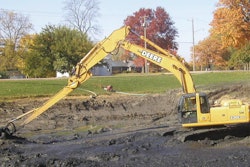
PWCE’s most popular attachment is the 16- to 20-ft. Extendavator model. “It pins on like a bucket,” says Wever. "We build them for all different size machines. Our most popular is the 40,000- to 70,000-lb. class… You can actually leave the extension on the machine and transport it based on how we have configured it.”
The same Extendavator attachment fits on all 40,000- to 70,000-lb. excavators. “In the 40,000- to 70,000-lb. class unit, the ears are spread 16 1/2 in. and it has a 90mm pin,” says Wever. This is designed to fit the machine with the largest pins and spread in the class. Bushing sets and longer pins are used to adapt the unit to other makes and models.
L&G Products offers the Add-a-Stick, which ranges from 12 to 20 ft. “It is a fast way to get extra reach without buying a different machine,” says Larry Heinneman. “In extreme cases, we will make something longer. We do not use a counterweight unless the ground underneath the machine is unstable. We work within the hydraulic limitations of the lifting capacity of the machine.”
What differentiates many of the attachments is the quality of materials used and customization offered. “It is structurally T1 steel and it is very strong,” says Heinneman. “We try to work with the customer and change things so they are convenient to use. Our engineering force will make something fit.”
For applications where you need to economically reach a little longer than the factory stick, L&G Products offers the Add-a-Boot. “That actually fastens to the stick and makes the stick longer,” says Heineman. "You just replace the pins and pull the bucket. On a 40,000-lb. machine, you can gain 6 or 8 ft. You get up to the top end and we go up to 12 ft.”
PWCE also offers a hydraulically telescoping dipper for mid-size excavators. “I have built them on up to a 70,000-lb. class machine,” Wever notes.
While many companies currently offer telescoping dippersticks as an option on mini-excavators, very few are offering these attachments on mid-size excavators. The concept is the same as it is for backhoe-loaders.
“You don’t have to keep moving. You can just extend that stick out to get a little bit extra reach,” says Wever. In some cases, it allows you to get away with a slightly smaller machine because you can get that extra 2 ft. of depth when needed. “We have found that once our customers have a telescoping dipper, the machine that doesn’t have it is the one that sits still.”
The extra reach with the extendible dipper depends on the carrier weight. It ranges from 5 ft. on a 40,000-lb. machine to 6 ft. on a 60,000-lb. machine.
Set for Success
With long reach attachments, setup is critical. For instance, consider the use of quick couplers. “A quick coupler will work,” says Heinneman. “I don’t like them because they usually weigh around 1,000 lbs. and that takes away from the lifting capacity of the machine. When you [extend the dipper] out there, it is desirable to have the least amount of weight possible.”
The operator is also key to success. “The operator has to have integrity in what he does,” says Heinneman. “A bad operator will do things that he isn’t supposed to do. The longer it gets, the better the operator that is required.”
The operator needs to consider the dynamics of the machine with the long reach arm. Swing speed at the end of the stick needs careful attention.
“The speed of the bucket at a farther distance away from the machine will dramatically change,” says Wever. “The operator needs to use caution when he slows down. Many operators in standard machines have no experience in long-front machines. You cannot stop as fast. The biggest issue that we have had with operator error is the operators using the pile as a brake.”
Another issue is not slowing the bucket down before it enters water. “When you are reaching out with a long-reach front machine and slam that bucket in the water, it is like slamming it into a wall of concrete," Wever points out. "Dynamically, it puts loads into the stick that will affect its cycle life.”
It is especially important to even out turret bearing wear. “To get normal wear on the turret bearings, you are supposed to reach over one side and then, after a certain number of hours, reach over the other side,” says Wever. “Let’s say your normal turret bearing wear in 10 years. You could easily take that down to three years if you never rotate your lower unit. That is one of the more expensive components.”





![Dsc07003 2 [1]](https://img.forconstructionpros.com/mindful/acbm/workspaces/default/uploads/2025/07/dsc07003-2-1.RopRyOdGL8.jpg?ar=16%3A9&auto=format%2Ccompress&dpr=2&fit=crop&h=135&q=70&w=240)


