Requests for information (RFIs) are commonly used in construction to clarify plans, specifications or other contract documents. Concrete contractors can use RFIs to cite plan or specification requirements that are unclear. But sometimes the contractor believes that following the plans or specifications may not satisfy the owner’s performance expectations. Reasons for failure to satisfy the owner’s performance expectations may include out-of-joint cracking in slabs-on-ground, excessive deflection of elevated slabs or problems related to aesthetics of the completed structure.
A successful outcome of an RFI that identifies problematic construction documents depends on:
- Knowing administrative procedures for RFIs, which should be established in a preconstruction meeting.
- Citing specific portions of plans, specifications or both that are the subject of the request.
- Quoting excerpts from concrete industry standards or guides needed to clarify unclear portions or better define the owners expectations.
Administrative procedures
In some cases, the owner defines and details the Request for Information process. In addition to clarifying plans and specifications, the owner may allow RFIs to request approval for minor deviations from contract requirements that do not involve any time or cost adjustment, and to obtain directions on how to proceed when there are conflicting contract requirements. Some owners have a standard RFI form to be used by the contractor. The form includes references to drawings or specifications, a description of the information needed, and a section for the response.
Concrete subcontractors needing additional information from the design professional are usually instructed to submit RFIs to the general contractor (GC) or the construction manager (CM). The GC or CM is responsible for reviewing and responding, or obtaining the required RFI response from the appropriate staff member for the design professional. It’s important to follow this RFI hierarchy rather than submitting the requests directly to an engineer or architect.
The need for specificity
The reference to drawings, specifications or both should be as specific as possible. Referencing specification sections and drawing numbers (as well as details on the drawing and column lines, or other identifiers) helps to pinpoint the parts of the contract documents that may lead to owner’s performance expectations not being met. Vague or nonexistent references to the plans or specifications are likely to result in the concrete subcontractor being asked to clarify the request or resubmit a revised RFI. This wastes time and may also impact the project schedule. Do it once and do it right is the plan.
Using industry documents
When the problem is related to clarity of requirements, citing industry documents such as those from ASTM International (ASTM) and the American Concrete Institute (ACI) can help to resolve ambiguity. For instance, one specification for a floor to be covered with sheet vinyl stated that troweled finish floors shall not be below FF35/FL30.
In the RFI, the concrete contractor stated that ACI 117, ACI 301 and ACI 302 use the description of Specified Overall Values (SOV) and Minimum Local Values (MLV) for the specification of F-numbers. ACI 302 indicates that FF35/FL30 as a SOV is appropriate for floors to receive vinyl flooring. ACI 117. ACI 301 and ACI 302 indicate that the MLV should be 3/5 of the SOV. In addition, the contractor pointed out that ASTM E 1155, which was referenced in the project specifications, states that the report will list the calculated overall F-number results for the entire test surface (Section 10.4). Based on these ACI documents and the ASTM standard, the contractor’s RFI stated the belief that the intent of the specification for the concrete to receive vinyl flooring was to have specified overall values (SOV) of FF35/FL30. The RFI resulted in the design professional concurring with the contractor’s interpretation.
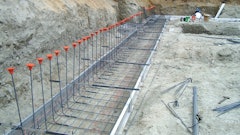
In another example, specifications called for #5 reinforcing bars at 12 inch on center, both ways, in a floor that was 5 inches thick. They also called for reinforcing bars to be continuous through joints at 12-foot spacing. The contractor believed that these requirements could result in out-of-joint cracking and also negated the need for sawed contraction joints. To support that belief, the contractor’s RFI cited Sections 6.2 and 8.3 of ACI 360R-10, “Guide for Design of Concrete Slabs on Ground.” Section 6.2 indicates that:
The continuation of a small percentage of deformed reinforcement (0.1% of the slab cross cross-sectional area) through sawcut contraction joints in combination
with joint spacings [ranging from about 12 to 16 ft for a 6-in.-thick slab] has been used successfully by some designers to provide load-transfer capability without using dowels.
Section 6.2 also states that:
As a general rule, the continuation of larger percentages of deformed reinforcing bars should not be used across sawcut contraction joints or construction joints because they restrain joints from opening as the slab shrinks during drying, and this increases the probability of out-of-joint random cracking.
Section 8.3, Reinforcement for crack width control only, further states:
To eliminate sawcut contraction joints, a continuous amount of reinforcement
with a minimum steel ratio of 0.5% … is recommended.
For #5 reinforcing bars at 12 inch on center in a 5-inch-thick slab, the deformed reinforcing area was slightly greater than 0.5% of the slab cross-sectional area. Using the references cited, the RFI asked the CM if it was appropriate to saw joints given that the reinforcing steel area specified was sufficient to keep cracks tightly closed. The owner, with concurrence from the design professional, then chose to accept many narrow cracks, eliminate sawed joints and opt for a decrease in the cost offered by the contractor as a result of not having to saw joints.
Getting a response
RFIs don’t always produce the desired results for concrete contractors. Sometimes the GC or CM refuses to pass the request on to the design professional, even though that’s the person who should reply. In this case, however, contractors have documented concerns that may prevent disputes over cracking, deflection or other alleged construction defects that could be identified during the final walkthrough.
Even if the RFI is passed on to the design professional, some design firms reserve the right to respond, or not, based on their judgment as to the validity of the contractors’ concerns. Again, a written record of the concerns is useful in resolving issues brought to light when approval of final payment is sought.
Finally, specifications may dictate an unreasonable time allowance for responses to RFIs, such as 30 to 45 days. This can cause schedule delays or result in a response that, when received, can no longer be of help to the concrete contractor. As an example of a response policy that reduces project delays, Jim Larson of Larson Associates Architects, Inc. in Phoenix says his firm strives to answer most RFIs within 24 hours of receipt.1 Not all contractors are fortunate enough to build structures designed by architects or engineers with this fast RFI turnaround time. But it sets an example for what can be done by design professionals to move projects smoothly toward completion.
References
1. Larson, James L., Larson Associates Architects, Inc., Phoenix, AZ, personal communication
Note: ACI documents cited can be purchased at www.concrete.org and ASTM documents cited can be purchased at www.astm.org.