Dustrol, based in Towanda, KS, near Wichita, was founded in 1973 by Ted Dankert when he began selling emulsions for sealing asphalt and controlling dust. In 1975, the company began using rented equipment to recycle asphalt and complement its pavement maintenance operations.
In 1979, Dustrol purchased its first cold milling machine and began focusing exclusively on asphalt recycling and resurfacing. Today it provides asphalt recycling and related highway maintenance services. Its geographic focus includes Kansas, Colorado, Texas, Oklahoma, Nebraska, New Mexico and Missouri. Recently the company has been building its presence in additional markets including Iowa, Arizona, Arkansas, Louisiana, Wyoming and Utah.
These days, the company is focusing on customized Hot In-place Recycling (HIR) preservation trains to grow both its markets and its profits. Brian Hansen, vice president, with Dustrol, says there are several different types of HIR methods, but Dustrol uses its specialized MARS (Mobile Asphalt Recycling System) process that it customizes for each job. The company has done several projects in the above-mentioned states using the MARS method.
"Before we developed MARS, we were doing a heater scarification surface recycling, which we still perform," says Hansen. "As a company, we wanted to be able to go deeper than we were able to with the surface recycling method we were using. We also wanted to be able to improve the quality of the material we were mixing and blending, and we just couldn't do that with conventional surface recycling."
The MARS method
HIR is an efficient process used to repair and rehabilitate deteriorated bituminous streets and highways on –site with specialized equipment. HIR allows available dollars to be spread over more square yards of pavement maintenance areas, which is attractive to road agencies. Increased costs of maintenance work make this process a desirable alternative in a roadway repair program. Dustrol's MARS system is designed for rejuvenating asphalt up to 2 inches or more.
The MARS system provides a low-cost maintenance strategy for removing cracks, ruts and low areas by using existing asphalt pavement for in-place rehabilitation. Flexibility and quality are restored to the asphalt material and the pavement is prepared for other surface treatments.
The MARS process is performed using multiple-lift milling heads. The multiple-lift operation allows for the rejuvenation to go to 2 inches or more in depth, without degrading the existing asphalt and aggregates.
"The process allows surfacing to be placed the same day or weeks later," says Hansen. "A recycled road or street can be completed and opened to traffic with only a few hours delay. Although the train is highly visible to the public, the process is fast and presents only a minor inconvenience to motorists."
Customized trains
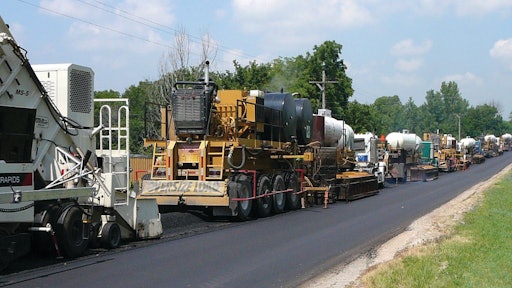
Dustrol designs and builds all MARS equipment itself. "Most companies in the HIR market build their own equipment," says Hansen. "There is some equipment available from suppliers, but we wanted to target open highway type work. Our trains can be over 1,000 feet long … we're not going after the small city street market or cul de sac market with our trains."
Because each job is different, Dustrol is able to customize its MARS train to fit the specific application. "Each state can require a different number of times the material has to be milled," explains Hansen. "For example, some might require that you can't take more than a 1-inch layer at a time. Other states might say you can't take more than 1/2 inch. If you're going 2 inches deep, you would have mill and level the road four times. This would require us to add more equipment to the train.
"Some states require us to add aggregate – rock or sand – or 10% virgin hot mix, and mix and blend it with the material we're milling," he continues. "This adds yet another piece of equipment to the train.
"The basic components are always the same," says Hansen. "We just add or subtract equipment."
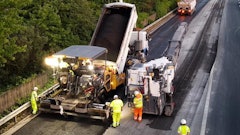
- The MARS process begins with two or more custom-made, propane-fueled preheaters.
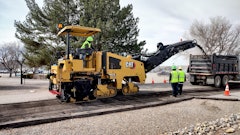
- The next heater in the train is equipped with grade-controlled milling drums which windrow the top 1 inch of material. The milling heads are capable of milling 15 feet wide and 1 inch deep.
- The tunnel heaters begin heating the underlying pavement while maintaining the temperature of the windrow.
- The surface is then milled and heated by up to three more milling heaters followed by tunnel heaters depending on material and depth.
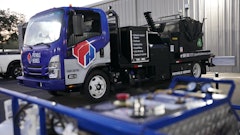
- The last milling heater in the process has an oil metering system that injects and mixes rejuvenating agent, which is a water-based emulsion that replaces the chemical constituents of the asphalt that has oxidized. The rejuvenating agent contains a polymer-modified asphalt which further improves elasticity and coating. This unit performs the last phase in the MARS process.
- The windrow – after having rejuvenating agent added and mixed – is picked up with a conventional elevator.
- The paving process is performed with a conventional electronic grade control, electric-screed paver.
- After paving, the material is rolled using conventional rollers.
The finished surface can be opened to traffic after a cool-off period similar to an asphalt paving operation, says Hansen.
Mix designs & surface layers
The type of mix designed for the project depends on the climate, traffic, environment and what type of material is already on the road, says Hansen.
"If there is a good, quality material on the road already, then that material can be recycled and made into good material again," he says. "If the road has some rutting because the initial mix was too fine, then we can add a coarse aggregate to stabilize the road.
"We do mix designs on every single project based on the situation," says Hansen. "The mix itself can be modified by the addition of new hot mix or aggregates."
Dustrol recommends some sort of riding surface be placed on top of the HIR surface. "Most states place some sort of finished riding surface, such as a chip seal, micro surfacing, thin hot mix overlay, UBAS or an open-graded friction course. There's a multitude of thin surface treatments that can be placed on top of the HIR when we're done."
HIR gaining in popularity through education
Hansen says he is seeing a slight uptick in agencies using HIR as a viable preservation method, but the process is slow.
"There's a lot of educating going on," he explains. "We work in multiple states, and it's a long process to educate the engineers on what we're doing and to get them to try a project. Usually it's a multi-year process. They don't just come out and look at a project once and decide they're going to bid a dozen projects.
"We like to show them what we're doing," he continues. "When we show them, it helps them to see they're going to get a good, quality material on the road and we can save them some money. Many engineers are leery about spending money on a new, unknown process.
"So it takes time and effort to convince these engineers that we have a good, quality product," Hansen says. "We spend a lot of time and money marketing to different state agencies to get them to take a look at what we're doing."
Hansen says the quality work the MARS process creates is the primary reason agencies usually decide to try the process. He also notes the high cost of liquid asphalt makes it more economic for agencies to look at options other than just placing hot mix.
"The combination of being able to do quality work along with the continued high price of asphalt is making more agencies take a look at the MARS option," says Hansen.