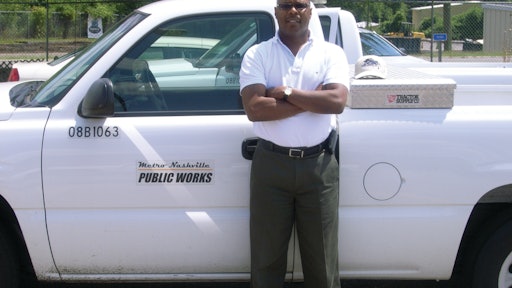
When it comes to preserving pavement, not every city’s paving manager is as open-minded as Nashville’s Donald Reid; then again, not every urban paving manager has Reid’s research background, either.
But what virtually every manager does have is awfully tight budgets and ever-expanding miles of deteriorating roads, which means they can learn a thing or two from Reid’s approach, which starts with methodical pavement management and pavement preservation.
“I am willing to test viable products provided by reputable manufacturers and vendors if they fit the profile of our roadways. We don’t put down just anything people contact me about,” says Reid, paving and right-of-way manager for Nashville for the past 10 years. “But I’ve tried a lot of them.”
Why?
“There is a definite benefit you get from putting a product down ahead of time to test it out,” he says. “People come to me with new products because of my history with research in the state DOT. Because I’ve kept up with the progress made by efforts like the Transportation Research Board’s Strategic Highway Research Program (SHRP) and the Federal Highway Administration’s Long Term Pavement Performance Program (LTPP), I’ve gotten a reputation for being willing to try emerging techniques and products. And why not? I would rather do that before Metro puts it down on a road in front of someone’s house, only to find out afterward that it was a bad idea. It has worked well for us to make sure a product meets the need and doesn’t cause problems for constituents or the environment before we commit to use it on the roadway.”
Reid says the Nashville effort to preserve its pavement – and his willingness to test out all sorts of materials and processes -- is based on a semi-annual survey of all roads under his responsibility. Half the roads are surveyed one year, and the other half are surveyed the next year, so every two years he gets a complete update of state of the roadways throughout his area.
Data for miles and miles of roads is collected, analyzed, and translated into a number – an overall pavement condition index (OCI) rating between 0 and 100 for each road. The higher the number, the better the condition of the pavement, and the less work it needs. Reid says that, under some systems, pavement managers have to go out to the road and verify what the OCI says. The system Nashville uses not only provides images, but also breaks the data down into segments of roads with images tied to each road segment. “We have digital images of every 20 feet of roadways in the county,” he says. “To me, it’s well worth it. We thought that when Google Earth came out we might not need this, but Google Earth just isn’t detailed enough. You can’t tell if the road is a 50, 60 or 75 rating, and you don’t have any control at all over when or how often the images are taken.”
TDOT Background Supports Efforts
Prior to joining Nashville, Reid had worked for 15 years for the Tennessee Dept. of Transportation (TDOT), where the state recognized it had to get its arms around the preservation of state-maintained pavement, and where Reid implemented a pavement management program for the state.
But working at a state level can be difficult.
“At the state DOT level, you’re dealing with a very large organization with many, many stakeholders, and it can be difficult to get consensus on implementing and utilizing new products,” he says. “During the years we’ve been doing it here at Metro, whenever I deploy a new test site, my counterparts come down from TDOT and from other local governments across the state to check it out. Here I can just decide I want to test a new product or process, identify a suitable test case, and supervise having the product applied under ideal conditions. I don’t have to go through bureaucracy to get approval to do it.”
Reid makes clear it’s not only the lack of a bureaucracy that enables him to test products as he sees fit -- it’s the nature of working over a much smaller area and a more homogenous environment than across an entire state. He says TDOT divides the state into four regions, and each sees a slightly different set of factors that affect the expected lifetime of pavement.
”So it’s difficult to implement a new fog seal or rejuvenator on a state-wide basis, for example, because the different regions may not benefit equally from the same types of products or treatments. What works in East Tennessee might not work in West Tennessee, because of differences in climate or types of aggregate, for example,” Reid says. “I don’t have that nearly as many variables here in Nashville as exist across the whole state.”
So he takes full advantage. Currently, more than a dozen producers have placed 500-foot test strips of fog seals, slurry seals, micro surfacing, and more for Reid to evaluate, and more than half of those strips are on the pavement immediately in front of the Nashville Public Works building.
“It’s great having them tested right in front of our facility so our director and chief engineer and everyone involved can drive over these products every day,” he says. “This way, my counterparts can see how it goes down, and they can watch how it performs.”
Reid says he tests material not only to evaluate the effectiveness of the material, but also to help determine which materials can work best on which roads. As paving and right-of-way manager he is responsible for the maintenance of arterials, collector routes, and local roads, and he says traffic volumes and traffic type varies significantly for each type of roadway.
“Some materials worked on local roads, but didn’t work on collector routes, for example,” he says. “What might last on a local road might last only three months on a collector route because of the traffic density.”
The first material he tested was the rejuvenator Reclamite Preservative Seal made by Tricor Refining. “We tested that because we were skeptical of jumping in to heavy black fog seals,” he says.
Reid says the rejuvenator worked well and is still in use throughout the area. “But Reclamite has to be put down on new roads,” Reid says. “You can’t put it down on raveled roads; it has to be put down on roads that are only three to five years old. But we have more nine- or ten-year-old roads than we do three-to-five-year old roads, so that’s what led me to look for other products.”
Reid says when testing is complete, his department provides the producer with the city’s viewpoint of the new material—the pros and the cons. Among the materials currently being tested or in use because of successful tests are Western Emulsion’s PASS QB and textured PASS QB, Star Inc.’s Road-Guard road sealant/micro surfacing material, SealMaster’s PMM (Polymer Modified MasterSeal) and Liquid Road. In addition, Reid three years ago tested a warm-mix asphalt overlay (which led to a TDOT spec that could lead to the use of WMA on 10% of paving jobs).
Currently Reid works through various contractors, with projects going to the low bidder. In a perfect world – a world without budget cuts and with enough tax dollars coming in -- Reid would like his own in-house crew, which he says he could keep busy doing infrared repairs, cracksealing, and fog sealing. “I could keep one crew busy all year now because cracksealing is best done in spring and fall, infrared patching can be done all year round, and fog seal is best applied in Summer.”
Testing a New Polymer
Reid says he will soon deploy a test area using a new hot-in-place polymer, Kraton Polymers’ HiMA formula, that when added to the hot mix asphalt makes it easier to place and work by hand.
“Typically, the more polymer added to a mix, the more difficult it is to place that mix and work it by hand. According to the developers, this polymer is supposed to make all that easier,” Reid says.
The product will be used in a state aid paving job along one side of an intersection alongside a more standard full-depth concrete construction on another part of the same intersection.
“So we’ll be able to see how well it performs, and how well it performs compared to a concrete roadway.”
Infrared Repair in Nashville
While most of Reid’s testing involves materials, he also tested infrared repair techniques, which led to a full-fledged program that has now been in place for five years.
“The first infrared test we did years ago was a disaster. It resulted in the worst-looking patch I’d ever seen,” Reid says. “But a few years later, another company wanted to test it and I said ‘go ahead’ and it worked out great.”
He says that while it’s not economical to use infrared technology on large-scale repairs -- and infrared doesn’t solve problems such as base failures and alligatored areas where repairs need to go deeper than the top layer-- the city plans up to $2 million in infrared repairs over the next two years.
“Today we do a lot of infrared repair because it just makes sense. You have more bad spots than you have bad roads – so why overlay the entire road?” he says. “When we go out and look at a road that’s one mile long, and only 5-10% is in bad shape, we try to address just that 5-10%. If we can address those particular spots, then we’ve bought ourselves five more years on that road. And then we don’t have to spend the money to pave it now.”
He says the city amped up its use of infrared patching following a major flooding in 2010 that resulted in a 15-point drop in the city’s overall pavement condition index. “What caused our condition index to drop was delamination of the top layer (he calls them ‘popouts ‘). And if it’s just that top layer that’s the problem, then infrared is the perfect remedy, because the problem is just affecting the top two inches of asphalt, and the rest is fine.”
Increase in Pavement Preservation
He says that advances in materials and techniques, as well as the information available about them, has made it much easier to pursue pavement preservation.
“It isn’t the city and state that were intentionally slow to adopt preservation and long-term maintenance, it was the industry itself that was slow to change. Many more companies now offer pavement preservation services,” and Metro is taking advantage of this to extend the lifetime of paved surfaces.
“Adopting pavement preservation techniques doesn’t mean you aren’t going to have to pave. You have to have the mindset that if I don’t do something with these roads I’m going to have to pave them sooner. If we treat roads before they fall apart, we can seriously postpone the inevitability of needing to resurface them. If we wait until they fall apart, it’s going to cost you serious money because resurfacing a road is the most expensive process we could perform on it,” Reid says. “I can crackseal for pennies, and I can fog seal for pennies. No one can pave for pennies.”
He says preservation and maintenance has grown in popularity not only because it’s proved to be effective in extending pavement life, but also because cities cannot afford a reconstruction-only budget. “When you do perform pavement preservation, your money goes further and you can afford to treat more roads during each budget cycle. That’s the reality of it,” he says.
Reid’s willingness to test new materials and his emphasis on pavement preservation and pavement maintenance means good things for Nashville. Over the last two years ending June 2012, Nashville’s approach to preventative maintenance has had a positive impact on more than 210 lane miles of road including:
- 180 lane miles of paving
- 6,139 linear feet of cracksealing
- More than 6,100 linear feet of cracksealing
- 48,500 sq. ft. of infrared repair
- 32.5 lane miles of fog seal
- 69,600 sq. ft. of pavement repair
“It means we can maintain more roads --visibly improve more roads-- making more constituents happy,” he says. “In the past, people would say ‘my road needs to be paved’ but the reality was the road ‘needed to be fixed.’ Taking a preservation and maintenance approach allows us to meet the needs of more people.”
And, he says, there’s less pressure to do the significantly more costly paving.
“I’m after an 18-year life cycle,” he says. “If I can get 18 years I’m a happy man whether I do it with cracksealing, infrared, fog seal, or some combination. For the money it takes me to resurface roads, I can positively affect three times as many roads with pavement preservation.”