Information from this article was first published in Demolition Magazine and is being reused with permission from the National Demolition Association.
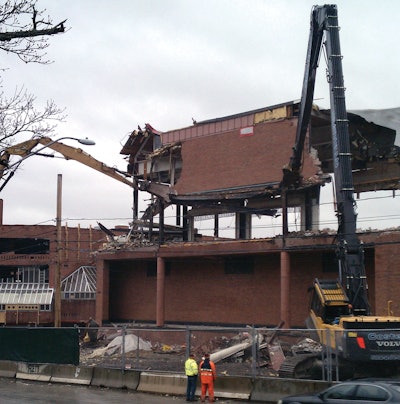
The new $200 million Newton North High School (NNHS), Newton, Mass., wouldn't be complete without athletic fields and grounds, which were designed to be adjacent to the new high school on the grounds of the old school. Costello Dismantling of West Wareham, Mass., took on the demolition of the former high school. A fairly routine, but difficult, demolition component was coupled with a massive environmental remediation scope of work to create an extremely challenging overall project. Compounded by a sensitive community relations element and discoveries made during the course of demolition, Costello had to employ a unique and inventive engineering solution.
The old high school site is surrounded on three sides by residential neighborhoods and on the back side by the new high school and athletic fields. To meet an accelerated project schedule, the building was carefully divided into eight work zones, allowing multiple environmental subcontractors and demolition crews to work simultaneously.
Handling the Asbestos
All the interior block walls had been identified as asbestos-contaminated from overspray of fireproofing applied to the structural steel during construction which had permeated the inner cavities of the masonry block walls. The spray-on fireproofing had also settled on top of ceiling tiles throughout a large portion of the building, necessitating careful abatement.
In addition, a large percentage of the flooring and flooring mastic in the classroom areas as well as window caulking and roofing mastics also tested positive for asbestos.
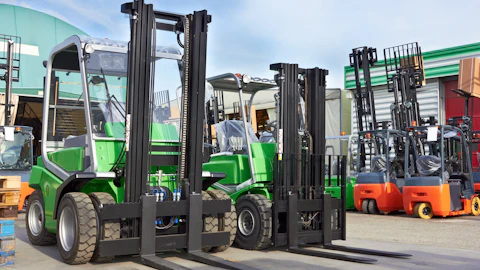
The site required packaging all asbestos debris in double-lined, labeled and sealed Gaylord (3 foot by 3 foot by 3 foot) heavy cardboard boxes. The loaded boxes were taken from containment zones into decontamination chambers then by forklift to load-out areas. To ensure optimum shipping weights, each Gaylord box was weighed, manifested and loaded into 53-foot box trailers for shipping. During the course of the project, more than 650 trailer loads were shipped.
Prior to structural demolition of Zone 1, Costello performed preliminary inspections of the exterior walls to fully understand the remaining structure. While, the pre-bid asbestos survey and as-built structural drawings from the original construction did not indicate fireproofing in the exterior wall areas, Costello quickly discovered the same asbestos fireproofing overspray present in the interstitial space of the masonry block as well as through-wall asbestos containing flashing at each floor level of the school.
Further testing quickly revealed that asbestos was pervasive in almost all of the exterior walls. Full containment, negative air in the work zones during abatement, packaging and loading out asbestos debris in cardboard boxes, and loading box trailers was required.
The task at hand became to engineer a system that could safely and cost effectively allow Costello to handle this excess material with as little effect on the schedule as possible.
Finding the Right Approach
The first approach that Costello looked at was to erect scaffolding around the entire four-story building and shrink-wrap the building envelope to allow removal of the exterior walls within negative air containment. Wrapping the building had been the only successfully executed practice that had been previously approved in Massachusetts for similar circumstances.
The price for the change order work came in excess of $5 million dollars, which was beyond the budget, contingency and “rainy day” fund authority. The city would have to consider finishing all interior abatement then securing the school building until funding could be realized in subsequent years. The new athletic fields would have had to be postponed.
Costello immediately began to think outside the box to come up with a different solution. The first seed of an idea came with the thought of somehow maintaining the exterior brick course in place, to provide containment without a complete building wrap, while removing the concrete block from the inside. The problem would be that the brick course was incapable of supporting itself with the masonry courses and steel ties removed.
After hours poring over the problem, a solution was reached - a system of exterior supports that braced the brick facade against the interior floors. The supports would be installed before interior masonry block removal then removed and reinstalled as each floor of a zone was abated. This also allowed the brick façade to be recycled rather than disposed of as asbestos-containing debris, a savings of at least 25 percent of disposal costs. After being granted a trial of the method, MassDEP approved the plan.
The Demolition Process
After approval of a funding request that shaved $2 million off the original estimate, abatement and subsequent demolition began, with two subcontractors working from each end of the building towards the middle.
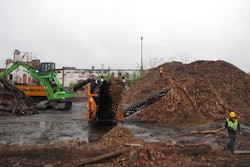
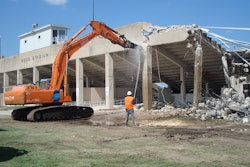
Costello sequentially had zones released for demolition and had demolition teams taking down zones of the building at the north and south ends simultaneously. A second team prepared and shipped 4,000 tons of structural steel while a third crew removed and processed concrete slabs and foundations, much of which was used for on-site fill requirements.
The discovery of asbestos fireproofing in exterior walls pushed back the start of demolition by four months, but an expertly organized and executed demolition plan released critical areas of the work zone to the developer only one month after the original milestone, a full month ahead of the revised schedule.