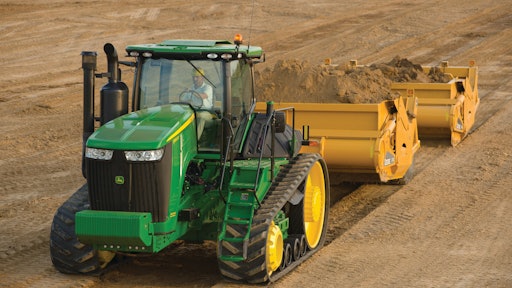
Versatility has made pull scrapers popular, but selection and set up determines success. “Pairing of the tractor and scraper(s) is the most critical step,” notes Mark Oliver, John Deere product marketing manager, scraper systems. “The relationships between scraper size, quantity, horsepower and ground conditions are key.” Pay close attention to ballast. “Try to achieve an even weight split between front and rear tractor tires under load without exceeding roughly 110 lbs. per horsepower. “
Then you must choose between tires or tracks. “Selecting the right tires or tracks for your conditions and following the manufacturer’s recommendations for wheel slip will lead to better performance and lower costs,” says Oliver. When using tires, proper air pressures can greatly affect performance in the cut. Tracks typically perform better in loose underfoot conditions like sand while tires perform well in topsoil and clays."
Tracks are also better suited for adverse conditions. “The CaseIH Quadtrac (track tractor) will get into conditions you simply can’t get with a self-propelled scraper,” says Roger Lewno, Case IH team leader of large tractor marketing. The advantage of a wheel tractor is the wheels slip, so you have an automatic slip clutch between the tractor and the ground. With tracks everything comes through the powertrain and through the engine. But the tracks also offer better ride quality. “You must carry a little higher air pressure on a wheel tractor because of the increased weight.” Also note that tracks do come with a little higher operating cost.
Also consider the operator's line-of sight to the cutting edge. “Without the ability to actually see the work area the operator can only guess at depth of cut and spread height as well as the load level in the bowl,” says Walt Baty, Bult Enterprises. “This will always result in reduced productivity through less than optimal load levels and inappropriate spread levels.”
Choose your scraper
You want a scraper that provides the lowest overall cost per yard for the specific job. “Factors driving the cost per yard include load carrying capability, time to load and overall cycle time, as well as fuel consumption or operating costs,” notes Baty.
Another tangible factor is versatility and the resulting utilization. “On many jobs there are areas where using a scraper results in the lowest cost per yard. In other areas it is more economical to top load a truck,” notes Baty. “If a scraper can be top loaded it may not be necessary to bring in additional equipment to achieve the overall lowest cost per yard.”
Scraper systems provide unmatched flexibility. “The beauty of a pull scraper system is that capacities can be adjusted by adding or subtracting scrapers from the prime mover to suit each individual project or set of conditions,” says Oliver.
John Deere and Case both offer scraper systems productivity calculators on their website that helps compare the costs of different earthmoving solutions. This can help identify the ideal size and quantity of scrapers to minimize the costs per cubic yard.
There is an art to sizing scrapers. “The more volume that can be moved per load, the more you minimize repetitive trips,” says Kelly Goossen, sales manager, K-Tec Earthmovers. K-Tec takes a unique approach by offering single scrapers with a capacity of 25 to 54 cu. yds.
When choosing between a dump or ejector scraper, soil type is the most important factor. “If your jobsite requires moving loose topsoil or land leveling, a wide format dump-style scraper is preferred over a narrower cut ejector scraper (which is used primarily to move bulky material like clay),” says Randy Rust, president, Ashtec Industries.
Dump scrapers are less costly than ejector scrapers and they can unload faster. “But ejector scrapers unload more evenly than dump scrapers,” says Rust. “This can be a benefit to meet compaction standards.”
Dump scrapers may also present problems when unloading if the material is wet or sticky. “As material that cannot be dumped builds up in the bowl, the load carrying capacity is reduced,” says Baty. “The ejector scraper always has the ability to positively eject, or push out of the bowl, all of the loaded material. The speed of the ejector can also be adjusted to provide better control of the spreading operation at the fill site. Consistent depth of material when being spread is a benefit during the compaction process.”
Ejector scrapers do offer the ability to work in all soil conditions. “Ejector scraper design allows loading of light or heavy material and with the fast ejector scrapers, ejector scrapers are considered all-in-one scrapers,” says Goosen.
But dump scrapers can really shine in the sand. “A Deere carry-all scraper approaches the cut with a slightly different angle than an ejector, making its performance in dry, loose materials, superior,” says Oliver. “Because the carry-all relies on gravity for dumping, its cycle times are typically faster than an ejector. Its aggressive approach and front pivot design give the ejector faster blade response than a carry all.”
Also take note of the blade configuration. “Certain blade configurations like drop centers and teeth are better in tougher soils while straight blades work better in sand,” says Oliver.
The use of grade control systems does require special consideration. “You need high auxiliary flow rate from the couplers,” notes Rust. “Most new tractors are ‘plug and play’ and integrate with automatic machine control systems. Older tractors may require additional electric over hydraulic valve systems.”
Sufficient flow is needed to fast and predictable hydraulic response for all functions. “CaseIH requires at least 57 gpm hydraulic flow on its scraper tractors. And there is a 3/4-in. coupler option. “That would minimize the restriction going back to the scrapers for increased speed.”
Plumbing a scraper setup also requires careful attention. “The industry standard quick connection couplers may often cause problems,” says Goossen. “Direct plumbing hydraulics is often the preferred choice and gives you the most hydraulic flow. When hooking up a K-Tec scraper you will need a free flowing hydraulic valve called a ‘CASE Drain’ to activate the automatic ride control. K-Tec’s automatic ride control allows for faster travel speed while causing less stress to both the tractor and scraper.”
Tractors more than they appear
While a scraper tractor may have the appearance of an ag tractor, critical differences exist. “The scraper tractor is factory configured to comply with most OSHA requirements,” says Rust. “A customer using an ag version tractor may risk having his/her job shut down because the tractor does not meet or exceed the OSHA requirements to be operated on the construction site.”
Scraper tractor cabs feature Roll-Cover Protective Structure (ROPS) and Falling Object Protective Structure (FOPS). “The seat retainer meets OSHA and MSHA standards, and there is a backup alarm, wide clearance marker, strobe light, and external mirror standard to improve jobsite safety,” notes Rust.
They are also built to withstand the tough duty cycle. “In general, a scraper tractor should have a more robust chassis, more appropriate tire and ballast options, and more horsepower than an ag tractor,” says Oliver. “Scraper tractors, due to the high tongue weight loads of a scraper, should be ballasted heavily on the front in order to deliver the massive engine power to the ground.”
The John Deere Scraper Special features a short drawbar support tongue weight transfer and high flow hydraulics for fast blade response. The most important feature, however, is the AutoLoad system. “AutoLoad allows push-button loading so that even the greenest of operators can load like a pro,” says Oliver.
Likewise, CaseIH produces specifically-designed scraper tractors that come with the scraper drawbar and a tow cable. “We require the heavy-duty axles with the reduction compound planetaries,” says Lewno. “We require differential locks on the axles.” It also comes with an upgraded transmission with the default set to second gear on startups as opposed to fourth gear on the ag tractors.
If you purchase a factory produced scraper tractor, most of the configuration/setup has already been completed. “If you’re converting an ag tractor, a common mistakes is purchasing a tractor without a power shift transmission,” says Rust. “This limits productivity on longer hauls.”
Scraper tractors are engineered to handle the weight transfer from the scraper. “Additional front weights are required to offset the vertical weight transfer the scraper displaces onto the rear of the tractor,” says Rust. “Scraper tractor manufacturers have preconfigured weight packages and tire/wheel configurations.”
Approximately one third of the weight of the scraper is on the drawbar of the tractor. “So an empty scraper is 18,000 lbs., you have 6,000 lbs. already on the rear of the tractor,” says Lewno. “When it fills the dirt may weight about 2,500 lbs. per yard.” You can do the math. “That weight is transferred to the tail of the tractor.” The nose of the tractor would be weighted to counteract this weight.
Pull scrapes utilize a special hitch. “A high-strength 1.5-in. horizontal hitch pin couples the tractor to the scraper, which allows the weight to be moved closer to the rear of the tractor,” says Rust.
The position of the hitch requires special attention. “When hitching a scraper to a tractor, attach it as close to the rear axle, and as low to the ground as possible,” notes Goossen. “Ideally, the pull point needs to be as close to the center of the tractor as possible.”
The tractors have adjustable drawbars, so when you couple the scraper to the tractor make certain the drawbar height is right for the scraper. “If the scraper is getting too high, when you lower the scraper it will sit back on its heel and will be very difficult to load,” says Lewno.
In addition to conventional scraper tractors, there are also tractors based on articulated dump trucks (ADTs). “You may want to consider an ADT power unit which will greatly increase your haul road speed,” says Goossen. The Bell 4206D scraper tractor is derived from heavy-duty articulated haul trucks with specific scraper application enhancements to the drive train. The Terra Titan S4412 uses a high arch, or gooseneck style drawframe mounted to a ball hitch located near the center of the tractor and thereby achieves optimum weight distribution as the scraper loads.
As the Terra Titan scraper loads, the weight of the growing load is transferred to the center point of the tractor which is equally distributed across both tractor axles. “This design utilizes the payload to increase traction as the scraper loads, no supplemental weights are necessary,” says Baty.
Push Loading Tips
A key benefit of the pull-type scraper over traditional self-propelled scrapers is its ability to self load. “However, Deere recognizes that in certain conditions a push load is preferred,” says Oliver. In extremely hard conditions it can be more productive to push load, while push loading can also shorten the scraper’s cut length on smaller job sites.
“Push loading is beneficial when a material is hard and difficult to load,” says Goossen. Also when the haul distance is fairly long and you want to every yard of dirt you can get in the scraper, push loading can provide a better fill. This results in fewer overall trips.
The design of the scraper has to be compatible with push loading. “When pushing, it is important to use a scraper with lift cylinders that are vertically mounted over the cutting edge. This prevents cylinder damage often experienced on scrapers that control the blade by moving the rear tires,” notes Rust.
Push loading maximizes load sizes on a repeatable basis and minimizes the overall cycle time for each load. “When the scrapers and the push dozer are properly matched, full loads should be achieved consistently in 30 to 35 seconds,” says Baty. “Obviously, push loading requires an additional machine and operator, but when the number of scrapers required for the job is properly balanced to the number of push dozers, the additional cost of that machine is effectively spread across all of the scrapers. The resulting benefit from larger loads, more loads per hour and lower scraper-tractor fuel consumption and component wear more than offsets the additional cost.”
Top Loading Tips
A scraper well suited for top loading should have well-shielded hydraulic and electrical components, as well as unobstructed access for loading material. “Deere uses steel hydraulic line and wire harness shielding from nose to tail, as well as protection for lighting and cylinders,” says Oliver.
Baty adds, “When top loading a scraper, either pull type or conventional, concern always arises due to the small target area that the scraper bowl offers as well as the potential for impacting exposed hydraulic cylinders and other components. “In the case of the Terra Titan, the bowl design offers a huge target area that is larger than most ADT dump bodies and all hydraulic cylinders and components are well protected and located away from the top of the bowl. Before top-loading any scraper, the bowl should always be lowered to the ground.”
In addition to a large apron opening, the scraper capacity should be matched to the excavator for top loading. “The excavator/bucket size compared to the scraper size is very important,” says Goossen. “Ideally, you want to load the scraper in about three to five swings of the excavator.”