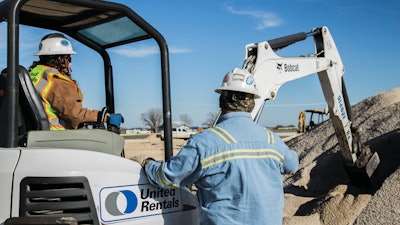
The uneven recovery in construction activity coupled with uncertainty about equipment availability and prospects for future work make for tough choices when it comes to acquiring equipment. The investment in even a smaller machine such as a compact excavator becomes a major decision.
The question becomes whether it’s more practical to buy the unit and have it on hand when and where it’s needed, or if it’s better to rent until you know you have both the project backlog and mix to justify the purchase. Leasing throws yet another potential acquisition option into the equation.
There can be benefits to each, but they depend largely on the situation and equipment utilization.
Rental’s Rewards
Compact excavators have grown to become a high-volume rental item. A number of factors have driven this trend.
- Availability of capital: Renting can help to maintain financial fluidity during times of uncertainty, such as we saw throughout much of 2020 and into 2021. As a generalization, a longer-term rental over multiple months will typically run 4% to 5% of the cost to purchase plus you avoid the sales tax required with outright acquisition.
- No long-term commitment: Rental gives you the ability to use a specific machine to complete a job without making a long-term commitment to a specific size class. You can determine and acquire the best machine for each job – whether it’s a 1.5-ton unit on one project or a 4-ton machine on the next.
- Rental limits maintenance exposure: If the rental equipment breaks down or fails to work properly, the cost of maintenance, repairs and equipment downtime falls to the rental company. You can simply return it and obtain a comparable replacement.
- Tax benefits: With rental, you pay the bill, charge it to the job and you can later deduct it as a cost of doing business. You don’t have to worry about depreciation, interest allocation or insurance.
“Another benefit of infusing rental equipment into a fleet strategy is the access to newer and more advanced fleets. Rental companies upgrade their fleets on a regular basis, giving contractors access to the most advanced gear and latest in control and operational technologies,” said Craig Schmidt, vice president, United Rentals.
A Matter of Utilization
Of course, rental is not a one-size-fits-all solution. It’s important to look at all of the factors that can influence the most cost-effective way to obtain a compact excavator. They can include:
- the number of hours put on the machine annually;
- how long you intend to keep the equipment;
- maintenance costs required for the equipment each year;
- financing programs available when purchasing the machine;
- and the type of cash flow you are looking to obtain.
Of these, expected utilization typically tops the list. “The ‘buy’ conclusion has to be based on future utilization,” says Garry Bartecki, managing member of GB Financial Services LLP, and a consultant to the Independent Equipment Dealers Association. “Because you are committing to at least a 60- to 72-month financing payment cycle, you had better be sure you have the work over this time period to cover cash flow requirements.”
He recommends purchasing the machine if you expect an annual time utilization of 60% or more based on 22 days of use per month. “From 40% to 60%, you are in middle ground, but you had better be sure you are going to hit the higher end of the spectrum. If you are not really, really sure about time utilization, then rent until you have a clearer picture,” he advises. “Lower than 40% is a rent situation.
“And let’s not forget transportation costs. If you own the trucks and trailers to move the equipment, you have another costly investment with zero time utilization when the construction equipment is in the field,” he points out.
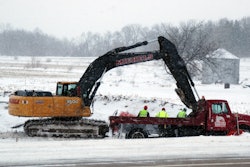
 If the utilization for the compact excavator is expected to be over 60%, or you need to have the machine on site for extended periods of time, a purchase may prove to be the most cost-effective option.Doosan Infracore
Even lower hour usage machines kept for longer terms may be more cost effective to purchase. However, make sure you understand your tax situation and current tax laws in effect for purchasing equipment to achieve the best benefit.
A Lesson in Leasing
Lease agreements offer another means to acquire equipment without making a substantial upfront capital investment. They provide a fixed budget amount for an extended term, typically 12 to 36 months.
This can be a good option for those who don’t want to tie up working capital. It also allows you to rotate equipment on planned replacement cycles, which can potentially reduce maintenance and downtime costs. Plus, it may reduce the amount of tax paid to acquire the equipment.
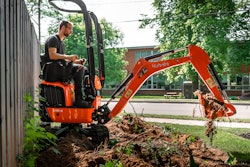
 Lease agreements offer another means to acquire equipment without making a substantial upfront capital investment.Kubota
The potential downsides vs. rental include maintenance costs, the potential that you may not need the equipment longer than expected or requiring different equipment for different jobs.
With a lease, you are also locked into a long-term, fixed financial commitment. If a job gets cancelled, you’re on the hook for the payments for the duration of the lease, whether you have the work to cover the cost or not.
Cost Comparisons
Comparing costs between a rental, purchase or lease can be a challenge. Rental rates can vary widely by market, so an accurate comparison is difficult.
Consider the following scenario: Say you rent a 3.5-ton excavator at a rate of $250 a day or $2,250 per month. (Rates shown are for example purposes only.) Now compare this to the payment rates for a loan or a lease based on a sales price of $42,000 at 0% for 36 months. The payment would be $1,166.67 per month. For a lease, the payment would be approximately $779 per month.
However, with a purchased or leased piece of equipment, you have an annual cost tied to it. For example, your annual payments on the loan would be roughly $14,000 or $9,348 with the lease, whether you use the machine or not. With a rental, you can return it at any time.
Owning and operating costs must be factored into your calculations, as well. Unfortunately, not everyone understands the true cost of owning equipment.
“Ownership cost is the realistic depreciation of the unit over the time you plan to keep it,” says Bartecki. “The residual should be based on the expected wholesale value at the end of the period taking into account the number of hours you expect to put on the machine.”
For easy figuring, let’s use a $100,000 piece of equipment as an example. “A $100,000 machine used for 2,000 hours a year for five years, with a 25% residual (of cost), generates $75,000 of depreciation or $7.50 per hour,” Bartecki notes. “Interest comes out to approximately $3.70. So, if you use the unit for 2,000 hours annually, it is costing you $11.20 an hour. Use it less than the 2,000 hours and the hourly rate increases.
“At 1,000 hours, the $100,000 unit will cost about the same as a rental,” he adds. “And if that’s the case, I would rather rent because it provides a lot more flexibility.”
Next, calculate the cost to operate the machine. “These costs include normal wear and tear, inspections, preventive maintenance. Obviously, the older the unit gets, the higher the costs become. It would not be unusual for the operating costs to double the hourly ownership cost over the five-year period,” says Bartecki.
Continuing with the example, this would equate to an operating cost of $22 an hour, with a combined owning and operating cost of $33.20 per hour. Add in a couple of dollars for administrative costs and the overall cost comes to $35.20 per hour.
 Buying new lets you to take advantage of the performance enhancements provided by the latest technology, but a used purchase can significantly reduce the initial capital investment required.United Rentals
“To compare, if you rent a unit for the full year, it will cost you $52,000 (or a negotiated rate for a full-year rental) compared to 2,000 hours times $35.20 per hour, or $70,400, to own and operate,” Bartecki indicates. “Obviously, a new unit will experience lower operating costs that reduce the annual cost to somewhere close to the rental number. Lower time utilization also lowers your total cost to own and operate. Cost to own remains the same, but the hourly operating costs are lower only if you hit that 60% to 80% time utilization.” At 75% time utilization, the total cost should be similar to rental.
“Even if the cost to rent is similar to the cost to own and operate, you have to consider the other costs of ownership,” Bartecki advises, “namely the balance sheet effect and the flexibility rental provides to expand your business or go into new lines of work. Rental also frees up your borrowing and bonding capability.”
Ongoing financial conditions also favor rental. “With the post-pandemic situation, I would prefer to rent rather than buy until the financial markets settle down,” Bartecki comments. “The corporate, personal and government debt could cause a lot of problems regarding debt loads and related cash flow requirements.”
As such, Bartecki’s advice is to “rent what you can and buy only what you must.”
“In many cases, rental is the way to go for contractors to protect their cash flow and capital base,” he states, “but dealers have to be prepared to support their customer base whether they need to own or rent equipment.”
Additional information for this article provided by United Rentals and Doosan Infracore Construction Equipment