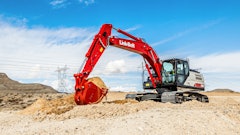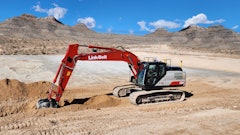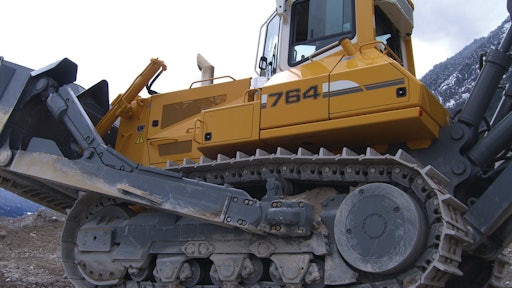
When it comes to the undercarriage on steel-tracked machines, “making do” with the inappropriate track shoes and chain can prove costly.
“Using the wrong steel track shoe and chain combinations can dramatically decrease the overall performance and efficiency on the one hand, and cause damage/shorter life of the undercarriage components on the other hand,” notes Robert Klima, product manager - crawler tractors, Liebherr Construction Equipment.
Yet, it’s not always practical, or even feasible, to match the track setup for every situation an excavator or dozer may encounter.
“The decision for a certain undercarriage is a compromise in most instances, especially in small and mid-size machines that frequently move from job to job and work in different applications and different materials,” says Klima. “For nearly every application you can think of, there is a ‘right’ shoe type available. However, as machines get moved from one job to another, conditions change. A shoe that might have been a good solution on one job might not be the best solution on another job.”
As such, it’s important to look beyond the current application. “End users are required to always make their choices with future usage in mind,” says Guido Bottin, vice president of operations (COO), Berco of America, “considering that the overall cost of repairing and/or maintaining the undercarriage may reach around 60% of the total operating costs on a mid-size dozer.”
Match Track Width to Conditions
“Each OEM usually has offerings such as standard track, wide track and low ground compaction (LGP),” says Jon Gilbeck, crawler dozer global product marketing manager, John Deere Construction & Forestry. “Shoes range from 16 to 36 in., depending upon the tractor model.”
According to Klima, undercarriages range from standard track gauge over wide tracks to LGP versions. “This is then combined with different track frame lengths, which determine the length of the track on the ground,” he notes.
The selection of a wider shoe usually is based on the need for additional flotation on rough, soft and uneven ground. Machines working at an angle also benefit from wider shoes on LGP track. “The wider track gauge provides superior stability while operating on side hills and slopes,” says Gilbeck. “The longer track and wider pads provide the maximum level of machine support on the ground surface.”
For dozers, this can mean improved grading characteristics for finish grading, especially when working on uncompacted base fill material. “The larger contact area associated with the wider pads and longer track frame improves the blade control,” Gilbeck explains. “In this configuration, the blade will have less of a tendency to porpoise and allow the operator to have a smoother finishing pass.”
Narrow shoes are better suited to hard soil and rocky conditions. “In a rocky application, a narrow width shoe is appropriate vs. a LGP shoe,” says Gilbeck. "Having a narrow shoe in a rocky application lowers the stress on the entire undercarriage and maximizes the life."
Both wide and narrow shoes have pros and cons. “Wider shoes are certainly going to provide a smoother ride and more flotation with a lower ground pressure, while the narrower ones will provide better soil penetration and grip to the machine,” says Bottin. “On the downside, larger shoes are definitely more demanding in terms of wear (especially when turning) and oil life on the undercarriage, while using shoes that are too narrow can lead to sinking of the unit, which can cause severe stress on the drive system.”
As a compromise, manufacturers recommend using the narrowest shoe practical for the situation. “As a general rule, the choice of the shoes should be the narrowest possible according to the weight of the machine, type of soil and applicable local regulation for ground pressure,” says Bottin. “Unfortunately, despite this recommendation, the tendency is to use wider shoes than necessary, mainly for smoother ride purposes and to keep the unit more versatile.”
This can result in reduced productivity and higher operating costs. “For example, using an LGP machine with very wide tracks... on a very hard/rocky ground would not be recommended,” says Klima. The grousers will be unable to penetrate the ground and the shoes will be at risk of becoming loose and damaged due to the high forces on the track bolts.
“On the other hand, using an undercarriage with less length of track on the ground and narrow shoes in soft ground does not work either,” he continues. “The machine would just sink in and be very hard to operate. Consequently, fuel consumption would increase, as increased power is needed to move the machine."
As such, he advises, “A good general rule for choosing the right shoe width is go with the narrowest shoe that still supports the machine and go wider only when it’s necessary.”
Customized to Conditions
“There are over 50 different types of shoes available to fit various applications,” says Klima. “There are shoes ranging from single to triple grousers or even special shoes for swamp applications with better self cleaning.” The shoes can be ordered with trapezoidal holes that allow material to be pushed out through the holes in the center for improved clean out.
While specialty shoes are offered for steel-tracked excavators, most variations are targeted to crawler dozers. “Due to their higher running time, usually dozers are more sensitive to the track solution that is used,” says Bottin.
Extra-wide shoes for LGP dozers are a common option. “Those shoes are up to 38 in. wide and reduce the ground pressure significantly. This is required in applications where the ground is very soft and the machine is likely to sink in,” says Klima. “If even lower ground pressure is required, swamp shoes can be installed.”
Moderate service, extreme service and even super extreme service shoes are also available. “Extreme service track pads are larger,” says Gilbeck. “Therefore, they offer more life in higher abrasive conditions, as well as provide more grouser penetration into the ground.”
“The higher the thickness of the grouser and shoe, the longer it will last,” Klima comments. “This is especially important in highly abrasive material or on heavier machines running on rock.”
Optional mud holes or clipped corners can further enhance performance the performance of moderate and extreme service shoes. “Muddy applications — when packing is an issue and can severely stress the components — require shoes with mud relief holes,” says Bottin. “If fine grading is necessary, shoes with clipped corners are recommended.” Clipped corners enable better steering control of the tractor.
Extreme service shoes are more commonly found on larger machines. “Usually, the benefit of these shoes is more evident in larger dozers than in smaller units, where the added cost and the affected smoothness of ride may not justify the choice,” says Bottin.
“On smaller and mid-size machines... extreme-service shoes should only be used if required,” Klima asserts. “Extreme service or super extreme service shoes do not penetrate the ground as easily as moderate service shoes do. With that, the ride gets bumpier, the machine can lose traction and the overall grading performance will decrease.”
Extreme service and other specialty shoes are more expensive than standard track shoes. “There is a price premium over standard equipment, ranging from a few hundred dollars to multiple thousands of dollars, depending on the tractor size,” Gilbeck acknowledges.
Yet, the added expense can be worth it under the right circumstances. “The advantages of the non-standard shoes are clearly in the better performance and cost savings in special applications,” says Klima. “Costs associated with the undercarriage are a major contributor to the overall service and maintenance costs on a dozer. It can be 50% or more. Having the wrong track and shoe combination on a machine can dramatically increase the wear and, with it, the cost.”
Chain Choices
As with shoes, the track chain type can have a substantial impact on operating costs and uptime. “Using a standard option when the conditions require [a heavy-duty chain] usually leads to premature wear of the components and, in some cases, premature failure due to fatigue,” says Bottin.
“It’s important to match the wear rate of the shoes to the other wear components of an undercarriage to maximize uptime,” adds Gilbeck. “In many applications, sealed and lubricated track links are all that is required. In sandy soil, an extended life bushing may be required to match the wear rate of the shoes, rollers, idlers and sprocket segments.”
Sealed and lubricated track chain is the most common type used for dozers. “Those tracks normally have a very good life span — proper maintenance assumed,” says Klima. “Sealed and lubricated tracks reduce bushing wear due to the lubrication. This type of track is also not very sensitive to high impacts or other external forces.”
However, this track chain is not well suited for use in highly abrasive material. If the bushing is pressed into the chain link and can’t rotate, it can create friction between the sprocket and the bushes while the machine is traveling. This can cause wear.
“The more abrasive the material, the higher the wear,” says Klima. “This wear can be reduced by using tracks with free-turning (rotating) bushes. Free-turning bushes reduce the friction between the sprocket and the bushing itself to a minimum. With that, wear is reduced and track components wear out more equally.”
Free-turning bushes have their drawbacks, however. “Not only are track chains with free-turning bushes more expensive than sealed and lubricated tracks, they are also much more impact sensitive,” Klima cautions. “In high-impact applications, the seals on tracks with free-turning bushes can fail much easier than on sealed and lubricated tracks.”
As with shoes, there is no one size fits all solution. But the closer you can get to matching a shoe and chain combination to the application, the better.
“The better an undercarriage fits an application, and the better it is maintained, the lower the cost,” says Klima. “With all the different options in undercarriage types, it can be difficult for a contractor to choose the right one. This is especially true if the machine is frequently moved from one application to the next.”
It’s natural to want to get the most out of the money you spend on an undercarriage. Yet, you need to evaluate the various options carefully.
“Depending on the application, track chains with rotating bushes can increase the bushing and overall undercarriage life. But just increasing bushing and undercarriage life might not save cost overall,” Klima states. “Some undercarriage systems with rotating bushes require special tools to service/split the tracks. Also, not all manufacturers allow a change between the sealed and lubricated tracks vs. the tracks with rotating bushes easily.”
Again, this is where future usage requirements come into play. “If a customer decides after having a system with rotating bushes to change to a sealed and lubricated track, it can get very expensive,” says Klima. “Therefore, the machine application has to be reviewed in detail before a decision is made. This will save cost later on.”


![[Video] TechTalk: Keeping the Undercarriage Clean](https://img.forconstructionpros.com/files/base/acbm/fcp/image/2015/12/default.566afba2a47a6.png?auto=format%2Ccompress&fit=crop&h=75&q=70&w=75)