
The introduction of sophisticated electronics necessary to meet the latest engine emissions regulations provide excavator manufactures new tools to increase hydraulic system efficiency. In addition, manufacturers have found many ways to increase the efficiency of the hydraulic systems through improved valve designs and optimized work modes.
Caterpillar increased the hydraulic efficiency of its E-Series excavators by changing the valve layout. “On many of the D-Series models we had side-by-side valves,” notes Kent Pellegrini, global excavator specialist. “We went to back to back valves.” The 90-degree elbows in the system are replaced by straight lines, which eliminates hydraulic lines and pressure spike points. “When you reduce pressure spikes, it helps eliminate heat and also helps increase hydraulic power.”
By reducing pressure spikes, less pressure is required from the pump. “The more pressure coming out of that pump, the harder you have to turn the engine to get that pressure,” explains Pelligrini. “If you can reduce that engine load coming into the pump by being more efficient with the valve, you can save more fuel and you will maximize hydraulic power. The pure hydraulic power that we get out of those valves is just exceptional. ”
Caterpillar dedicated resources to improve the oil flow within the main valve as well. “Where we might have had a hard corner, we rounded it so the oil flow doesn’t restrict against the hard corner,” says Pellegrini. The passages in the valve were improved to make them more efficient. “That improves controllability.”
The back-to-back valve also allows easier access. Operators will notice the clean appearance when they look down into the well. Hose lengths were reduced and the hoses are mounted more directly.
Pellegrini explains that in order to maximize hydraulic horsepower while reducing fuel consumption you must find ways to reduce the amount of flow that you put to the main valve. This is possible with advanced electronics, such as the boom regeneration valve. “That allows us to run the engine at a lower speed but still maintain the hydraulic power.”
Consider an excavator that does not have an electronic regeneration valve. “How the system works is it populates oil from the head end of the cylinder to the rod end,” Pelligrini explains. “The oil flow after I use my stick goes right back to the hydraulic tank. Then it has to come back from the hydraulic tank through the main valve into the cylinder.”
The electronic regeneration valve makes this process more efficient. “We put a loop in the system that recirculates oil on the head end of the rod into the cylinder. So we isolate it in one area,” says Pelligrini. “That reduces the amount of oil that you have to put through the main valve. Therefore the engine doesn’t have to turn as hard to run the pump. Energy loss is minimized when you recirculate from the head end to the rod end electronically. It is done by a solenoid on the main control valve. It is a very simple device.”
This system has also eliminated hydraulic lines. “We do it more internally,” notes Pelligrini. “Therefore we don’t have to run oil flow through those lines anymore. That helps with fuel reduction.”
Between the combination of the new valve design and the electric regeneration valve, Caterpillar has managed to increase fuel efficiency by approximately 2%.
Matching power to the application
Fuel efficiency has also been the driving force behind the most recent advancements in Volvo Construction Equipment’s excavator line. The company uses a smart hydraulic system that features bucket regeneration, boom priority and reduced internal losses in the hydraulic circuit for increased efficiency and productivity, as well as lower fuel consumption.
The most significant advancement has been the ECO mode where pump flow is controlled to avoid the inertia from overflowing the overload relief vales while maintaining digging power and maximum swing torque. Depending on the selected working mode, the fuel savings can be substantial. In heavy digging (H) mode with ECO mode you can save 8% to 12% in fuel. “If you use the highest setting in general (G) mode you will be saving a lot more fuel,” says Joe Escalante, sales competence development manager.
“The Volvo Mechatronic System allows maximum utilization of available engine power regardless of the application,” says Escalante. “Pilot pressure is monitored by low-pressure sensors located on the different pilot lines (arm, boom, bucket, swing, travel and auxiliary hydraulic functions) and main pump pressure is monitored by the high-pressure sensors located at the main pump lines communicating with the machine’s computer.”
“The pump flow output is very smooth during operation resulting in higher operating efficiency,” says Escalante. “More importantly, hydraulic power is matched to the available engine power at any given moment under any loading conditions. The operator selects the work mode to match the jobsite condition and proceeds to operate the machine and the Volvo Mechatronic System goes to work.”
A boom float lowers the boom simply by using gravity. As a result more flow is available to the arm circuit which ensures faster cycle times and enables grading and finishing operations to be carried out easily. “The maximum advantages of boom float are maximum comfort for the operator and faster cycle times since the operator does not have to fight the machine to maintain the bottom of the bucket in contact with the ground surface while leveling, and pump flow is prioritized to the arm and bucket during truck loading,” says Escalante.
And the cost of this feature has just been made more affordable. “Due to the fact that this feature has been found very beneficial by our customers, we re-designed it to lower the cost,” notes Escalante. “Previously the hose rupture valve (HRV) had to be included to have this option, making it an expensive option. Now the HRV has been eliminated from the boom float option to add more value to our excavators.”
The Volvo Attachment Management System has also been designed to operate special attachments that require priority flow and pressure such as mowers and grinders without the use of a diverter valve as long as the attachment is matched properly to the machine model. “This offers a lot of cost savings to customers,” notes Escalante.
Improving pump design
Komatsu has also concentrated on improving fuel efficiency through improvements in its hydraulic system design. “The Komatsu Dash 10 excavators feature advanced matching technology that helps improve efficiency across the entire load range and contributes to reduced fuel consumption when compared to the previous models,” says Brian Yureskes, product marketing manager, excavators, Komatsu America Corp. “To further enhance fuel savings, certain Dash 10 excavators also feature newly designed higher displacement pumps that provide more hydraulic flow per revolution.”
Komatsu has built on its existing architecture. “Several features from the previous models, such as the closed center load sensing system and arm quick return circuit, were carried over to the latest generation and improve efficiency and reduce hydraulic loss across the system,” says Yureskes.
Fuel efficiency gains are made by matching the flow to the application. “Variable speed matching is a pump control technology that allows the engine speed to adjust to the hydraulic demand placed on the system,” says Yureskes. “So with higher hydraulic flow applications, engine speed will remain high in order to provide the necessary output. In lower hydraulic flow applications however; the engine speed can reduce slightly due to a lower hydraulic demand placed on the system. This is in contrast to previous models where engine speed would remain high throughout the work cycle. The reduction in engine speed during low-load applications results in a more efficient system that will help reduce fuel consumption.”
Hybrid technology cuts fuel consumption
Komatsu has rolled out a single hybrid excavator model, but the technology could easily spread to other models.“Komatsu decided to introduce the hybrid technology in a PC200 size class machine because it is the largest excavator size class,” says Yureskes. “Expansion of the hybrid concept is a possibility as the technology can be scaled up for larger size class machines or down for smaller size class machines.”
“The HB215LC-1 and a standard machine are identical with the exception of three components that work together to make up the hybrid system,” says Yureskes. The first is the swing motor, which is electric on the Hybrid as opposed to hydraulic. The braking portion of the swing in the work cycle is what generates the kinetic energy that is stored in the Ultra Capacitor, the second hybrid component. The Ultra Capacitor not only stores the kinetic energy generated during the swing but also converts it to useable energy that the third hybrid component, the generator motor, uses to assist the engine.
“The hybrid excavator provides the same performance but can reduce fuel consumption up to 25 to 40% in certain applications when compared to a standard excavator,” says Yureskes. “An equivalent reduction in CO2 emissions is another advantage of the Hybrid.”
By utilizing a purely electric swing motor, the hybrid is able to capture the kinetic energy that is produced during the braking action during the swing phase of the work cycle. “This energy would normally be dissipated as heat when the machine swing slows down,” notes Yureskes. “The hybrid stores this energy in an Ultra Capacitor which can be used to assist the engine during various stages of the work cycle.”
An integrated system approach
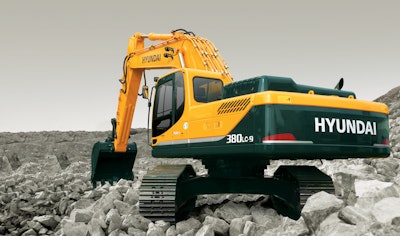
Hyundai integrates several systems to increase the efficiency of its hydraulic excavators. “The latest generation of Hyundai – 9 excavators combine several new systems that work together to give proper power to different systems based on the job at hand,” says Shane Sirmons, sales and product support manager. These systems include the Computer Aided Power Optimization (CAPO) system, the Boom and Arm Flow Regeneration System, Hydraulically Dampered Travel Controls, Attachment Flow Control Systems and Pump Flow Control System.
“The CAPO system allows the operator to set power based on the job he is doing,” says Sirmons. “It allows for three power mode settings (Power/Standard/Economy), three work mode settings (Digger/Breaker/Crusher) and user-defined settings based on the operator’s needs.”
The Pump Flow Control System reduces pump flow when controls are in the neutral position, saving power loss. “During operation maximum flow is delivered to each actuator based on control movement, providing fast, smooth operation of each component,” explains Sirmons.
The Attachment Flow Control Systems provide adequate hydraulic flow to attachments, preventing excess flow and smooth operation. “The attachment used is selected through the LCD cluster,” notes Sirmons.