Highly mobile. Self-sustaining. Ready for deployment. These are the hallmarks of the RED HORSE (Rapid Engineer Deployable Heavy Operations Repair Squadron Engineer) Squadrons (RHS) of the U.S. Air Force. The same could also be said for the two new Terex E225P counterflow drum mix plants recently purchased for the 820th and 554th RHS units, making them a perfect match for this branch of the Air Force.
At a moment’s notice, the four active-duty and 15 Guard Reserve RHS units can be deployed to assist with combat efforts in hostile environments. The mission of these self-sustaining squadrons is to provide the Air Force a highly mobile civil engineering response force. During combat operations, it is the RHS that constructs new infrastructure and performs heavy damage repair of infrastructure in order to carry out a successful mission. When not abroad on active duty, these units construct and maintain the infrastructure at the home base.
The work for members of this engineering force is personal, and the projects they complete can mean the difference between life and death. Sgt. Dennis Hagglund, asphalt plant subject matter expert and equipment operator for the 820th RHS based in Las Vegas, NV, recalls one airport construction project in Afghanistan that holds special meaning.
Prior to the 820th RHS constructing an 8,600-ft. long runway in a remote part of Afghanistan, critically wounded would first have to be evacuated to Bagram Air Field by helicopter before being transported to Ramstein Air Base, which delayed medical attention. “We constructed the ramps, taxiways and runway with our own equipment, so that the C17s could land to evacuate wounded directly to Ramstein,” says Sgt. Hagglund. “It was definitely worth the blood, sweat and tears.”
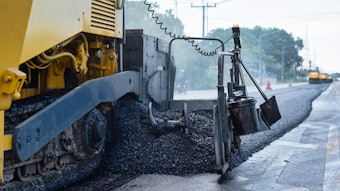
When the unit says self-sustaining, they mean it. They have the equipment, personnel and expertise to do anything from blasting and excavation to material production and paving. With regards to its asphalt operations, these units will blast and crush the aggregate, develop and produce the required mix design for a road or runway, and compact the asphalt mat.
Given time, these units will clear an impassible jungle and construct a passible road network, if that’s the mission. In order to accomplish these assignments, they must have the right equipment at their disposal.
The right plant
For making asphalt mix and training other squadrons on plant operation, the 820th RHS had, until recently, an outdated mid-1980s vintage asphalt plant. Its sister unit, the 554th stationed at Andersen Air Force Base in Guam, had no asphalt plant but was embarking on a new infrastructure project at Northwest Field. It was time for a change, so both squadrons had at their disposal flexible and mobile asphalt plants equipped with the latest technology.
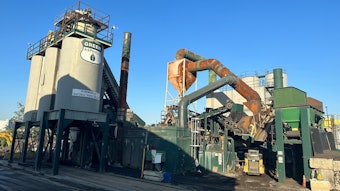
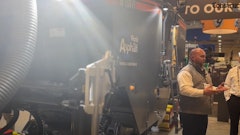
This year, they took possession of and installed two new Terex E225P super-portable asphalt plants from Terex Roadbuilding. “Both plants are configured nearly identical with the exception of the control house on the plant for the 820th,” says Mike Rodriguez, district manager for Terex Roadbuilding. The plant at Nellis Air Force Base in Las Vegas will serve as a training center in addition to producing asphalt, so it has a specially built, larger control house to accommodate training classes.
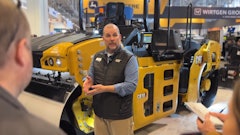
Sgt. Hagglund is one of the officers in charge of training members of other RHS units on how to operate the plant. “We typically have 14 students per class and hold four classes per year,” he says. “We review the plant’s components and calibrations and cover mix design production.” The goal is to have each student familiar with plant operation, so they can make mix in the field.
Some of the people trained to operate the E225P plant in Nevada were from the 554th RHS. Their education is scheduled to be put to use to make asphalt for the roads leading from the base to a regional training center at Northwest Field. “The new Terex plant will support a 10-mile, $727,000 Pacific Regional Training Center (PRTC) road project,” says SSgt Matthew Belmer, U. S. Air Force.
The overall $251 million PRTC project will house contingency training of troops, and the joint-use building will help the 554th house and maintain its more than 400 pieces of construction equipment. True to its self-sustaining form, a majority of the construction activity will fall under the responsibility of the 554th RHS. This includes blasting, crushing and screening the aggregate that will serve as the buildings’ foundations and be used in the asphalt mix used to pave the roads.
“The E225P is the only military asphalt plant in Guam,” mentions SSgt. Belmer. In addition to making the mix for the 10 miles of roads, the plant could also be moved for other projects. “We ordered this mobile plant for movement capability in contingency operations,” he adds.
Operating ease, latest technology
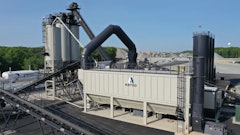
Featuring counterflow drum technology and the latest in emissions control, the Terex E225P super-portable plant is capable of producing up to 225 tph of asphalt. The drum is pitched at operating angle on its triple-axle chassis with all ductwork pre-installed, significantly reducing set-up and tear-down times. “The E225P is one of our most portable plant designs, and the base configuration can be moved by truck in only five loads,” says Rodriguez.
A portability enhancing feature, the plant only has 20 plug-and-play cable connections, which is significantly less than traditional portable plants. This design feature not only helps with portability but is especially beneficial for the 820th, stationed in the arid desert conditions of Las Vegas. “All breakers and relay switches are inside the control house, so sand can’t get into them,” explains Hagglund. “Sand would get into our old plant and blow the breakers.”
The rest of the RHS plant components consist of an 85-ton self-erect silo, four cold-feed bins, liquid AC tank, control house and Roto-Aire RA218 baghouse. Specifically designed to match mixer production, the RA218 offers a 40,000-cfm capacity and a 4.5 to 1 air-to-cloth ratio to efficiently remove particulates from exhaust gases. “The new baghouse is much more efficient than our old,” adds Hagglund.
One significant difference between the new E225P and the model it replaced lies in a component that increases mix design flexibility. The new plant can produce mixes as either warm or hot mix asphalt. “Warm mix,” says Hagglund, “is the wave of the future. The Terex system allows us to produce asphalt at lower temperatures, increase haul distances and reduce emissions by up to 14%.”
The Terex warm mix asphalt system uses a “foamed” technology that expands binder to more readily coat the aggregate at lower temperatures. Its patented, field-proven expansion chamber is mounted inline on the plant’s existing AC supply line and features single-point mixing of water and asphalt binder. It is a cost effective way for lowering asphalt production temperatures by up to 90° Fahrenheit (23° C) with production capacities reaching 600 tph.
The system comes complete with a 250-gallon water tank with auto refill. Once water in the tank reaches a prescribed low point, the plant controls automatically turn on water flow to refill the tank, so the plant can continue to make warm mix asphalt without stopping. A high level marker shuts off the flow of water to avoid overfilling. The system’s water meter includes a “no flow” indicator to alert the plant operator of water flow restrictions when making warm mix.
A final creature comfort that RHS operators like on the new plant is the Impulse II plant control system. The programmable logic controller based controls package features a high-speed computer processor and easy-to-use Windows operating system. “The control system on our old plant was harder to use than Impulse II,” says Hagglund. “The new system is laid out in a step-by-step manner that is much easier to pick up and run.”
The user-friendly Impulse II plant controls system provides instructions and guides the operator through detailed step-by-step procedures for plant component calibration. Plant operators can easily input asphalt mix recipes using screen menus or quickly import mix designs from Excel spreadsheets. The system stores virtually an unlimited number of mixes on the computer’s internal hard drive. Additionally, the Impulse II system offers advanced, detailed diagnostics for plant trouble-shooting.
With plant installation and training complete at Nellis Air Force Base, the 820th RHS is set to start a base road improvement project in addition to training other RHS units on plant operation. The new plant will help the unit to remain self-sufficient by making the asphalt mix used to build the 2-mile perimeter road at the base.
If time comes for either the 820th or 554th RHS to deploy to a combat zone to build asphalt roads, they will be ready to make mix with the latest technology available on the private market.