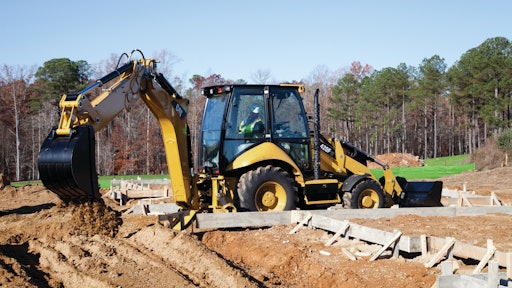
Advancements in backhoe loader controls have increased the options available. But to make the best choice, you first must understand what is available and the advantages and drawbacks of each system.
Backhoes are constantly evolving. “Most recent innovations – such as excavator-style joystick controls, pattern changer valves and ride control systems – focus more on efficiency, controllability and ergonomics,” says Curtis Goettel, brand marketing manager, New Holland Construction. “These innovations not only help make the operator more comfortable and productive, they also allow for faster working speeds from higher flow rates, more effective engine power, greater fuel efficiency and minimized engine overloading or stalling.”
He adds, “Providing the operators with the control pattern, digging position and control feel they prefer is essential. Less experienced backhoe loader operators, who may have previously worked on excavators, for example, will have a different feel for the controls than the more experienced backhoe loader operator who may choose a more ergonomic style of operation.” This is why New Holland Construction offers several control options.
“Control options provide the operator with greater, more precise control with less effort, making them more comfortable,” says Goettel. “And a comfortable operator is a productive operator, especially when working in tough conditions and on jobs like digging trenches or placing pipes.”
Operators prefer different controls, which is why New Holland continues to offer pilot and two-lever controls on the New Holland C-Series loader backhoes, notes Goettel. “The pilot control option, which is growing in popularity, provides infinite forward and reverse movement,” notes Goettel.
“For owner operators, the feel of the backhoe can be a primary factor in the purchase decision,” says Sherrie Carter, backhoe loader product marketing, Caterpillar. “It’s why Caterpillar spends a significant effort during the product development on hydraulic tuning. This involves intricate work on hydraulic valve spools to create smooth modulation, balanced multi-function performance and quick response to operator inputs. Good tuning enables the operator to work confidently in applications like fiber optics, yet be very efficient in production trenching operations.”
Controls evolve
Jim Blower, JCB, offers a perspective on the evolution of backhoe controls. Servo controls were introduced on the JCB backhoes in the mid-90s. “The whole reason to go to the servos from the mechanical levers is to reduce operator fatigue. You push the lever less distance and it takes less effort to push it.”
Operator comfort is directly linked to productivity. “Pilot operated joysticks offer primarily ergonomic advantages, but the reality is that in an eight to ten hour day those advantages can translate to more work done simply because the operator is fatigued,” says Caterpillar’s Carter.
“Before servo controls came along we had manual controls through the levered link through the valve block,” says Blower. The move to servo controls required some changes. “The manual controls have an open-center circuit and a full-flow valve block.” The early servo controls required a move to a closed-center hydraulic system and flow sharing valve blocks.
Open-center and closed-center systems each have unique operating characteristics. “Open-center circuits give the operator a feel for a backhoe,” notes Blower. “If you dig a trench with an open-center machine and you encounter an obstacle, and you want to power through it, you pull the lever a little bit further to increase the pressure. This increases the breakout force of the bucket edge. The operator has to do something to increase the pressure (i.e. moving the lever).”
He adds, “When you go to a closed-center system and encounter an obstacle the machine senses the resistance and increases the pressure automatically to increase the breakout force.” The decision on which system is better really depends on your application and operators. “The less experienced operators would like the machine to do the multi-functioning for them.” This would be a closed-center system. “It makes it easier to run the backhoe.” But if there is a pipe or service in the ground the operator wants to know when he hits it and back away, an open-center style machine makes it possible.
Another advantage of the mechanical controls with open-center systems was the use of a full-flow valve block. “If you have 100 gpm in a circuit and you pull one lever, you get 100 gpm going to that one circuit,” Blower explains. You can also have 80 gpm going to the boom and 20 gpm going to the dipper. “You are just juggling levers and putting the flow where you want it to go.”
Compare this to the flow-sharing valve block where the amount of oil to each cylinder is limited. In the example of the 100 gpm circuit, it may only allow 50 gpm to the boom and 50 gpm to the dipper. “So it is slowing the boom circuit by half. Overall it is easier for the operator to multi-function with the flow-sharing valve block, but it slows the cycle time because you can only get 50 percent flow at any one time.”
To address these trade-offs, JCB offers three distinct control options. “We give the operator whatever choice he wants,” says Blower. There are manual controls with an open-center system and full-flow valve block. There are the EasyControl servo controls with closed-center circuits and flow sharing. Then there is the most recent innovation, Advanced EasyControl servos with open-center circuits and full flow valve blocks. “We put servos onto a system with open-center to get the feel back and a full-flow valve block to get the speed back. So you can have the comfort of the servos with the faster cycle times.” With the Advanced EasyControl, as you spin the seat to face the front, the right-hand control becomes the loader lever as well.”
Intuitive controls
“Whether you are a customer that is in the seat of a backhoe all day, or you are jumping in the seat quickly for a few minutes as you complete a task on the jobsite, controls need to be intuitive and easy to operate to provide the most efficient experience,” says Louann Hausner, backhoe loader product marketing manager, John Deere Construction & Forestry. “The feel of the controls has evolved into being the need for a control that acts as an extension of the operator’s hand, enabling the operator to have multiple functions at their fingertips, without searching and reaching within the cab.”
The benefits of smart controls that are ergonomically placed exactly where an operator needs them to efficiently complete a task include increase fuel efficiency and productivity. “The key is that operators can accomplish more in less time with less fuel by having the controls easy to learn and operate,” says Hausner. “With Deere’s loader control eliminating the need for an additional lever and buttons on the side console to locate, operators can focus more attention on the task instead of searching for controls and juggling the coordination of two levers in one hand.”
John Deere offers a variety of controls to meet the needs of a wide spectrum of users. “Loader controls vary by customer need,” says Hausner. “Regardless if customers are doing the basics and controlling only the two key functions of lift and bucket, or if they are maximizing the use of a multi-purpose loader bucket, Deere offers a single lever control to meet all needs.”
The new loader control combines two levers into one easy-to-grip control. “This loader control provides additional functionality including momentary MFWD and proportional auxiliary hydraulic control, which is needed for multi-purpose buckets,” says Hausner. All controls are at your fingertips. “Tire wear is reduced because operators will only use MFWD only when needed to get the job done.”
A variety of backhoe controls meet every need. “With mechanical, hydraulically-driven pilots and electrohydraulic controls all available, depending upon the model, Deere can provide the variety customers need,” says Hausner.
In addition to the controls backhoe controls, John Deere allows the operators to choose several operating modes. “Deere has brought smart features such as Economy Mode, Auto Idle and Auto Shutdown to customers with the K-Series backhoes,” says Hausner. “Economy Mode enables the backhoe to operate at optimal fuel economy and productivity; while Auto Idle and Auto Shutdown reduce overall fuel usage when idling; both of which have a very positive impact to customers’ bottom line.”
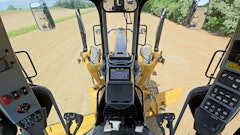
Caterpillar also offers both mechanical and pilot controls. “While pilot controls are the most popular, some operators prefer the long-standing mechanical controls. “The Cat 416 offers mechanical backhoe controls (often referred to as wobble sticks), which includes attached foot pedal controls for auxiliary functions,” says Carter. “The 420, 430 and 450 offer pilot backhoe controls. The operator has the ability to select the preferred pattern by a flip of a switch inside the cab.”
Thumb rollers for auxiliary functions are provided on Cat backhoes with pilot controls,” says Carter. “These roller switches enable the operator to control all backhoe functions with the joystick controls and eliminate the need for foot operated pedals, providing extra foot space and leg room for the operators. In addition, the controls provide smooth modulation for precise operation of work tools like hydraulic thumbs.”
She adds, “Other controls on Cat 420 and 430 backhoes enable Automatic Engine Speed Control (AESC), a fuel saving feature, and a manual kick-down switch that allows the operator to instantly reduce engine speed to low idle for communication with ground laborers. On machines with auxiliary functions, a continuous flow switch allows the operator to select and lock in on flow to the tool without constant operation of the roller switches. This is a great benefit for loader tools like brooms, and backhoe tools like augers, compactors and trash pumps.”
Cat also offers both mechanical and pilot controls for the loader as well. “Both offer the ability to operate a multi-function bucket on the front end,” says Carter. “With the pilot controls you gain a thumb roller on the joystick that operates the auxiliary functions, including additional loader work tools.”
Gains in system efficiency
Load sensing piston pumps have been migrating from the excavator to backhoe loader as more emphasis is being placed of efficiency.
Cat backhoes have always had load sensing hydraulics with variable displacement piston pumps for productivity and fuel efficiency. “For our new F Series machines we introduced an electronically controlled piston pump,” says Carter. “The pump automatically optimizes performance for specific operations – for both loader power management, and for backhoe productivity. In addition, the electronic control provides better pump response, which has contributed to productivity increases on our F Series machines.”
JCB has made a few changes to improve backhoe efficiency. “In the Tier 3 machines we were still running gear pumps,” says Blower. “But we added a third pump into the system so the operator could reduce the engine revs from 2,200 rpm down to 1,600 or 1,700 rpm. We made up for the lower rpm by adding a third pump to make the flow the same. The pressures are all the same. By reducing engine rpm, we reduce fuel consumption by about 16 percent.”
He adds, “Moving to Tier 4 our engine is now an electronic engine controlled by an ECU.” To take advantage of this new capability, JCB is now installing a piston pump and marrying the pump and the engine together through the ECU. “So each stage of the evolution we are looking at more efficiencies throughout the machine.
“The piston pump is more advanced, so they are a little more expensive for the initial purchase price,” notes Blower. “But the cost between a piston pump and a gear pump has reduced dramatically over the last 10 to 15 years. The piston pump is a little more complex. It requires a little finer filtration of the hydraulic system to make sure you get all the dirt out. You have to watch the cleanliness of the oil when you use the piston pumps.”
The pilot backhoe controls on the New Holland C Series models deliver improved fuel efficiency and improved cycle times through the variable volume hydraulic system. “This system operates at a lower temperature,” says Goettel. New Holland C Series loader backhoe models with mechanical backhoe controls continue to feature a single gear pump open hydraulic system. The variable volume pump feature means lower fuel consumption each day, faster operating times and more productivity at lower costs.”
As you can see, the backhoe loader manufacturers offer a diverse choice of backhoe loader controls that is expanding with new capabilities provided by the advent of electronic engines to meet Tier 4. But the key really lies in identifying which control system is really the best fit for your operators and application.