
We are all familiar with hybrid automotive technology. The concept is to capture energy wasted during braking and reuse it for productive purposes, which increases vehicle efficiency. But hybrids have broken out of the automotive arena and we are starting to see the infiltration of hybrid technology in the world of heavy iron. Excavators are at the forefront of this evolution.
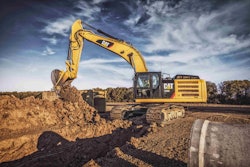
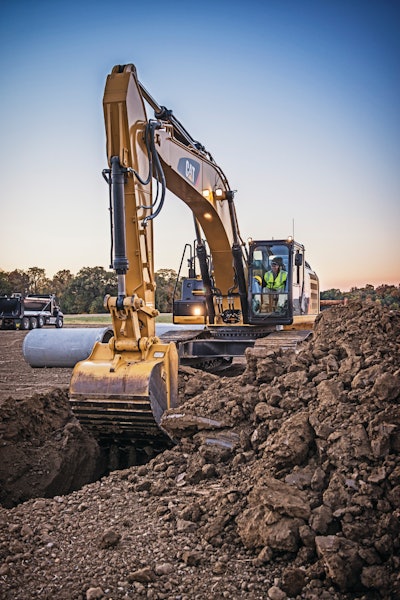
Komatsu was the first to introduce a hybrid excavator to the U.S. market and it currently offers a second generation model, the 23.8-ton Komatsu HB215LC-1. And Caterpillar recently announced its own unique hybrid technology with the Caterpillar 336E H. Although it is not currently offered outside of Japan, Hitachi has displayed its ZH200 hybrid excavator at Intermat this past April.
While the approaches to capturing and reusing wasted energy may differ, the concept is the same. With a hybrid excavator the goal is to capture that large amount of energy required to brake the upper structure while it is swinging back and forth. Typically, a lot of energy is lost as you swing the excavator back and forth on the undercarriage.
The more you swing the upper structure, the greater potential benefit from the hybrid. “The Caterpillar 336E will deliver fuel savings in all applications this machine was designed to perform: however, the best fuel savings will come in high-volume truck loading and trenching where the machine is required to cycle frequently,” says John Crowley, marketing consultant, Caterpillar. “The more it swings or cycles, the more opportunities there are to store and reuse energy, which leads to more savings and quicker payback for customers. It makes the most sense on high-production excavators where the machine is winging frequently.”
Video: How Does Cat's 336E Hybrid Excavator Conserve Fuel, Optimize Performance and Reuse Energy?
The same applies for the Komatsu hybrid. “Since the HB215LC-1 utilizes the energy created during the swing brake motion, applications that require a high amount of swinging maximize the effectiveness of the hybrid technology,” says Brian Yureskes,marketing manager for excavators, Komatsu America Corp. “Provided that a utility machine is operating with similar characteristics, customers can expect the same benefits of hybrid technology as those experienced with larger machines.”
“The first misconception about hybrid technology is that performance is sacrificed for fuel savings,” says Yureskes. “This is not the case with the HB215LC-1, which offers the same high level of performance as its conventional counterpart, the PC200LC-8. In addition to the 25 to 40 percent fuel savings, hybrid technology produces an environmentally friendly machine that reduces CO2 and greenhouse gas emissions significantly. Noise levels are also reduced when compared to a conventional machine, making the Komatsu HB215LC-1 a suitable choice for urban areas or night work.”
Hybrid technology can yield significant fuel savings over comparable conventional machines. “The Caterpillar 336E H uses up to 25percent less fuel than the standard 336E without sacrificing power or productivity,” says Crowley. “Fuel efficiency – the amount of fuel used per ton of material moved – is also a benefit. Compared to our 336D, the 336 E H is 50 percent more fuel efficient. Using less fuel per unit of work performed also results in a lower carbon footprint, and that benefits us all.”
Hitachi also claims that the hybrid system on its ZH200 offers a 20 percent fuel saving and corresponding drop in CO2 emissions compared to a standard ZX200-3 excavator.
How they work
Hybrids basically need to capture and store energy during the braking process. This energy then needs to be released at the appropriate time to produce useful work. The actual components needed will depend upon the design of the particular hybrid system.
Komatsu has added a few key electrical components to form the backbone of its hybrid system. “Three components; the electric swing motor, generator motor, and ultra-capacitor, differentiate the HB215LC-1 from a conventional excavator,” notes Yureskes. “The machine body, undercarriage, hydraulics system and work equipment are identical to those found on Komatsu conventional excavators.”
The electric swing motor recovers energy during each swing brake. This energy is stored in the capacitor to be used when needed. The energy in the capacitor can be sent to either the swing motor or to the generator motor to help the engine accelerate as engine assist. This allows the hybrid to quickly respond to hydraulic power demands. This responsiveness gives the hybrid the advantage over a conventional machine.
Proprietary machine control logic also contributes to fuel savings. The Komatsu hybrid has a different approach to engine speed management during operation. A low engine speed of 700 rpms helps reduce fuel in between work cycles. The electrical engine assist helps the engine and hydraulic system quickly reach the necessary speed to match hydraulic demand.
In a conventional machine, the engine would lug down to peak torque. But with the hybrid system, the engine ramps up to the needed engine speed based on the hydraulic demand. There are other benefits, such as reduced noise. Due to the engine speed management and electrical engine assist, the engine spends less time at high rpms, making its quieter operation ideal for noise sensitive areas.
The Hitachi ZH200 also uses a hydraulic/electric swing motor to generate electrical power under braking, which is stored in a capacitor alongside the machine’s cooling pack. The electrical power is used to boost slew speed and also feeds a secondary hydraulic motor to assist the diesel engine when there is a demand for hydraulic power.
Caterpillar uses a different approach by capturing the swing brake energy with a hydraulic accumulator. A large accumulator squeezed under the hood between the engine and the counterweight is pressurized by house-swing braking, and that energy is then used to accelerate the excavator upper structure back in the opposite direction.
The Caterpillar 336E H has all of the same powerful advantages of the 336E, with the biggest difference between the two models being even greater fuel efficiency. To achieve added fuel savings, the design of the 336E H uses three building block technologies that:
1) Conserve fuel with engine power management via the Cat Electronic Standardized Programmable (ESP) pump, which smoothly transitions between the hydraulic hybrid power sources, engine and accumulator. It also matches pump and engine load to outperform the 336E, even at lower engine speed.
2) Optimize performance using restriction management via the patented Cat Adaptive Control System (ACS) valve, which intelligently manages restrictions and flows to seamlessly control machine motion with no loss of power, and to ensure operators experience no difference in control, hydraulic power or lift capability. The ACS main valve takes energy that is wasted in conventional excavators when flow dumps over relief and directs it to circuits that can immediately use the power. It reduces fuel consumption by preventing pressure loss.
3) Reuse energy via the hydraulic hybrid swing system, which captures the excavator’s upper structure swing brake energy in accumulators, and then releases the energy during swing acceleration.
The design of the Caterpillar 336E H allows it to run at reduced engine speeds. Lower engine speed is not only saves fuel, but it reduces noise.
Electric or hydraulic?
There are currently two ways to capture the swing brake energy from the excavator – electrically with a capacitor or hydraulically with an accumulator. The Komatsu and Hitachi excavators use capacitors while the Caterpillar excavator uses a hydraulic accumulator.
The electric hybrids share little in common with automotive hybrid technology. “The way construction equipment operates played a major role in the development of the electric hybrid technology,” says Yureskes. “Construction applications differ from the automotive industry because there is less time for energy to be captured and converted into energy.”
To illustrate this, look at a typically 90-degree swing:
Swing starts/swing acceleration approximately 40 degrees
Swing coasting approximately 30 degrees
Swing braking approximately 20 degrees.
“Even if the swing is large (greater than 90 degrees) the degree of swing brake still represents a small portion of the work cycle – resulting in a small window for capturing the energy,” says Yureskes. “By contrast, the automotive industry can use batteries since the time it takes to accelerate from a stop light is a few seconds; therefor the battery has time to convert the chemicals into electricity.”
Capacitors provide the necessary solution. “A capacitor has the ability to capture the energy very quickly so the energy generated in that small window of swing braking is able to be captured and stored,” says Yureskes. “Due to the size of the machine, a large amount of energy is necessary to quickly decelerate the upper structure, and these large forces directly correlate to the amount of energy that is stored. A capacitor allows the machine to convert and use this energy instantaneously.”
Caterpillar weighed the electric and hydraulic options and took a different route. “We considered both the electric and hydraulic paths, and we built prototypes of both and tested them along with competitive machines,” says Crowley.” We determined that the most efficient, least complex, and easiest to service is the hydraulic hybrid solution.”
By using this approach there is very little difference between a Caterpillar 336E H and a conventional 336E. “Nearly 98 percent of the machine is made from the same proven and reliable components used on our standard 336E,” says Crowley. “Production machines have been tested by operators globally. Productivity studies and customer applications have validated performance. The ‘brains’ of the system, the ACS valve, has been in the field since 2008 with superior results. The ACS and hybrid system have proven to work well together over thousands of hours of testing. There is no special training required for dealer technicians to service the machine.”
Return on Investment
The additional components needed for the hybrid systems will add to the initial purchase price, but manufacturers expect you to earn a return on this investment through fuel savings.
“The factors that impact the return on investment for Komatsu HB215LC-1 the most are application, utilization and fuel price,” says Yureskes. “High swing applications, such as truck loading or trenching, maximize the amount of energy that can be stored and made available for high load cycles.”
He adds, “Ensuring high utilization is important since fuel savings are realized while the machine is working. The magnitude of fuel savings directly correlates with fuel prices; so as fuel prices increase the level of savings will also increase considering the HB215LC-1 consumes up to 25 to 40 percent less fuel than a conventional machine.”
Hydraulic components kept the overall cost of the 336E down to an undisclosed number for which the company could fabricate a palatable return on investment. Caterpillar claims a production machine can earn back the price premium for the hybrid in 2,000 hours.
Because the 336E H burns less fuel and reduces regulated engine emissions, owning and operating costs will be dramatically lower compared to the standard machine, and its carbon footprint will be smaller, as well. Precisely when customers will recoup their initial investment in a 336E H depends on fuel prices and their applications. Assuming today’s fuel prices and a high-production application for a 336E H, Caterpillar estimates customers can realistically expect to see a return on their investment for the hybrid excavator model in as little as one year.