
Concrete suppliers and contractors are sometimes accused of producing or placing low-strength concrete. While low-strength concrete does occasionally occur, many times reported cylinder strengths are evaluated improperly creating a low-strength false alarm. Unnecessary low-strength concerns, rejected concrete, construction delays and expensive investigations can be avoided by properly evaluating concrete cylinder strengths.
Strength acceptance
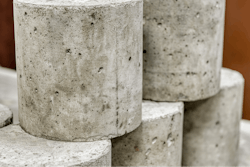
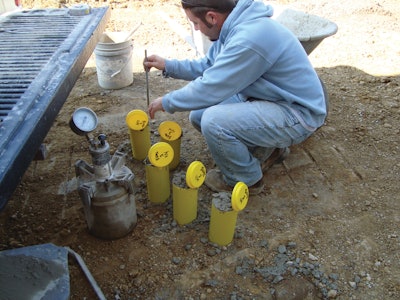
Unless otherwise specified, concrete strength acceptance is based on the average strength of at least two 6 by 12 inch or at least three 4 by 8 inch "standard” cylinders made from the same sample of concrete and tested at 28 days. Standard cylinders are test cylinders made and cured in accordance with ASTM C31 and tested in accordance with ASTM C39. To ensure a proper strength evaluation, each individual class of concrete should be represented by at least five strength tests.
Read "How to Make and Cure Standard Test Cylinders in the Field"
 Concrete cure box
Requirement #1 - No individual strength test (average of two or three cylinders) falls below fc’ by more than 500 psi when fc’ is 5,000 psi or less, or falls below fc’ by more than 10 percent (0.10 x fc’) when fc’ is more than 5,000 psi.
Requirement #2 - Every average of three consecutive strength tests equals or exceeds the specified compressive strength (fc’).
The specified strength (fc’) is the concrete compressive strength used by engineers in the design calculations to determine member sizes and reinforcement details of concrete structures. Since concrete strength is a function of time and temperature, fc’ is based on test cylinders made in accordance with standardized time and temperatures as specified by ASTM C31.
Due to material and statistical variability, expect about 1 in 100 tests to fail the strength requirements even though the concrete strength and uniformity are acceptable. Concrete strength acceptance is based on probabilistic concepts that account for the strength variations that naturally occur with concrete. Also, the design calculations used by engineers take into account concrete strength variations. In combination, the concrete strength acceptance requirements and the safety factors built into the design process ensure the load-carry capacity of concrete structures is adequate.
Read "How to Estimate In-place Strength of Concrete"

Acceptable strength example for 4,000 psi concrete
As shown in Table 1, column #1 shows the strength test number (1-5) and column #2 shows the individual 6 by 12 inch cylinder compressive strengths A and B. By averaging the A and B single-cylinder strengths, strength tests shown in column #3 were computed. For test 1, the average strength of 4,110 and 4,260 is 4,185 psi [(4,110 + 4,260) ÷ 2 = 4,185 psi]. A strength test is the average strength of two or more single-cylinder strengths, not the strength of an individual or single cylinder.
 After initial curing, start final curing by storing cylinders in a water storage tank or moist room.
Strengths for tests 1, 3 and 5 (column #3) exceed the 4,000 psi specified strength. However, strengths for tests 2 and 4 (3,960 and 3,745 psi) fall below the specified strength, but these strengths are acceptable. Strengths 3,960 and 3,745 psi are acceptable because they do not fall below 4,000 psi by more than 500 psi or both strengths exceed 3,500 psi. Therefore, Requirement #1 has been satisfied for all tests and the strengths 3,960 psi and 3,745 psi should not se toff the low-strength concrete alarm.
Column #4 shows the average three consecutive strengths exceed the 4,000 psi specified strength; therefore Requirement #2 has been satisfied. Columns #5 and #6 reflect that both of the strength acceptance requirements have been satisfied; therefore, concrete strengths in this example are acceptable, even though two strengths fell below the specified strength of 4,000 psi.
 Compressive strengths are determined by loading cylinders in a testing machine until concrete failure occurs. Strengths are computed by dividing the maximum compressive load obtained during the test by the average cross-sectional area of the cylinder. Example for a 6 by 12 inch cylinder: 116,190 lbs ÷ 28.27 sqin = 4,110 psi.
Low-strength example for 4,000 psi concrete
In Table 2, strength 3,250 psi for test 5 (column #3) falls below 4,000 psi by more than 500 psi; therefore, it fails to satisfy Requirement #1. Also, the average of three consecutive strengths for test #3 (column #4) falls below 4,000 psi. Therefore, test 3 fails to satisfy Requirement #2. Subsequently, strengths for tests 3 and 5 are low and not acceptable.
 Table 2
Unacceptable strengths
When strength tests fail to satisfy Requirement #1, the building code requires steps to be taken to assure the load-carrying capacity of the structure has not been jeopardized. In addition to assuring safety of the structure, the building code also suggests the engineer and/or building official should use judgment determining the significance of the low-strength tests and to decide whether the low-strength tests indicate a need for concern.  Concrete test cylinder moist room.
Because the building code does not specify the steps for investigating low-strength test results, consider these:
- Review the concrete testing procedures to confirm or deny the possibility of low-strength tests. This review should consider the procedures for sampling fresh concrete, making cylinders, initial and final curing, and transporting and testing cylinders. Essentially, determine if low-strength tests were most likely caused by improper testing or inadequate concrete.
- If the likelihood of low-strength concrete is confirmed, the engineer should determine if the low-strength concrete affects the load-carrying capacity of the structure. If the engineer determines the load-carrying capacity of the structure has not been jeopardized, then the engineer can accept the low-strength concrete and no further investigation is needed.
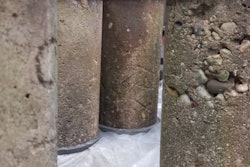
- If the likelihood of low-strength concrete is confirmed and calculations indicate that load-carrying capacity is significantly reduced, tests of cores drilled from the area in question should be considered to determine the in-place concrete strength. Then, the engineer can determine the appropriate actions to be taken to ensure the load-carrying capacity of the structure is adequate.
When strength tests fail to satisfy Requirement #1 and/or Requirement #2, the building code requires steps to be taken to increase the average of subsequent strength tests. Steps could include one or more of the following:
- Check mix design and batching procedures and correct errors found
- Adjust mix proportions (e.g., increase cementitious materials content)
- Closer control of water content (e.g., moisture content of aggregates)
- Closer control of air content (as air content increases, strength decreases)
- Improve quality of concrete testing including strict compliance with ASTM standard testing procedures
For future projects, evaluate concrete cylinder strengths properly and avoid the low-strength false alarm. If strength tests do fail to meet the strength acceptance requirements when evaluated properly, perform a low-strength investigation to determine the appropriate actions to ensure the safety of the structure. In many cases, expensive options and construction delays associated with drilling cores, tearing out and replacing concrete may not be necessary.
References
ASTM C172 – Standard Practice for Sampling Freshly Mixed Concrete, ASTM International, www.astm.org
ASTM C31 – Standard Practice for Making and Curing Concrete Test Specimens in the Field, ASTM International, www.astm.org
ASTM C39 – Standard Test Method for Compressive Strength of Cylindrical Concrete Specimens, ASTM International, www.astm.org
ACI 318-11 Building Code Requirements for Structural Concrete and Commentary, American Concrete Institute, www. concrete.org